
Learne2i
Learne2i Guess Paper solutions
JEE Main 2025 / Session 2
All chapters

Chemistry

Chemical Bonding and Molecular Structure

Question 16 / MCQ
Question 16
Which of the following is least ionic ?
A.
BaCl2
B.
AgCl
C.
KCl
D.
CoCl2
Correct answer: B

Source solution

Sol:- AgCl<CoCl2<BaCl2<KCl (ionic character) Reason : Ag+has pseudo inert gas configuration.
Question 17 / MCQ
Question 17
An element ' E ' has the ionisation enthalpy value of 374 kJ mol−1. 'E' reacts with elements A, B, C and D with electron gain enthalpy values of −328,−349, -325 and −295 kJ mol−1, respectively. The correct order of the products EA, EB, EC and ED in terms of ionic character is :
A.
EB>EA>EC>ED
B.
ED>EC>EA>EB
C.
EA>EB>EC>ED
D.
ED>EC>EB>EA
Correct answer: A

Source solution

Solution Ionisation enthalpy of E=374 kJmol−1 Electron gain enthalpies are A=−328,B=−349 C=−325,D=−295 kJmol−1 Greater the difference between I.E. of cation-forming atom and E.G.E. of anion-forming atom, greater is the ionic character. ΔA=374−328=46 ΔB=374−349=25 ΔC=374−325=49 ΔD=374−295=79 Smaller the value of (I.E.−|E.G.E.|), greater is the tendency for ionic bond formation. 25<46<49<79 ∴ EB>EA>EC>ED EB>EA>EC>ED Correct Option : (1)
Question 18 / Numerical
Question 18
Total number of species from the following with central atom utilising 2p2 hybrid orbitals for bonding is . NH3,SO2,SiO2,BeCl2,C2H2,C2H4,BCl3,HCHO, C6H6,BF3,C2H4Cl2
Numerical answer: ____________________
Enter the requested value (an integer; 0 decimal places). Use the units and scaling stated in the question.
Correct answer: 6

Source solution

Central atom utilising sp2 hybrid orbitals SO2,C2H4,BCl3,HCHO,C6H6,BF3
Question 19 / Numerical
Question 19
Number of compounds/species from the following with non-zero dipole moment is BeCl2,BCl3,NF3,XeF4,CCl4,H2OH2 S,HBr, CO2,H2,HCl
Numerical answer: ____________________
Enter the requested value (an integer; 0 decimal places). Use the units and scaling stated in the question.
Correct answer: 5

Source solution

Polar molecule : NF3,H2O,H2 S,HBr,HCl ( μ≠0 ) Non Polar molecule: BeCl2,BCl3,XeF4,CCl4,CO2,H2 ( μ=0 ) So answer is 5 .
Question 20 / Numerical
Question 20
Number of compounds from the following with zero dipole moment is . HF,H2,H2 S,CO2,NH3,BF3,CH4,CHCl3,SiF4, H2O,BeF2
Numerical answer: ____________________
Enter the requested value (an integer; 0 decimal places). Use the units and scaling stated in the question.
Correct answer: 6

Source solution

H2,CO2,BF3,CH4,SiF4,BeF2 are symm. molecule so dipole moment is zero
Question 21 / MCQ
Question 21
Match List-I with List-II List-I (A) ΨMO=ΨA−ΨB (B) μ=Q×r (C) Nb−Na2 (D) ΨMO=ΨA+ΨB List-II (I) Dipole moment (II) Bonding molecular orbital (III) Anti-bonding molecualr orbital (IV) Bond order
A.
-(II), (B)-(I), (C)-(IV), (D)-(III)
B.
(A)-(III), (B)-(IV), (C)-(I), (D)-(II)
C.
(A)-(III), (B)-(I), (C)-(IV), (D)-(II)
D.
(A)-(III), (B)-(IV), (C)-(II), (D)-(I)
Correct answer: C

Source solution

TEST PAPER WITH SOLUTION Sol. (A) ψMO=ψA−ψB (III) ABMO (B) μ=Q×r (I) Dipole moment (C) Nb−Na2 (IV) Bond order (D) ψMO=ψA+ψB (II) BMO
Question 22 / Numerical
Question 22
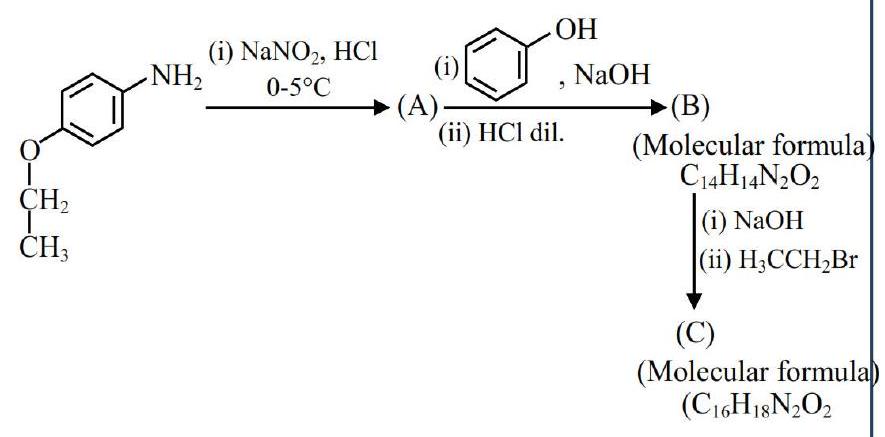
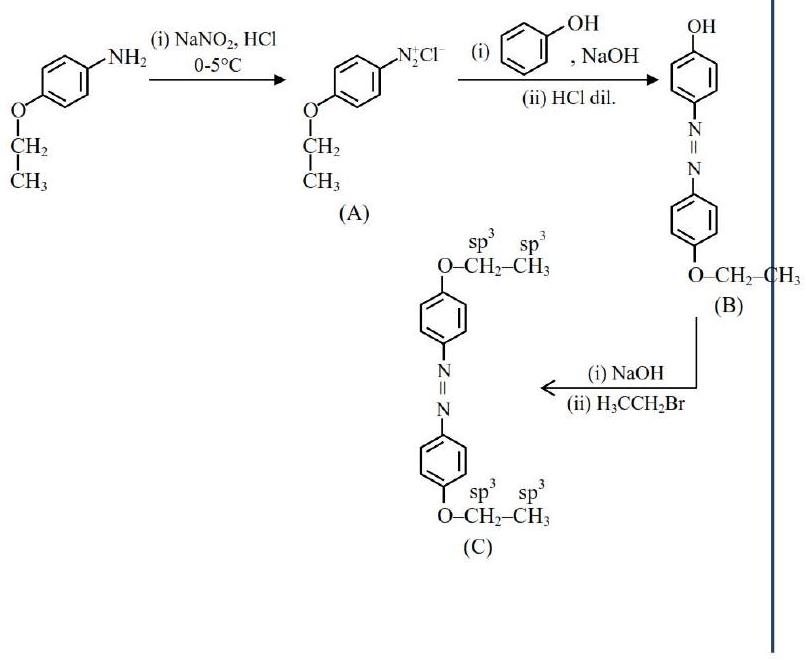
Consider the following sequence of reactions. Question figure Total number of sp3 hybridised carbon atoms in the major product C formed is .
Numerical answer: ____________________
Enter the requested value (an integer; 0 decimal places). Use the units and scaling stated in the question.
Correct answer: 4

Source solution
Question figure
Question 23 / MCQ
Question 23
Match List - I with List - II List - IList - II (A)ΨMO=ΨA−ΨB(I)Dipole moment(B)μ=Q×r(II)Bonding molecular orbital(C)Nb−Na2(III)Anti-bonding molecular orbital(D)ΨMO=ΨA+ΨB(IV)Bond order
A.
(A)-(II), (B-(I), (C)-(IV), (D)-(III)
B.
(A)-(III), (B)-(IV), (C)-(I), (D)-(II)
C.
(A)-(III), (B)-(I), (C)-(IV), (D)-(II)
D.
(A)-(III), (B)-(IV), (C)-(II), (D)-(I)
Correct answer: C

Source solution

Solution: In molecular orbital (MO) theory: ΨMO=ΨA+ΨB⇒Bonding molecular orbital ΨMO=ΨA−ΨB⇒Anti-bonding molecular orbital μ=Q×r⇒Dipole moment Bond order=Nb−Na2 where Nb is the number of electrons in bonding orbitals and Na is the number of electrons in anti-bonding orbitals. Therefore, the correct matching is: (A)→(III),(B)→(I),(C)→(IV),(D)→(II)
Question 24 / MCQ
Question 24
Match List-I with List-II List-I(Molecule)List-II(Bond order) (a)Ne2(i)1(b)N2(ii)2(c)F2(iii)0(d)O2(iv)3 Choose the correct answer from the options given below.
A.
(a)-(iii), (b)-(iv), (c)-(i), (d)-(ii)
B.
(a)-(i), (b)-(ii), (c)-(iii), (d)-(iv)
C.
(a)-(ii), (b)-(i), (c)-(iv), (d)-(iii)
D.
(a)-(iv), (b)-(iii), (c)-(ii), (d)-(i)
Correct answer: A

Source solution

Solution Using Molecular Orbital Theory: Ne2:Bond Order=Nb−Na2=0 ∴Ne2→(iii) N2:Bond Order=3 ∴N2→(iv) F2:Bond Order=1 ∴F2→(i) O2:Bond Order=2 ∴O2→(ii) A→III,B→IV,C→I,D→II (a)−(iii),(b)−(iv),(c)−(i),(d)−(ii) Correct Answer : (1)
Choose another chapter