
Learne2i
Learne2i Guess Paper solutions
JEE Main 2025 / Session 2
All chapters

Mathematics

Sequences and Series

Question 31 / MCQ
Question 31
If the domain of the function log5⁡(18x−x2−77) is (α,β) and the domain of the function log(x−1)⁡(2x2+3x−2x2−3x−4) is (γ,δ), then α2+β2+γ2 is equal to :
A.
195
B.
174
C.
186
D.
179
Correct answer: C

Source solution

log5⁡(18x−x2−77) has domain (α,β), and log(x−1)⁡(2x2+3x−2x2−3x−4) has domain (γ,δ). We need to find α2+β2+γ2. \hrulefill \textbf{Step 1: Domain of } log5⁡(18x−x2−77) For a logarithm, 18x−x2−77>0. −x2+18x−77>0 x2−18x+77<0. Factorizing, x2−18x+77=(x−7)(x−11). Hence, (x−7)(x−11)<0. Therefore, 7<x<11. Thus, (α,β)=(7,11). So, α=7,β=11. \hrulefill \textbf{Step 2: Domain of } log(x−1)⁡(2x2+3x−2x2−3x−4) For a logarithm: x−1>0,x−1≠1 which gives x>1,x≠2. Also, 2x2+3x−2x2−3x−4>0. Factorize: 2x2+3x−2=(2x−1)(x+2), x2−3x−4=(x−4)(x+1). Hence, (2x−1)(x+2)(x−4)(x+1)>0. Critical points: −2,−1,12,4. Using sign analysis: (2x−1)(x+2)(x−4)(x+1)>0 for (−∞,−2)∪(−1,12)∪(4,∞). Now intersect with x>1. Therefore, x∈(4,∞). Thus the domain is (γ,δ)=(4,∞). Hence, γ=4. \hrulefill \textbf{Step 3: Required value} α2+β2+γ2=72+112+42 =49+121+16 =186. 186 Hence, the correct option is (3) 186.
Question 32 / Numerical
Question 32
Let the plane x+3y−2z+6=0 meet the co-ordinate axes at the points A,B,C. If the orthocentre of the triangle ABC is (α,β,67), then 98(α+β)2 is equal to .
Numerical answer: ____________________
Enter the requested value (an integer; 0 decimal places). Use the units and scaling stated in the question.
Correct answer: 288

Source solution
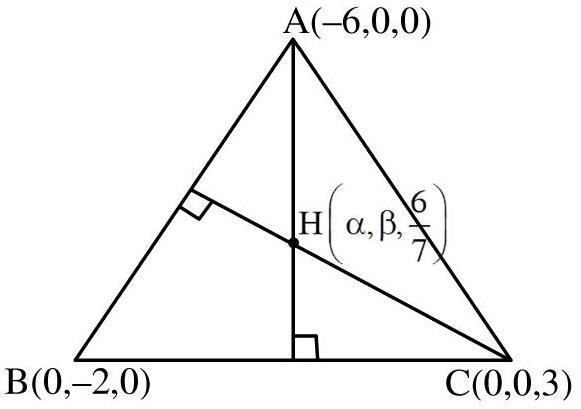
A(−6,0,0)B(0,−2,0)C=(0,0,3) AB→=6i^−2j^,BC→=2j^+3k^, AC→=6i^+3k^ Question figure AH→⋅BC→=0 (α+6,β,67)⋅(0,2,3)=0 β=−97 CH→⋅AB→=0 (α,β,−157)⋅(6,−2,0)=0 6α−2β=0 α=−37 98(α+β)2=(98)(144)49=288
Question 33 / Numerical
Question 33
A ray of light passing through the point P(2,3) reflects on the x -axis at point A and the reflected ray passes through the point Q(5,4). Let R be the point that divides the line segment AQ internally into the ratio 2:1. Let the co-ordinates of the foot of the perpendicular M from R on the bisector of the angle PAQ be (α,β). Then, the value of 7α+3β is equal to .
Numerical answer: ____________________
Enter the requested value (an integer; 0 decimal places). Use the units and scaling stated in the question.
Correct answer: 31

Source solution
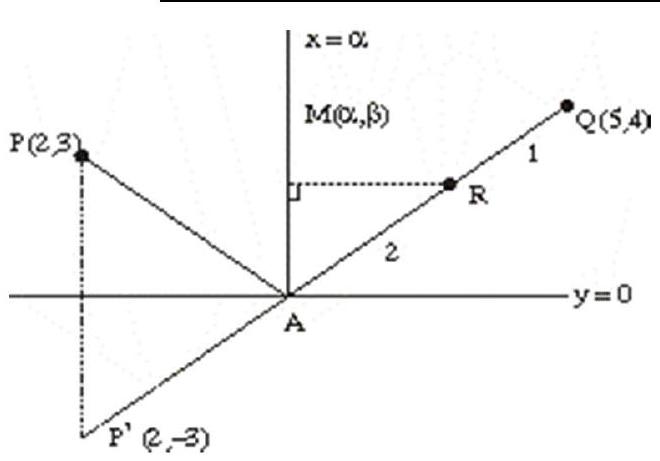
Question figure By observation we see that A(α,0). And β=y-cordinate of R (1)=2×4+1×02+1=83 Now P′ is image of P in y=0 which will be P′(2,−3) ∴ Equation of P′Q is (y+3)=4+35−2(x−2) i.e. 3y+9=7x−14 A≡(237,0) by solving with y=0 (2)∴α=237 By (1), (2) 7α+3β=23+8=31
Question 34 / Numerical
Question 34
Let the image of the point P(1,2,3) in the line L:x−63=y−12=z−23 be Q . let R(α,β,γ) be a point that divides internally the line segment PQ in the ratio 1:3. Then the value of 22(α+β+γ) is equal to
Numerical answer: ____________________
Enter the requested value (an integer; 0 decimal places). Use the units and scaling stated in the question.
Correct answer: 125

Source solution
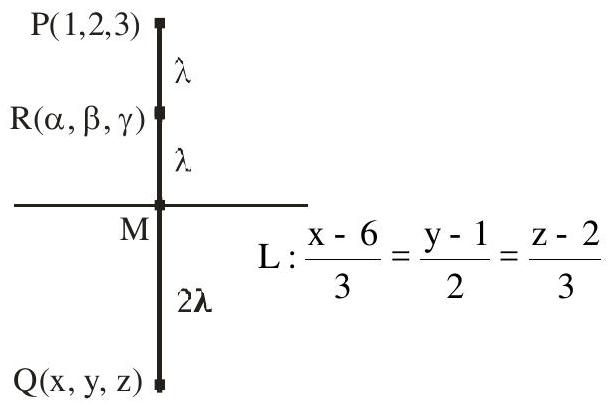
Question figure Let M be the mid-point of PQ ∴M=(3λ+6,2λ+1,3λ+2) Now, PM→=(3λ+5)i^+(2λ−1)j^+(3λ−1)k^ ∵PM→⊥(3i^+2j^+3k^) ∴3(3λ+5)+2(2λ−1)+3(3λ−1)=0 λ=−511 ∴M(5111,111,711) Since R is mid-point of PM 22(α+β+γ)=125
Question 35 / Numerical
Question 35
Let a conic C pass through the point (4,−2) and P(x,y),x≥3, be any point on C . Let the slope of the line touching the conic C only at a single point P be half the slope of the line joining the points P and (3, -5). If the focal distance of the point (7, 1) on C is d , then 12 d equals .
Numerical answer: ____________________
Enter the requested value (an integer; 0 decimal places). Use the units and scaling stated in the question.
Correct answer: 75

Source solution
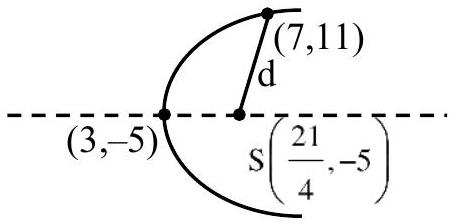
P(x,y)&x≥3 Slope of line at P(x,y) will be dydx=12(y+5x−3) ⇒2dy(y+5)=1(x−3)dx ⇒2ℓn(y+5)=ℓn(x−3)+C Passes through (4,−2) ⇒2ℓn(3)=ℓn(1)+C ⇒C=2ℓn(3) ⇒2ℓn(y+5)=ℓn(x−3)+2ℓn(3) ⇒2(ln⁡(y+53))=ln⁡(x−3) ⇒(y+53)2=(x−3) ⇒(y+5)2=9(x−3) ↓ Parabola 4a=9 a=94 Question figure d=(74)2+62 d=6254 d=254 12 d=75
Question 36 / Numerical
Question 36
A line passes through A(4,−6,−2) and B(16,−2,4). The point P(a,b,c) where a,b,c are non-negative integers, on the line AB lies at a distance of 21 units, from the point A . The distance between the points P(a,b,c) and Q(4,−12,3) is equal to .
Numerical answer: ____________________
Enter the requested value (an integer; 0 decimal places). Use the units and scaling stated in the question.
Correct answer: 22

Source solution

- x−412=x+64=z+26x−467=y+627=z+237=21(21×67+4,27×21−6,37×21−2)=(22,0,7)=(a,b,c)∴324+144+16=22
Question 37 / Numerical
Question 37
Let a1,a2,…,a10 be an AP with common difference -3 and b1,b2,…,b10 be a GP with common ratio 2 . Let ck=ak+bk,k=1,2,…,10. If c2=12 and c3=13, then ∑k=110ck is equal to .
Numerical answer: ____________________
Enter the requested value (an integer; 0 decimal places). Use the units and scaling stated in the question.
Correct answer: 2021

Source solution

c2=a2+b2=a1−3+2 b1=12 (1)a1+2 b1=15 c3=a3+b3=a1−6+4b1=13 (2)a1+4b1=19 from (1) & (2) b1=2,a1=11 ∑k=110ck=∑k=110(ak+bk)=∑k=110ak+∑k=110 bk =102(2×11+9×(−3))+2(210−1)2−1 =5(22−27)+2(1023) =2046−25=2021
Question 38 / Numerical
Question 38
Points P(−3,2),Q(9,10) and (a,4) lie on a circle C with PR as its diameter, The tangents to C at the points Q and R intersect at the point S. If S lies on the line 2x−ky=1, then k is equal to
Numerical answer: ____________________
Enter the requested value (an integer; 0 decimal places). Use the units and scaling stated in the question.
Correct answer: 3

Source solution

Equation of circle is (x+3)(x−α)+(y−2)(y−4)=0 Question figure Q lies on it 12(9−α)+8×6=0 α=13 x2+y2−10x−6y−31=0 Equation of Tangent at Q x.9+y.10−5(x+9)−3(y+10)−31=0 (1)4x+7y=106 Equation of Tangent at R x.13+y.4−5(x+13)−3(y+4)−31=0 (2)8x+y=108 Solution (1) and (2) s=(252,8) which lies on 2x−ky=1
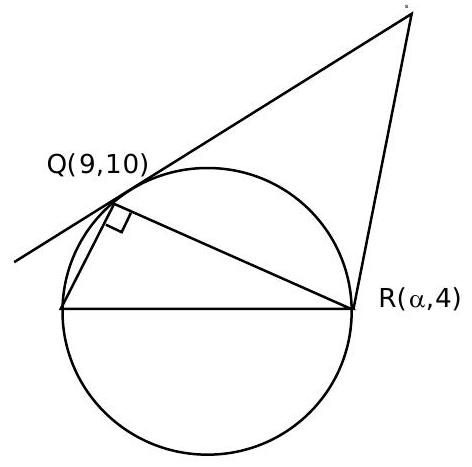
k=3
Question 39 / MCQ
Question 39
Let a1,a2,……,a21 be an AP such that ∑n=1201anan+1=49. If the sum of this AP is 189, then a6a16 is equal to :
A.
57
B.
72
C.
48
D.
36
Correct answer: B

Source solution

∑n=1201anan+1=∑n=1201an(an+d)=1d∑n=120(1an−1an+d)⇒1d(1a1−1a21)=49 (Given) ⇒1d(a21−a1a1a21)=49⇒1d(a1+20d−d1a1a2)=49⇒a1a2=45 Now sum of first 21 terms =212(2a1+20 d)=189 ⇒a1+10 d=9 For equation (1) & (2) we get a1=3& d=35 OR a1=15& d=−35 So, a6.a16=(a1+5 d)(a1+15 d) ⇒a6a16=72
Question 40 / MCQ
Question 40
Let f:N→R be a function such that f(x+y)=2f(x)f(y) for natural numbers x and y. If f(1)=2, then the value of α for which ∑k=110f(α+k)=5123(220−1) holds, is
A.
2
B.
3
C.
4
D.
6
Correct answer: C

Source solution

f:N→R,f(x+y)=2f(x)f(y) f(1)=2, (2)∑k=110f(α+k)=2f(α)∑k=110f(k)=2f(α)(f(1)+f(2)+…..+f(10)) From (1) f(2)=2f2(1)=23 f(3)=2f(2)f(1)=25 ⋮⋮ f(10)=29f10(1)=219 f(α)=22α−1;α∈N from (2) ∑k=110f(α+k)=2(22α−1)(2+23+25+….+219)5123(220−1)=22α(2(220−1)3) Hence α=4
Question 41 / MCQ
Question 41
Let A1,A2,A3,…… be an increasing geometric progression of positive real numbers. If A1A3A5A7=11296 and A2+A4=736, then, the value of A6+A8+A10 is equal to
A.
33
B.
37
C.
43
D.
47
Correct answer: C

Source solution

Sol. A1⋅A3⋅A5⋅A7=11296 (A4)4=11296 (1)A4=16 A2+A4=736 (2)A2=136 A6=1 A8=6 A10=36 A6+A8+A10=43
Question 42 / Numerical
Question 42
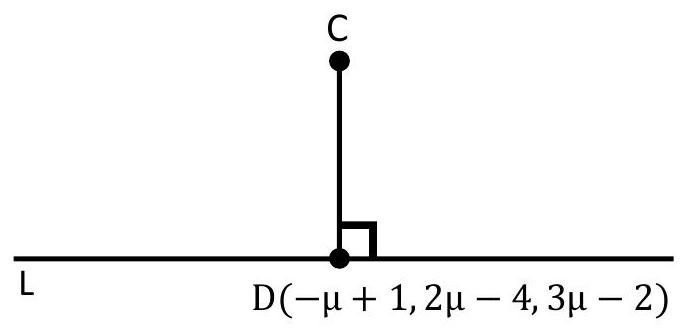
The point of intersection C of the plane 8x+y+2z=0 and the line joining the point A(−3,−61) and B(2,−4,−3) divides the line segment AB internally in the ratio k :. If a,b,c(|a|,|b|,|c|) are coprime are the direction ratios of the perpendicular form the point C on the line 1−x1=y+42=z+23, then ∣a+b+ c|is equal to
Numerical answer: ____________________
Enter the requested value (an integer; 0 decimal places). Use the units and scaling stated in the question.
Correct answer: 10

Source solution

10 Plane : 8x+y+2z=0 Given line AB:x−25=y−410=z+3−4=λ Any point on line (5λ+2,10λ+4,−4λ−3) Point of intersection of line and plane 8(5λ+2)+10λ+4−8λ−6=0 λ=−13 C (13,23,−53) L:x−1−1=y+42=z+23=μ Question figure CD―=(−μ+23)i^+(2μ−143)j^+(3μ−13)k^ (−μ+23)(−1)+(2μ−143)2+(3μ−13)3=0 μ=1114 CD→=−542,−13042,8542 Direction ratio →(−1,−26,17) |a+b+c|=10
Question 43 / MCQ
Question 43
If the first term of an A.P. is 3 and the sum of its first 25 terms is equal to the sum of its next 15 terms, then the common difference of this A.P. is:
A.
1/6
B.
1/5
C.
1/4
D.
1/7
Correct answer: A

Source solution

\textbf{Given:} a=3 and S25=sum of the next 15 terms. Since the next 15 terms are from the 26th to the 40th term, S25=S40−S25. Hence, 2S25=S40. \hrulefill \textbf{Step 1: Use the formula for sum of an A.P.} Sn=n2[2a+(n−1)d]. Since a=3, S25=252[6+24d]=75(1+4d). Also, S40=402[6+39d]=20(6+39d). \hrulefill \textbf{Step 2: Apply the condition} 2S25=S40 2⋅75(1+4d)=20(6+39d). 150+600d=120+780d. 30=180d. d=30180. d=16. \hrulefill d=16 Hence, the correct answer is 16.
Question 44 / Numerical
Question 44
Let a→=i^+2j^+λk^,b→=3i^−5j^−λk^,a→⋅c→=7,2b→⋅c→+43=0,a→×c→=b→×c→. Then |a→⋅b→| is equal to
Numerical answer: ____________________
Enter the requested value (an integer; 0 decimal places). Use the units and scaling stated in the question.
Correct answer: 8

Source solution

8 a¯=(1,2,λ)b¯=(3,−5,−λ) (1)a¯⋅c¯=7,b¯⋅c¯=−432(a¯−b¯)×c¯=0c=x[−2,7,2λ]=(−2x,7x,2λx) now ,a¯⋅c¯=−2x+14x+2λ2x=72λ2x+12x=7b¯⋅c¯=−6x−35x−2λ2x=−432−41x−2λ2x=−432 by adding (1) + (2) −29x=−292⇒x=12∴λ2+6=7⇒λ2=1|a¯⋅b¯|=|3−10−λ2|=|−8|
Question 45 / MCQ
Question 45
If the sum of the second, third and fourth terms of a positive term G.P. is 3 and the sum of its sixth, saventh and eighth terms is 243, then the sum of the first 50 terms of this G.P. is:
A.
213(350−1)
B.
126(349−1)
C.
113(350−1)
D.
126(350−1)
Correct answer: D

Source solution

\textbf{Question:} If the sum of the second, third and fourth terms of a positive-term G.P. is 3, and the sum of its sixth, seventh and eighth terms is 243, then the sum of the first 50 terms of this G.P. is: (1) 213(350−1)(2) 126(349−1) (3) 113(350−1)(4) 126(350−1) \hrulefill \textbf{Solution:} Let the first term be a and the common ratio be r. Then T2+T3+T4=ar+ar2+ar3=ar(1+r+r2). Given, (1)ar(1+r+r2)=3. Also, T6+T7+T8=ar5+ar6+ar7=ar5(1+r+r2). Given, (2)ar5(1+r+r2)=243. Dividing (2) by (1), r4=2433=81. Since the G.P. has positive terms, r=3. Substituting r=3 into (1), a(3)(1+3+9)=3, 39a=3, a=113. Now the sum of the first 50 terms is S50=a(r50−1)r−1. Substituting a=113 and r=3, S50=113(350−1)3−1=126(350−1). Hence, S50=126(350−1). Therefore, the correct option is (4) 126(350−1).
Choose another chapter