
Learne2i
Learne2i Guess Paper solutions
JEE Main 2025 / Session 2
All chapters

Physics

Thermodynamics

Question 76 / MCQ
Question 76
A diatomic gas with rigid molecules does 10 J of work when expanded at constant pressure. What would be the heat energy absorbed by the gas, in this process?
A.
30 J
B.
35 J
C.
25 J
D.
40 J
Correct answer: B

Source solution

W=nRΔT=10J ΔQ=(ΔQ)P=nCPΔT∴ΔQ=n⋅72R⋅ΔT=72⋅(10)=35J
Question 77 / MCQ
Question 77
A diatomic gas (γ=1.4) does 200 J of work when it is expanded isobarically. The heat given to the gas in the process is :
A.
850 J
B.
800 J
C.
600 J
D.
700 J
Correct answer: D

Source solution

γ=1+2f. Given, γ=1.4. Therefore, 1.4=1+2f 2f=0.4 f=5. For an ideal gas, CP=(f+22)R. Substituting f=5, CP=72R. Given that nRΔT=200J, the heat supplied at constant pressure is Q=nCPΔT. Hence, Q=(72)nRΔT=(72)(200). Q=700J. Therefore, Q=700J.
Question 78 / MCQ
Question 78
n moles of an ideal gas with constant volume heat capacity CV undergo an isobaric expansion by certain volume. The ratio of the work done in the process, to the heat supplied is :
A.
4nRCV+nR
B.
nRCV+nR
C.
4nRCV−nR
D.
nRCV−nR
Correct answer: C

Source solution

CP−CV=nR CP=CV+nR γ=CPCV=75 CV+nRCV=75 1+nRCV=75 nRCV=25 CV=52nR 4nRCV−nR=4nR52nR−nR =4nR32nR =83 4nRCV−nR=83
Question 79 / Numerical
Question 79
The temperature of 3.00 mol of an ideal diatomic gas is increased by 40.0 °C without changing the pressure of the gas. The molecules in the gas rotate but do not oscillate. If the ratio of change in internal energy of the gas to the amount of workdone by the gas is x10. Then the value of x (round off to the nearest integer) is ____. (Given R=8.31 J mol−1 K−1 )
Numerical answer: ____________________
Enter the requested integer (0 decimal places).
Correct answer: 25

Source solution

Pressure is not changing ⇒ isobaric process ⇒ΔU=nCvΔ T=5nRΔ T2 and W=nRΔT ΔUW=52=x10⇒x=25.00
Question 80 / Numerical
Question 80
A sample of gas with γ=1.5 is taken through an adiabatic process in which the volume is compressed from 1200 cm3 to 300 cm3. If the initial pressure is 200 kPa . The absolute value of the workdone by the gas in the process = J.
Numerical answer: ____________________
Enter the requested value (an integer; 0 decimal places). Use the units and scaling stated in the question.
Correct answer: 480

Source solution

v=1.5 p1 V1v=p2 V2v (200) (1200)1.5=P2(300)1.5 P2=200[4]3/2=1600kPa ∣ W.D. |=p2v2−p1v1v−1=(480−2400.5)=480 J
Question 81 / MCQ
Question 81
A diatomic gas (γ=1.4) does 100 J of work in an isobaric expansion. The heat given to the gas is :
A.
350 J
B.
490 J
C.
150 J
D.
250 J
Correct answer: A

Source solution

For an isobaric process: w=PΔv=nRΔT=100J Q=Δu+w Q=f2nRΔT+nRΔT Q=(f2+1)nRΔT Q=(52+1)⋅100=350J
Question 82 / MCQ
Question 82
A mixture of one mole of monoatomic gas and one mole of a diatomic gas (rigid) are kept at room temperature (27∘C). The ratio of specific heat of gases at constant volume respectively is:
A.
75
B.
32
C.
35
D.
53
Correct answer: C

Source solution

(CV)mono(CV)dia=32R52R. Cancelling R, (CV)mono(CV)dia=35. Hence, (CV)mono(CV)dia=35.
Question 83 / MCQ
Question 83
A sample of gas at temperature T is adiabatically expanded to double its volume. Adiabatic constant for the gas is γ=3/2. The work done by the gas in the process is : (μ=1 mole )
A.
RT[2−2]
B.
RT[1−22]
C.
RT[22−1]
D.
RT[2−2]
Correct answer: D

Source solution

W=nRΔT1−γ. For an adiabatic process, TVγ−1=constant. Given that the volume doubles, Tf(2V)γ−1=TVγ−1. For a monoatomic gas, γ=53. Therefore, Tf=T(V2V)γ−1=T(12)2/3. If γ=32 is assumed, then Tf=T(12)1/2=T2. Hence, ΔT=Tf−T=T2−T. Substituting into the work expression, W=R(T2−T)1−32. W=2RT(1−12). W=2RT(2−1)2=RT(2−2). Therefore, W=RT(2−2).
Question 84 / MCQ
Question 84
7 mole of certain monoatomic ideal gas undergoes a temperature increase of 40 K at constant pressure. The increase in the internal energy of the gas in this process is(Given R=8.3JK−1 mol−1 )
A.
5810 J
B.
3486 J
C.
11620 J
D.
6972 J
Correct answer: B

Source solution

For a quasi-static process, the change in internal energy of an ideal gas is ΔU=nCVΔT. For a monoatomic ideal gas, CV=3R2. Therefore, ΔU=n(3R2)ΔT. Substituting n=7,R=8.3J mol−1K−1,ΔT=40K, we get ΔU=7×32×8.3×40. ΔU=3486J.
Question 85 / MCQ
Question 85
Read the following statements :A. When small temperature difference between a liquid and its surrounding is doubled the rate of loss of heat of the liquid becomes twice.B. Two bodies P and Q having equal surface areas are maintained at temperature 10∘C and 20∘C. The thermal radiation emitted in a given time by P and Q are in the ratio 1:1.15C. A carnot Engine working between 100 K and 400 K has an efficiency of 75%D. When small temperature difference between a liquid and its surrounding is quadrupled, the rate of loss of heat of the liquid becomes twice.Choose the correct answer from the options given below:
A.
A, B, C only
B.
A, B only
C.
A, C only
D.
B, C, D only
Correct answer: A

Source solution

Statement A According to Newton's law of cooling, dQdt∝(T−Ts), for small temperature differences. Hence, if the temperature difference is doubled, the rate of loss of heat also doubles. A is true. Statement B According to Stefan's law, E∝T4. For temperatures TP=10∘C=283K,TQ=20∘C=293K, EPEQ=(283293)4≈0.87. Thus, EP:EQ≈1:1.15. B is true. Statement C For a Carnot engine, η=1−TCTH. With TC=100K,TH=400K, η=1−100400=34=75%. C is true. Statement D From Newton's law of cooling, dQdt∝(T−Ts). If the temperature difference is quadrupled, the rate of loss of heat becomes four times, not twice. D is false. Therefore, Statements A, B and C are correct.
Question 86 / MCQ
Question 86
A thermally insulated vessel contains an ideal gas of molecular mass M and ratio of specific heats 1.4. Vessel is moving with speed v and is suddenly brought to rest. Assuming no heat is lost to the surrounding and vessel temperature of the gas increases by : ( R= universal gas constant)
A.
Mv27R
B.
Mv25R
C.
2Mv27R
D.
7Mv25R
Correct answer: B

Source solution

Sol. CPCv=1+2F=1.4⇒F=5 By conservation of energy, F2nRΔT=12[nm]v2 ΔT=mv2FR=Mv25R
Question 87 / Numerical
Question 87
A diatomic gas (γ=1.4) does 400 J of work when it is expanded isobarically. The heat given to the gas in the process is J.
Numerical answer: ____________________
Enter the requested value (an integer; 0 decimal places). Use the units and scaling stated in the question.
Correct answer: 1400

Source solution

Q=nCpΔT=nvv−1RΔT Q=vv−1ω=1.40.4×400=1400 J
Question 88 / MCQ
Question 88
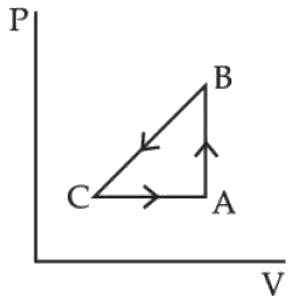
A sample of an ideal gas is taken through the cyclic process ABCA as shown in figure. It absorbs, 40 J of heat during the part AB , no heat during BC and rejects 60 J of heat during CA . A work 50 J is done on the gas during the part BC . The internal energy of the gas at A is 1560 J . The work done by the gas during the part CA is:Question figure
A.
20 J
B.
30 J
C.
-30 J
D.
-60 J
Correct answer: B

Source solution

ΔQcycle=40−60=−20J. For a cyclic process, ΔUcycle=0. Hence, from the first law of thermodynamics, ΔQcycle=Wcycle. Therefore, Wcycle=−20J. Also, Wcycle=WBC+WCA. Thus, −20=WBC+WCA. Given WBC=−50J, we get WCA=−20−(−50). WCA=30J. Hence, WCA=30J.
Question 89 / MCQ
Question 89
An ideal gas goes from an initial state to final state. During the process, the pressure of gas increases linearly with temperature (A) The work done by gas during the process is zero. (B) The heat added to gas is different from change in its internal energy (C) The volume of the gas is increased (D) The internal energy of the gas is increased (E) The process is isochoric (constant volume process)Choose the correct answer from the options given below :-
A.
A, B, C, D Only
B.
A, D, E Only
C.
E Only
D.
A, C Only
Correct answer: B

Source solution

Given that the pressure increases linearly with temperature, P∝T. Using the ideal gas equation, PV=nRT. ::contentReference[oaicite:0]{index=0} Since PT=constant, from PV=nRT, we get V=nRP/T=constant. Hence, the process is isochoric. (E) is correct. Since the volume remains constant, W=∫PdV=0. Therefore, (A) is correct. As pressure increases linearly with temperature, T increases. For an ideal gas, ΔU=nCVΔT. Since ΔT>0, ΔU>0. Thus, (D) is correct. Also, for an isochoric process, W=0, and by the first law, Q=ΔU. Therefore, statement (B) is false. Since the volume remains constant, (C) is false. Hence, the correct statements are A, D and E.
Question 90 / MCQ
Question 90
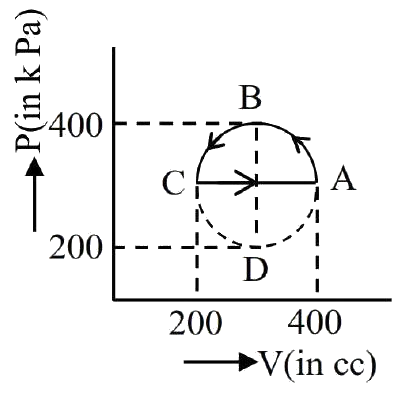
The magnitude of heat exchanged by a system for the given cyclic process ABCA (as shown in figure) is (in SI unit)Question figure
A.
10π
B.
5π
C.
zero
D.
40π
Correct answer: B

Source solution

The work done is equal to the area enclosed by the semicircular loop on the P-V diagram. The area of a semicircle is W=12πab, where a=2002×103 Pa,b=2002×10−6 m3. Therefore, W=12π(2002×103)(2002×10−6). W=12π(100×103)(100×10−6). W=12π(10). W=5π J. Hence, W=5π J.
Choose another chapter