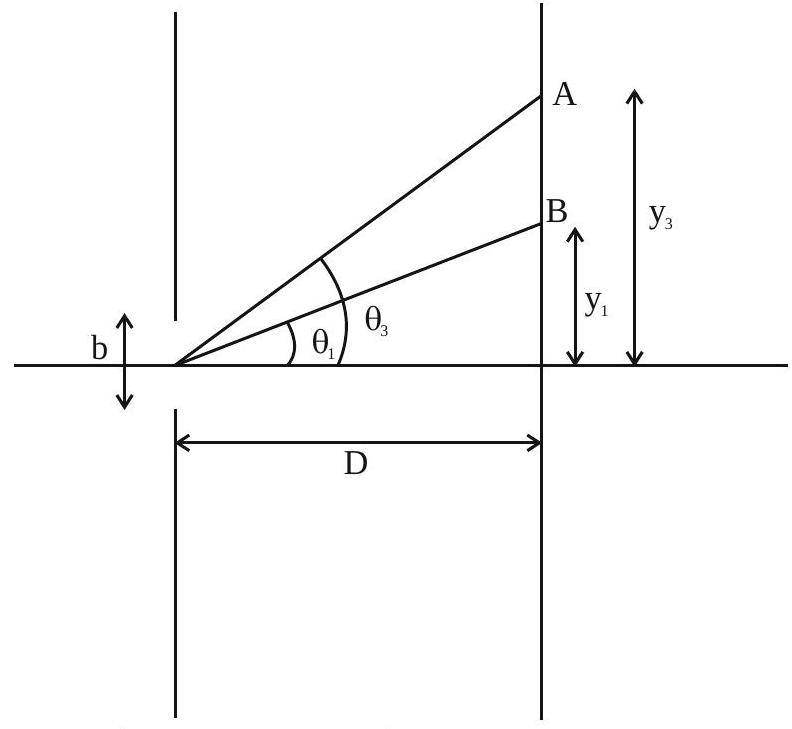
Physics
Waves
Question 105 / Numerical
A beam of electromagnetic radiation of intensity
Numerical answer: ____________________
Enter the requested value (an integer; 0 decimal places). Use the units and scaling stated in the question.
Correct answer: 11
Source solution
(11)Question 106 / Numerical
As per given figure 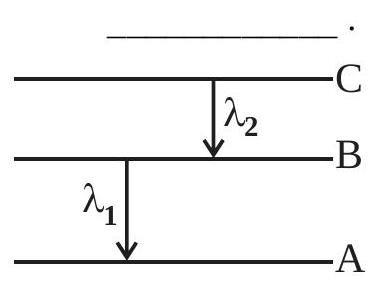
Numerical answer: ____________________
Enter the requested value (an integer; 0 decimal places). Use the units and scaling stated in the question.
Correct answer: 5
Source solution
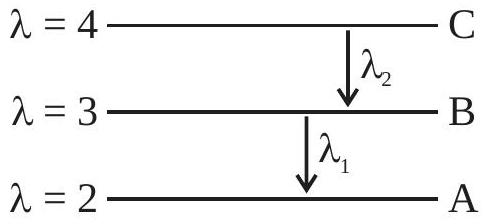 As
Question 107 / Numerical
A monochromatic light is incident on a hydrogen sample in ground state. Hydrogen atoms absorb a fraction of light and subsequently emit radiation of six different wavelengths. The frequency of incident light is
Numerical answer: ____________________
Enter the requested value (an integer; 0 decimal places). Use the units and scaling stated in the question.
Correct answer: 3
Source solution
Question 108 / Numerical
A fringe width of 6 mm was produced for two slits separated by 1 mm apart. The screen is placed 10 m away. The wavelength of light used is ' x ' nm . The value of ' x ' to the nearest integer is
Numerical answer: ____________________
Enter the requested value (an integer; 0 decimal places). Use the units and scaling stated in the question.
Correct answer: 600
Source solution
Question 109 / Numerical
Monochromatic light of wavelength 500 nm is used in Young's double slit experiment. An interference pattern is obtained on a screen When one of the slits is covered with a very thin glass plate (refractive index
Numerical answer: ____________________
Enter the requested value (an integer; 0 decimal places). Use the units and scaling stated in the question.
Correct answer: 4
Source solution
Question 110 / Numerical
In a YDSE interference pattern obtained with light of wavelength
Numerical answer: ____________________
Enter the requested value (an integer; 0 decimal places). Use the units and scaling stated in the question.
Correct answer: 750
Source solution
(750) If the length of the segment is y , ThenQuestion 111 / Numerical
In a Young's double slit experiment, an angular width of the fringe is
Numerical answer: ____________________
Enter the requested value (an integer; 0 decimal places). Use the units and scaling stated in the question.
Correct answer: 4
Source solution
Question 112 / Numerical
In a Young's double slit experiment, the intensities at two points, for the path differences
Numerical answer: ____________________
Enter the requested value (an integer; 0 decimal places). Use the units and scaling stated in the question.
Correct answer: 3
Source solution
Question 113 / Numerical
Two wavelengths
Numerical answer: ____________________
Enter the requested value (an integer; 0 decimal places). Use the units and scaling stated in the question.
Correct answer: 9
Source solution
Question 114 / Numerical
In a Young's double slit experiment, a laser light of 560 nm produces an interference pattern with consecutive bright fringes' separation of 7.2 mm . Now another light is used to produce an interference pattern with consecutive bright fringes' separation of 8.1 mm . The wavelength of second light is
Numerical answer: ____________________
Enter the requested value (an integer; 0 decimal places). Use the units and scaling stated in the question.
Correct answer: 630
Source solution
Question 115 / Numerical
In Young's double slit experiment, carried out with light of wavelength
Numerical answer: ____________________
Enter the requested value (an integer; 0 decimal places). Use the units and scaling stated in the question.
Correct answer: 10
Source solution
Question 116 / Numerical
In a double slit experiment with monochromatic light, fringes are obtained on a screen placed at some distance from the plane of slits. If the screen is moved by
Numerical answer: ____________________
Enter the requested value (an integer; 0 decimal places). Use the units and scaling stated in the question.
Correct answer: 600
Source solution
Question 117 / Numerical
A parallel beam of monochromatic light of wavelength
Numerical answer: ____________________
Enter the requested value (an integer; 0 decimal places). Use the units and scaling stated in the question.
Correct answer: 30
Source solution
For first minimaQuestion 118 / Numerical
A beam of light consisting of two wavelengths
Numerical answer: ____________________
Enter the requested value (an integer; 0 decimal places). Use the units and scaling stated in the question.
Correct answer: 462
Source solution
Question 119 / Numerical
In a single slit diffraction pattern, a light of wavelength
Numerical answer: ____________________
Enter the requested value (an integer; 0 decimal places). Use the units and scaling stated in the question.
Correct answer: 2
Source solution
For