Learne2i
Learne2i Guess Paper solutions
JEE Main 2026 / Session 1
All chapters

Chemistry

Chemical Bonding and Molecular Structure

Question 16 / Numerical
Question 16
Total number of species from the following with central atom utilising 2p2 hybrid orbitals for bonding is . NH3,SO2,SiO2,BeCl2,C2H2,C2H4,BCl3,HCHO, C6H6,BF3,C2H4Cl2
Numerical answer: ____________________
Enter the requested value (an integer; 0 decimal places). Use the units and scaling stated in the question.
Correct answer: 6

Source solution

Central atom utilising sp2 hybrid orbitals SO2,C2H4,BCl3,HCHO,C6H6,BF3
Question 17 / MCQ
Question 17
Match List-I with List-II List-I (Molecule/Ion)List-II (Hybridisation)A. PF5I. dsp2B. SF6II. sp3dC. Ni(CO)4III. sp3d2D. [PtCl4]2−IV. sp3 Choose the correct answer from the options given below.
A.
A-II, B-III, C-IV, D-I
B.
A-IV, B-I, C-II, D-III
C.
A-I, B-II, C-III, D-IV
D.
A-III, B-I, C-IV, D-II
Correct answer: A

Source solution

Solution: PF5 5 bond pairs +0 lone pair ⇒sp3d A→II SF6 6 bond pairs +0 lone pair ⇒sp3d2 B→III Ni(CO)4 Tetrahedral complex ⇒sp3 C→IV [PtCl4]2− Square planar complex ⇒dsp2 D→I A−II,B−III,C−IV,D−I Correct Option (1)
Question 18 / MCQ
Question 18
Match List-I with List-II List-I(Molecule)List-II(Bond order) (a)Ne2(i)1(b)N2(ii)2(c)F2(iii)0(d)O2(iv)3 Choose the correct answer from the options given below.
A.
(a)-(iii), (b)-(iv), (c)-(i), (d)-(ii)
B.
(a)-(i), (b)-(ii), (c)-(iii), (d)-(iv)
C.
(a)-(ii), (b)-(i), (c)-(iv), (d)-(iii)
D.
(a)-(iv), (b)-(iii), (c)-(ii), (d)-(i)
Correct answer: A

Source solution

Solution Using Molecular Orbital Theory: Ne2:Bond Order=Nb−Na2=0 ∴Ne2→(iii) N2:Bond Order=3 ∴N2→(iv) F2:Bond Order=1 ∴F2→(i) O2:Bond Order=2 ∴O2→(ii) A→III,B→IV,C→I,D→II (a)−(iii),(b)−(iv),(c)−(i),(d)−(ii) Correct Answer : (1)
Question 19 / MCQ
Question 19
Match List-I with List-II List-IList-IIA. Molecules obeying octet ruleI. NO, NO2B. Molecules with incomplete octetII. BCl3, AlCl3C. Molecules with odd electronIII. H2SO4, PCl5D. Molecules with expanded octetIV. CCl4, CO2 Choose the correct answer from the options given below :
A.
A-IV, B-II, C-I, D-III
B.
A-III, B-II, C-I, D-IV
C.
A-IV, B-I, C-III, D-II
D.
A-II, B-IV, C-III, D-I
Correct answer: A

Source solution

Solution A. Molecules obeying octet rule CCl4, CO2 ⇒(IV) B. Molecules with incomplete octet BCl3, AlCl3 ⇒(II) C. Molecules with odd electron NO, NO2 ⇒(I) D. Molecules with expanded octet H2SO4, PCl5 ⇒(III) ∴ A−IV,B−II,C−I,D−III Correct Answer : (1)
Question 20 / MCQ
Question 20
Match List-I with List-II List-IList-IIA. SO2Cl2I. ParamagneticB. NOII. DiamagneticC. NO2−III. TetrahedralD. I3−IV. Linear Choose the correct answer from the options given below :
A.
A-IV, B-I, C-III, D-II
B.
A-III, B-I, C-II, D-IV
C.
A-II, B-III, C-I, D-IV
D.
A-III, B-IV, C-II, D-I
Correct answer: B

Source solution

Solution SO2Cl2⇒Tetrahedral⇒(III) NO⇒One unpaired electron⇒Paramagnetic⇒(I) NO2−⇒All electrons paired⇒Diamagnetic⇒(II) I3−⇒Linear⇒(IV) ∴A−III,B−I,C−II,D−IV Correct Answer : (2)
Question 21 / MCQ
Question 21
Match List I with List II :
List-I (molecule) List-II (hybridization; shape)
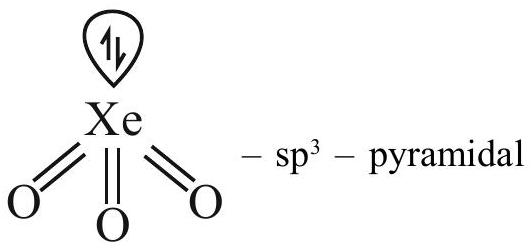
A. XeO3I. sp3 d; linear
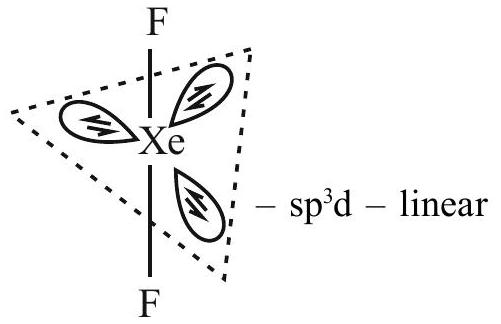
B. XeF2II. sp3; pyramidal
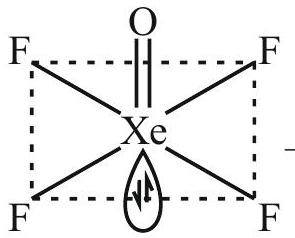
C. XeOF4III. sp3 d3; distorted octahedral
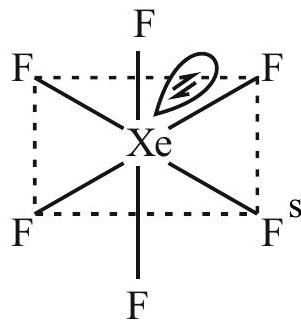
D. XeF6IV. sp3 d2; square pyramidal
Choose the correct answer from the options given below:
A.
A-II, B-I, C-IV, D-III
B.
A-II, B-IV, C-III, D-I
C.
A-IV, B-II, C-III, D-I
D.
A-IV, B-II, C-I, D-III
Correct answer: A

Source solution

(A) Question figure (B) Question figure (C) Question figure −sp3 d2− square pyramidal (D) Question figure TIME : 3:00 PM to 06:00 PM TEST PAPER WITH SOLUTION
Question 22 / Numerical
Question 22
Consider the following sequence of reactions. Question figure Total number of sp3 hybridised carbon atoms in the major product C formed is .
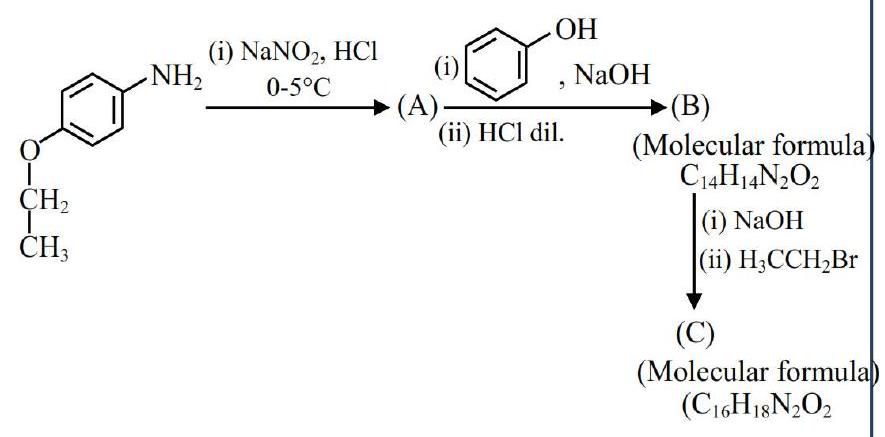
Numerical answer: ____________________
Enter the requested value (an integer; 0 decimal places). Use the units and scaling stated in the question.
Correct answer: 4

Source solution
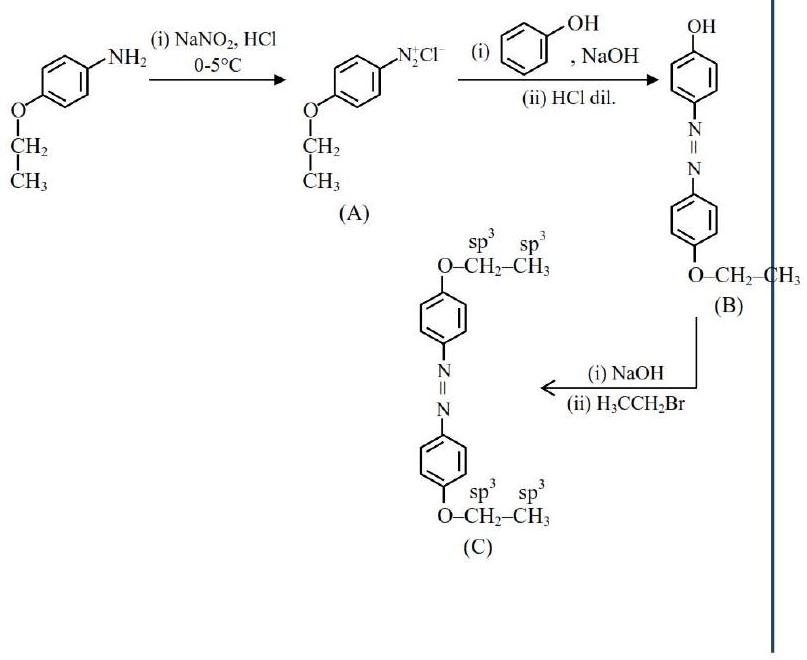
Question figure
Question 23 / MCQ
Question 23
Match List-I with List-II List-I (A) ΨMO=ΨA−ΨB (B) μ=Q×r (C) Nb−Na2 (D) ΨMO=ΨA+ΨB List-II (I) Dipole moment (II) Bonding molecular orbital (III) Anti-bonding molecualr orbital (IV) Bond order
A.
-(II), (B)-(I), (C)-(IV), (D)-(III)
B.
(A)-(III), (B)-(IV), (C)-(I), (D)-(II)
C.
(A)-(III), (B)-(I), (C)-(IV), (D)-(II)
D.
(A)-(III), (B)-(IV), (C)-(II), (D)-(I)
Correct answer: C

Source solution

TEST PAPER WITH SOLUTION Sol. (A) ψMO=ψA−ψB (III) ABMO (B) μ=Q×r (I) Dipole moment (C) Nb−Na2 (IV) Bond order (D) ψMO=ψA+ψB (II) BMO
Choose another chapter