
Learne2i
Learne2i Guess Paper solutions
JEE Main 2026 / Session 1
All chapters

Mathematics

Trigonometric Functions

Question 10 / Numerical
Question 10
Let S={sin2⁡2θ:(sin4⁡θ+cos4⁡θ)x2+(sin⁡2θ)x+ (sin6⁡θ+cos6⁡θ)=0 has real roots }. If α and β be the smallest and largest elements of the set S , respectively, then 3((α−2)2+(β−1)2) equals.....
Numerical answer: ____________________
Enter the requested value (an integer; 0 decimal places). Use the units and scaling stated in the question.
Correct answer: 4

Source solution
D=(sin⁡2θ)2−4(1−sin2⁡2θ2)(1−34sin2⁡2θ) =(sin⁡2θ)2−4(1−54sin2⁡2θ+38sin4⁡2θ) D=−32sin4⁡2θ+6sin2⁡2θ−4>0 3sin4⁡2θ−12sin2⁡2θ+8<0 sin2⁡2θ=12±122−12.86=12±436=6±233 sin2⁡2θ=2±23, but sin2⁡2θ∈[0,1] ∴α=2−23,β=1→(α−2)2=43,(β−1)2=0 3(α−2)2+(β−1)2=4
Question 11 / Numerical
Question 11
If for some α,β;α≤β,α+β=8 and sec2⁡(tan−1⁡α)+cosec2(cot−1⁡β)=36, then α2+β is .
Numerical answer: ____________________
Enter the requested value (an integer; 0 decimal places). Use the units and scaling stated in the question.
Correct answer: 14

Source solution

If (tan⁡(tan−1⁡(α))+1(cot⁡(cot−1⁡β))2=36 α2+β2=34 αβ=15 α=3,β=5 ∴α2+β=9+5=14
Question 12 / Numerical
Question 12
Question ID: 101787 Let c,k∈R. If f(x)=(c+1)x2+(1−c2)x+2k and f(x+y)=f(x)+f(y)−xy, for all x,y∈R, then the value of |2(f(1)+f(2)+f(3)+……+f(20))| is equal to .
Numerical answer: ____________________
Enter the requested value (an integer; 0 decimal places). Use the units and scaling stated in the question.
Correct answer: 3395

Source solution

f(x)=(c+1)x2+(1−c2)x+2k (1)&f(x+y)=f(x)+f(y)−xy∀xy∈R limy→0f(x+y)−f(x)y=limy→0f(y)−xyy⇒f′(x)=f′(0)−x f(x)=−12x2+f′(0)⋅x+λ but f(0)=0⇒λ=0 (2)f(x)=−12x2+(1−c2)⋅x ∴ as f′(0)=1−c2 Comparing equation (1) and (2) We obtain, c=−32 ∴f(x)=−12x2−54x Now |2∑x=120f(x)|=∑x=120x2+52⋅∑x=120x =2870+525=3395
Question 13 / MCQ
Question 13
A value of θ∈(0,π/3), for which |1+cos2⁡θsin2⁡θ4cos⁡6θcos2⁡θ1+sin2⁡θ4cos⁡6θcos2⁡θsin2⁡θ1+4cos⁡6θ|=0, is :
A.
π18
B.
7π36
C.
7π24
D.
π9
Correct answer: D

Source solution

Let a=cos2⁡θ,b=sin2⁡θ,c=4cos⁡6θ. Then a+b=1 and the determinant becomes Δ=|1+abca1+bcab1+c|. Given, Δ=0. \bigskip Apply the row operation R1→R1−R2. Then Δ=|1−10a1+bcab1+c|. Expanding along the first row, Δ=|1+bcb1+c|+|aca1+c|. =(1+b)(1+c)−bc+a(1+c)−ac. =1+b+c+a. Since a+b=1, Δ=2+c. Substituting c=4cos⁡6θ, 2+4cos⁡6θ=0. cos⁡6θ=−12. \bigskip Therefore, 6θ=2π3,4π3,8π3,10π3. Hence, θ=π9,2π9,4π9,5π9. Since 0<θ<π3, the admissible values are θ=π9,θ=2π9. Among the given options, only π9 appears. Option (4) ```
Question 14 / MCQ
Question 14
If cot⁡α=1 and sec⁡β=−53, where π<α<3π2 and π2<β<π, then the value of tan⁡(α+β) and the quadrant in which α+β lies, respectively are
A.
−17 and IV th  quadrant
B.
7 and Ist  quadrant
C.
-7 and IVth  quadrant
D.
17 and Ist quadrant
Correct answer: A

Source solution

Sol. cot⁡α=1,sec⁡β=−53,cos⁡β=−35,tan⁡β=−43 tan⁡(α+β)=1−431+43×1=−17 Option(1) is the correct answer.
Question 15 / Numerical
Question 15
The number of values of x in the interval (π4,7π4) for which 14cosec2x−2sin2⁡x=21 −4cos2⁡x holds, is
Numerical answer: ____________________
Enter the requested value (an integer; 0 decimal places). Use the units and scaling stated in the question.
Correct answer: 4

Source solution

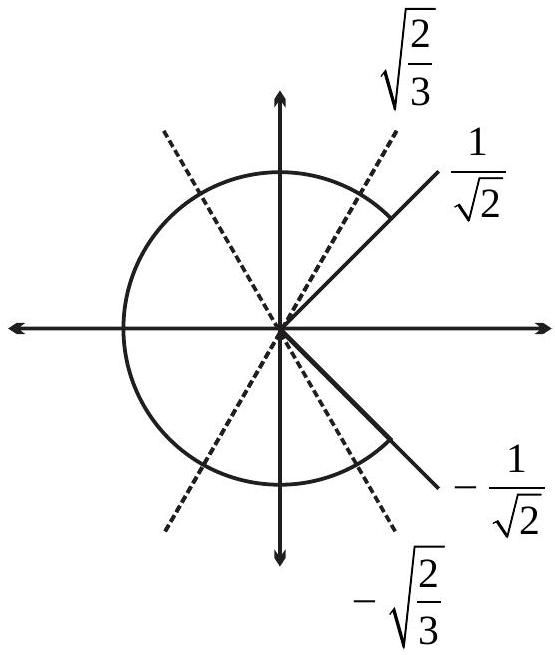
x∈(π4,7π4) 14cosec2x−2sin2⁡x=21−4cos2⁡x =21−4(1−sin2⁡x) =17+4sin2⁡x 14cosec2x−6sin2⁡x=17 let sin2⁡x=p 14p−6p=17⇒14−6p2=17p 6p2+17p−14=0 p=−3.5,23⇒sin2⁡x=23 ⇒sin⁡x=±23 Question figure ∴ Total 4 solutions
Choose another chapter