
Learne2i
Learne2i Guess Paper solutions
JEE Main 2026 / Session 1
All chapters

Mathematics

Vector Algebra

Question 144 / MCQ
Question 144
If the equation of the plane containing the line x+2y+3z−4=0=2x+y−z+5 and perpendicular to the plane r→=(i^−j^)+λ(i^+j^+k^)+μ(i^−2j^+3k) is ax+by+cz=4, then (a−b+c) is equal to
A.
20
B.
24
C.
22
D.
18
Correct answer: C

Source solution

The given line is the intersection of the planes x+2y+3z−4=0 and 2x+y−z+5=0. The normals to these planes are n→1=(1,2,3),n→2=(2,1,−1). Hence the direction vector of the line is d→=n→1×n→2=|i^j^k^12321−1|=(−5,7,−3). --- The given plane is r→=(i^−j^)+λ(i^+j^+k^)+μ(i^−2j^+3k^). Its two direction vectors are a→=(1,1,1),b→=(1,−2,3). Therefore, its normal vector is n→p=a→×b→=|i^j^k^1111−23|=(5,−2,−3). --- Let the required plane have normal vector N→=(a,b,c). Since the required plane contains the given line, N→⋅d→=0. Thus, −5a+7b−3c=0. Also, the required plane is perpendicular to the plane whose normal is (5,−2,−3), so N→⋅(5,−2,−3)=0, i.e., 5a−2b−3c=0. Solving −5a+7b−3c=0 and 5a−2b−3c=0, adding, 5b−6c=0 b=6c5. Substituting into 5a−2b−3c=0, 5a−12c5−3c=0 25a=27c. Taking c=25, a=27,b=30. Hence, N→=(27,30,25). Therefore the required plane is 27x+30y+25z=4. So, a−b+c=27−30+25=22. 22 Hence, the correct option is (3)22.
Question 145 / Numerical
Question 145
Let a line l pass through the origin and be perpendicular to the lines l1:r→=(i^−11j^−7k^)+λ(i^+2j^+3k^),λ∈R and l2:r→=(−i^+k^)+μ(2i^+2j^+k^),μ∈R. If P is the point of intersection of l and l1, and Q(α , β,γ ) is the foot of perpendicular from P on l2, then 9(α+β+γ) is equal to .
Numerical answer: ____________________
Enter the requested value (an integer; 0 decimal places). Use the units and scaling stated in the question.
Correct answer: 5

Source solution

Let ℓ=(0i^+0j^+0k^)+γ(ai^+bj^+ck^) =γ(ai^+bj^+ck^) ai^+bj^+ck^=|i^j^k^123221| =i^(2−6)−j^(1−6)+k^(2−4) =−4i^−5j^−2k^ ℓ=γ(−4i^+5j^−2k^) P is intersection of ℓ and ℓ1 −4γ=1+λ,5γ=−11+2λ,−2γ=−7+3λ By solving there equation γ=−1,P(4,−5,2) Let Q(−1+2μ,2μ,1+μ) PQ→⋅(2i^+2j^+k^)=0 −2+4μ+4μ+1+μ=0 9μ=1 μ=19 Q(−79,29,109) 9(α+β+γ)=9(−79+29+109) =5
Question 146 / Numerical
Question 146
If the equation of a plane P, passing through the intersection of the planes, x+4y−z+7=0 and 3x+y+5z=8 is ax+by+6z=15 for some a,b∈R, then the distance of the point (3,2,−1) from the plane P is..........
Numerical answer: ____________________
Enter the requested value (an integer; 0 decimal places). Use the units and scaling stated in the question.
Correct answer: 3

Source solution

p1+λp2=0 (x+4y−z+7)+λ(3x+y+5z−8)=ax+by+6z−15 1−3λa=4+λb=−1+5λ6=7−8λ−15 ∴15−75λ=42−48λ −27=27λ λ=−1 ∴ plane is −2x+3y−6z+15=0 d=|−6+6+6+154+9+36|=3
Question 147 / Numerical
Question 147
Let a→,b→ and c→ be three non-zero non-coplanar vectors. Let the position vectors of four points A,B,C and D be a→−b→+c→,λa→−3b→+4c→,−a→+2b→−3c→ and 2a→−4b→+6c→ respectively. If AB→,AC→ and AD→ are coplanar, then λ is equal to
Numerical answer: ____________________
Enter the requested value (an integer; 0 decimal places). Use the units and scaling stated in the question.
Correct answer: 2

Source solution

AB→=(λa→−3b→+4c→)−(a→−b→+c→)=(λ−1)a→−2b→+3c→AC→=(−a→+2b→−3c→)−(a→−b→+c→)=−2a→+3b→−4c→AD→=(2a→−4b→+6c→)−(a→−b→+c→)=a→−3b→+5c→ For coplanar vectors |λ−1−23−23−41−35|=0 ⇒3λ−6=0 ∴λ=2
Question 148 / MCQ
Question 148
If the vectors a→=λı^+μȷ^+4k^,b→=2ı^+4ȷ^−2k^ and c→=2ı^+3ȷ^+k^ are coplanar and the projection of a→ on the vector b→ is 54 units, then the sum of all possible values of λ+μ is equal to
A.
0
B.
24
C.
6
D.
18
Correct answer: B

Source solution

Sol. 2} Vector a→=λi^+μj^+4k^,b→=−2i^+4j^−2k^ and c→=2i^+3j^+k^ are coplanar then [a→b→c→]=0⇒|λμ4−24−2231|=0 ⇒10λ−2μ−56=0 (1)⇒5λ−μ=28 also projection of a→ on the b→ is 54 units. then a→.b→=54 ⇒−2λ+4μ−824=54 ⇒−2λ+4μ−8=36 (2)⇒−2λ+4μ=44 from (1) and (2) λ=263 and μ=463 ⇒λ+μ=26+463=723=24
Question 149 / MCQ
Question 149
Let a→=4ı^+3ȷ^ and b→=3ı^−4ȷ^+5k^. If c→ is a vector such that c→⋅(a→×b→)+25=0,c→⋅(ı^+ȷ^+ k^)=4, and projection of c→ on a→ is 1 , then the projection of c→ on b→ equals
A.
15
B.
52
C.
32
D.
12
Correct answer: B

Source solution

Sol. (2) Let c→=c1i^+c2j^+c3k^ c→⋅(i+j+k)=4 (i)c→.a→×b→ c1+c2+c3=4 |c1c2c34303−45|=−25 ⇒c1(15−0)−c2(20−0)+c3(−16−9)=−25 ⇒15c1−20c2−25c3=−25 (2)⇒3c1−4c2−5c3=−5 Proj. of c→ on a→=a→⋅c→|a→|=1 ⇒(4i^+3j^)(c1i^+c2j^+c3k^)16+9=1 ⇒4c1+3c2=5 ⇒4c1=5−3c2 (3)⇒c1=5−3c24 Eqn⋅ (1) & (3) 5−3c24+c2+c3=4 Eq n . (2) & (3) 3(5−3c24)−4c2−5c3=−515−9c2−16c2−20c3=−20(5)−25c2−20c3=−35 5−3c2+4c2+4c3=16 c2+4c3=11 Eqn. (4) & (5) c2=11−4c3 −25c2−20c3=−35 −25(11−4c3)−20 c 2=11−4×3 5(11−4c3)+4c3=7 =11−12 55−20c3+4c3=7 c2=−1 −16c3=−48 c1=5−3c24 c3=3 =5−3(−1)4 c→=2i^−j^+3k^ c1=2 Projection of c→ on b→=|c→⋅b→|b→|| ⇒|(2i^−j^+3k^)⋅(3i^−4j^+5k^)9+16+25| ⇒|6+4+1552|=2552=52
Question 150 / MCQ
Question 150
Let a→=2i^−7j^+5k,b→=i^+k and c→=i^+2j^−3k be three given vectors. If r→ is a vector such that r→×a→=c→×a→ and r→⋅b→=0, then |r→| is equal to:
A.
1152
B.
9147
C.
1172
D.
117
Correct answer: C

Source solution

Sol. 3 r→×a→=c→×a→ ⇒(r→−c→)×a→=0⇒r→−c→=λa→(r→−c→&a→ are parallel) ⇒r→=c→+λa→ ⇒r→⋅b→=c→⋅b→+λa→⋅b→ 0=(1−3)+λ(2+5)⇒λ=27 Hence, r→=c→+2a→7 r→⇒117ı^−117k^ |r→|=(117)2+(−117)2⇒r=1127
Question 151 / MCQ
Question 151
If a→,b→,c→ are three non-zero vectors and n^ is a unit vector perpendicular to c→ such that a→=αb→−n^,(α≠ 0 ) and b→⋅c→=12, then |c→×(a→×b→)| is equal to :
A.
9
B.
15
C.
6
D.
12
Correct answer: D

Source solution

Sol. 4 a→=αb→−n^,b→.c→=12 c→×(a→×b→)=(c→⋅b→)a→−(c→⋅a→)b→ (1)c→×(a→×b→)=12a→−(c→.a→)b→ ∵a→=αb→−n c.→a→=αc.→b→−c.n→ (2)c.→a→=12α Equation (2) put in equation (1) c→×(a→×b→)=12a→−12αb→ |c→×(a→×b→)|=12|a→−αb→|[∵a→−αb→=−n then |a→−αb→|=1] ⇒|c→×(a→×b→)|=12
Question 152 / Numerical
Question 152
Let the three sides of a triangle ABC be given by the vectors 2i^−j^+k^,i^−3j^−5k^ and 3i^−4j^−4k^. Let G be the centroid of the triangle ABC . Then 6(|AG→|2+|BG→|2+|CG→|2) is equal to
Numerical answer: ____________________
Enter the requested value (an integer; 0 decimal places). Use the units and scaling stated in the question.
Correct answer: 164

Source solution
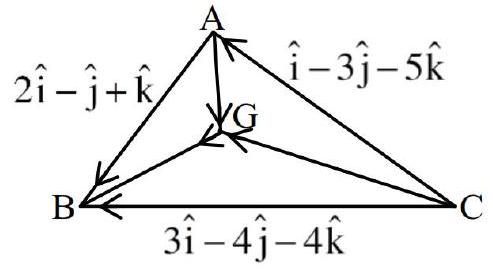
Question figure By given data AB→+AC→=CB→ Let pv of A→ are O→ then AB→=B→−A→ i.e. pv of B→−=2i^−j^+k^ CA→=A→−C→ i.e. pv of C→=−(i^−3j^−5k^) Now pv of centroid (G→)−=A→+B→+C→3=0→+(2,−1,1)+(−1,3,5)3 G→=13(i^+2j^+6k^) Now AG→=13(i^+2j^+6k^) ⇒|AG→|2=19×41 BG→=(13−2)i^+(23+1)j^+(2−1)k^ ⇒|BG→|2=599 CG→=(13+1)i^+(23−3)j^+(2−5)k^ ⇒|CG→|2=1469 Now 6[|AG→|2+|BG→|2+|CG→|2]=6×[419+599+1469] =6×2469=164
Question 153 / MCQ
Question 153
Let the position vectors of three vertices of a triangle be 4p→+q→−3r→,−5p→+q→+2r→ and 2p→−q→+2r→. If the position vectors of the orthocenter and the circumcenter of the triangle are p→+q→+r→4 and αp→+βq→+γr→ respectively, then α+2β+5γ is equal to:
A.
3
B.
1
C.
6
D.
4
Correct answer: A

Source solution

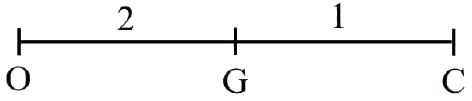
Sol. We know that O (orthocentre) p→+q→+r→4 C (circum centre) αp→+βq→+γr→ C( centroid )=p→+q→+r→3 by relation ⇒2(αp→+βq→+γr→)+p→+q→+r→4=3(p→+q→+r→3) ⇒8(αp→+βq→+γr→)=3(p→+q→+r→) ⇒8α=3,8β=3,8γ=3 α=38,β=38,γ=38 ∴α+2β+3γ 38+68+158=248=3Question figure
Question 154 / Numerical
Question 154
Let P be a plane passing through the points (1, 0, 1), (1, -2, 1) and (0, 1, -2). let a vector a→=αi^+βj^+γk^ be such that a→ is parallel to the plane P , perpendicular to (i^+2j^+3k^) and a→(i^+j^+2k^)=2, then (α−β+γ)2 equals ____.
Numerical answer: ____________________
Enter the requested integer (0 decimal places).
Correct answer: 81

Source solution

Equation of plane : |x−1y−0z−11−121−11−00−11+2|=0⇒3x−z−2=0a→=αi^+βj^+γk^‖ to 3x−z−2=0⇒3α−γ=0a→⊥i+2j^+3k^⇒α+2β+3γ=0a→(i^+j^+3k^)=0⇒α+β+2γ=2 on solving 1,2 & 3 α=1,β=−5,γ=3 So (α−β+γ)=81
Question 155 / MCQ
Question 155
If the components of a→=αi^+βj^+γk^ along and perpendicular to b→=3i^+j^−k^ respectively, are 1611(3i^+j^−k^) and 111(−4i^−5j^−17k^), then α2+β2+γ2 is equal to :
A.
23
B.
18
C.
16
D.
26
Correct answer: D

Source solution

Sol. let a→11= component of a→ along b→ a→1= component of a→ perpendicular to b→ a→11=1611(3i^+j^−k^) a→1=111(−4i^−5j^−17k^) ∵a→=a→11+a→1 ∴a→=1611(3i^+j^−k^)+111(−4i^−5j^−17k^) =4411i^+1111j^−3311k^ a→=4i^+j^−3k^ α=4β=1γ=−3 α2+β2+γ2=16+1+9=26
Question 156 / MCQ
Question 156
Let a→=4i^+3j^+5k^ and β→=i^+2j^−4k^. Let β→1 be parallel to a→ and β→2 be perpendicular to a→. If β→= β→1+β→2, then the value of 5β→2⋅(i^+j^+k^) is
A.
7
B.
9
C.
6
D.
11
Correct answer: A

Source solution

β→1=α→⋅β→|α→|α^ =(4+6−2016+9+25)(4,3,5)50 =−1050(4,3,5) β→1=(−45,−35,−1) Given, β→=β→1+β→2=(1,2,−4) Hence, β→2=β→−β→1 =(1+45,2+35,−4+1) =(95,135,−3) Therefore, 5β→2=(9,13,−15) Now, 5β→2⋅(1,1,1)=9+13−15 =7 7
Question 157 / MCQ
Question 157
Let A be a point on the line r→=(1−3μ)i^+(μ−1)j^+(2+5μ)k^ and B(3,2,6) be a point in the space. Then the value of μ for which the vector AB→ is parallel to the plane x−4y+3z=1 is :
A.
12
B.
−14
C.
14
D.
18
Correct answer: C

Source solution

Sol. Let point A is (1−3μ)i^+(μ−1)j^+(2+5μ)k^ and point B is (3, 2, 6) then AB→=(2+3μ)i^+(3−μ)j^+(4−5μ)k^ which is parallel to the plane x−4y+3z=1 ∴2+3μ−12+4μ+12−15μ=0 8μ=2 μ=14
Question 158 / MCQ
Question 158
Let three vectors a→=αi^+4j^+2k^, b→=5i^+3j^+4k^,c→=xi^+yj^+zk^ from a triangle such that c→=a→−b→ and the area of the triangle is 56. if α is a positive real number, then |c→|2 is :
A.
16
B.
14
C.
12
D.
10
Correct answer: B

Source solution

c→=a→−b→ ⇒(x,y,z)=(α−5,1,−2) Hence, (1)x=α−5,y=1,z=−2 Area of the triangle is given as Δ=56 Using 12|a→×c→|=56, we get |i^j^k^α42x1−2|=106 ⇒|−10i^−j^(−2α−2x)+k^(α−4x)|=106 Substituting x=α−5, (2α+2α−10)2+(α−4α+20)2=(106)2 ⇒(4α−10)2+(20−3α)2=600 ⇒16α2−80α+100+9α2−120α+400=600 ⇒25α2−200α=0 ⇒25α(α−8)=0 ⇒α=8 (since α is positive) x=α−5=3 Therefore, |c→|2=x2+y2+z2 =32+12+(−2)2 =9+1+4 =14 14
Choose another chapter