Learne2i
Learne2i Guess Paper solutions
JEE Main 2026 / Session 1
All chapters

Physics

Work, Energy and Power

Question 46 / MCQ
Question 46
A body at rest is moved along a horizontal straight line by a machine delivering a constant power. The distance moved by the body in time ' t ' is proportional to :
A.
t32
B.
t12
C.
t14
D.
t34
Correct answer: A

Source solution

P= constant 12mv2=Pt⇒v∝tdxdt=CtC= constant by integration x=Ct21+t12+1 x∝t3/2
Question 47 / Numerical
Question 47
A body of mass 2 kg moving with a speed of 4 m/s. makes an elastic collision with another body at rest and continues to move in the original direction but with one fourth of its initial speed. The speed of the two body centre of mass is x10 m/s. Then the value of x is ____.
Numerical answer: ____________________
Enter the requested integer (0 decimal places).
Correct answer: 25

Source solution

pi=pf 2×4=2×1+m2×v2m2v2=6…..(i) by coefficient of restitution 1=v2−14⇒v2=5 m/s by (i) m2×5=6 m2=1.2 kgvcm=m1v1+m2v2 m1+m2vcm=2×1+1.2×52+1.2=83.2=2510x=25
Question 48 / MCQ
Question 48
A body of mass 4 kg is placed on a plane at a point P having coordinate (3,4)m. Under the action of force F→=(2i^+3j^)N, it moves to a new point Q having coordinates (6,10)m in 4 sec . The average power and instantaneous power at the end of 4 sec are in the ratio of :
A.
13:6
B.
6:13
C.
1:2
D.
4:3
Correct answer: B

Source solution

Sol. Given, F→=2i^+3j^ N and m=4kg Hence, the acceleration is a→=F→m a→=12i^+34j^ Assuming the particle starts from rest, v→=a→t At t=4s, v→=(12i^+34j^)4 v→=2i^+3j^ Instantaneous power at t=4s: Pins=F→⋅v→ =(2i^+3j^)⋅(2i^+3j^) =4+9 =13W Displacement in 4s: s→=12a→t2 =12(12i^+34j^)(4)2 =4i^+6j^ Average power: ⟨P⟩=F→⋅s→t =(2i^+3j^)⋅(4i^+6j^)4 =8+184 =264 =132W Therefore, ⟨P⟩Pins=13213=12 Note: If the question states the final position as (6,10), then the given data are inconsistent with F→=2i^+3j^,m=4kg,u=0. Using the force data, the correct displacement after 4s is s→=4i^+6j^.
Question 49 / Numerical
Question 49
A spherical body of mass 2 kg starting from rest acquires a kinetic energy of 10000 J at the end of 5th  second. The force acted on the body is N.
Numerical answer: ____________________
Enter the requested value (an integer; 0 decimal places). Use the units and scaling stated in the question.
Correct answer: 40

Source solution

40 Impulse =ΔP FΔT=P−O⇒FΔT=2mk F(5)=2×2×10000 F=40 N
Question 50 / MCQ
Question 50
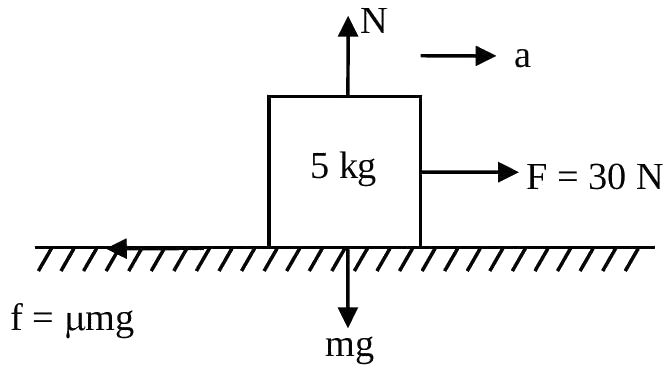
A block of mass 5 kg is placed at rest on a table of rough surface. Now, if a force of 30 N is applied in the direction parallel to surface of the table, the block slides through a distance of 50 m in an interval of time 10 s . Coefficient of kinetic friction is (given, g=10 ms−2 ):
A.
0.60
B.
0.25
C.
0.75
D.
0.50
Correct answer: D

Source solution

Sol. (D) S=ut+12at2 50=0⋅t+12⋅a⋅(10)2 50=12⋅a⋅100 a=100100⇒a=1m/s2 ∑Fx=max 30−μmg=ma 30−μ⋅50=5 50μ=25 μ=2550=12⇒μ=0.5Question figure
Question 51 / Numerical
Question 51
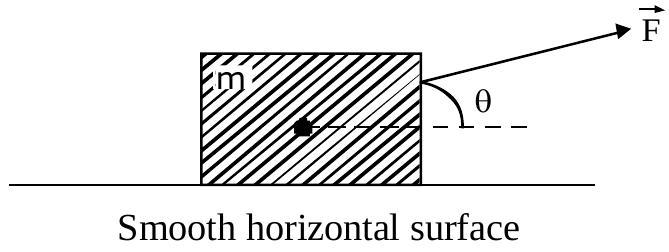
An object of mass ' m ' initially at rest on a smooth horizontal plane starts moving under the action of force F= 2 N . In the process of its linear motion, the angle θ (as shown in figure) between the direction of force and horizontal varies as θ=kx, where k is constant and x is the distance covered by the object from the initial positon. The expression of kinetic energy of the object will be E=nksin⁡θ, The value of n is . Question figure
Numerical answer: ____________________
Enter the requested value (an integer; 0 decimal places). Use the units and scaling stated in the question.
Correct answer: 2

Source solution
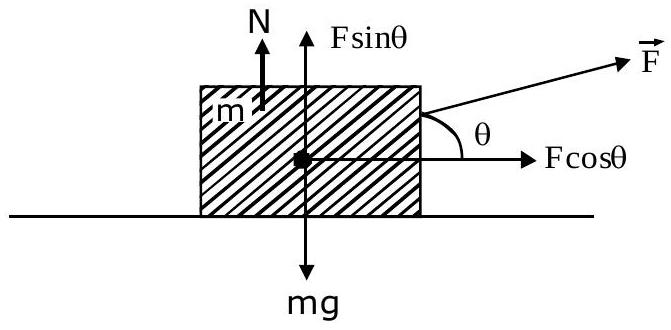
Question figure Fx=2cos⁡kx Fy=2sin⁡kx−mg According to Work Energy Theorem, ΔK=ΔW Taking motion only along horizontal direction( X ) i.e., linear motion as mentioned in question, ΔK=∫0xFxdx Kf−Ki=∫0x2cos⁡kxdx=2sin⁡kxk Hence Ki=0,∴Kf=2sin⁡kxk ∴n=2
Question 52 / MCQ
Question 52
The bob of a pendulum was released from a horizontal position. The length of the pendulum is 10 m . If it dissipates 10% of its initial energy against air resistance, the speed with which the bob arrives at the lowest point is : [Use, g:10 ms−2 ]
A.
65 ms−1
B.
56 ms−1
C.
55 ms−1
D.
25 ms−1
Correct answer: A

Source solution

Sol. Length of the pendulum, ℓ=10m Initial potential energy (taking the lowest point as reference) is Ei=mgℓ Given that 10% of the energy is lost, the remaining energy is Ef=910mgℓ At the lowest point, this energy becomes kinetic energy: 910mgℓ=12mv2 Substituting ℓ=10m,g=10m/s2, 910×m×10×10=12mv2 90m=12mv2 v2=180 v=180 v=65m/s
Question 53 / MCQ
Question 53
A particle is placed at the point A of a frictionless track ABC as shown in figure. It is gently pushed toward right. The speed of the particle when it reaches the point B is : ( Take g=10 m/s2).Question figure
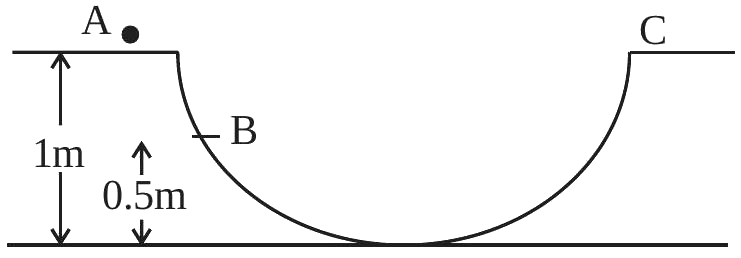
A.
20 m/s
B.
10 m/s
C.
210 m/s
D.
10 m/s
Correct answer: B

Source solution

Sol. By conservation of energy, KEA+UA=KEB+UB 0+mg(1)=12mv2+mg⋅0.5 v=g=10m/s2
Question 54 / Numerical
Question 54
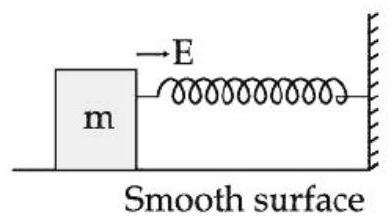
A block of mass ' m ' (as shown in figure) moving with kinetic energy E compresses a spring through a distance 25 cm when, its speed is halved. The value of spring constant of used spring will be nENm−1 for n= . Question figure
Numerical answer: ____________________
Enter the requested value (an integer; 0 decimal places). Use the units and scaling stated in the question.
Correct answer: 24

Source solution

Using work - energy theorem Wnet =(Kf−Ki) ⇒−12Kx2=12m(v2)2−12mv2=E4−E ⇒12Kx2=3E4⇒ K=3E2x2 ⇒K=3E2×(14)2=24E n=24
Question 55 / Numerical
Question 55
A uniform chain of length 3 meter and mass 3 kg overhangs a smooth table with 2 meter laying on the table. If k is the kinetic energy of the chain in joule as it completely slips off the table, then the value of k is (Take g=10 m/s2 )
Numerical answer: ____________________
Enter the requested value (an integer; 0 decimal places). Use the units and scaling stated in the question.
Correct answer: 40

Source solution
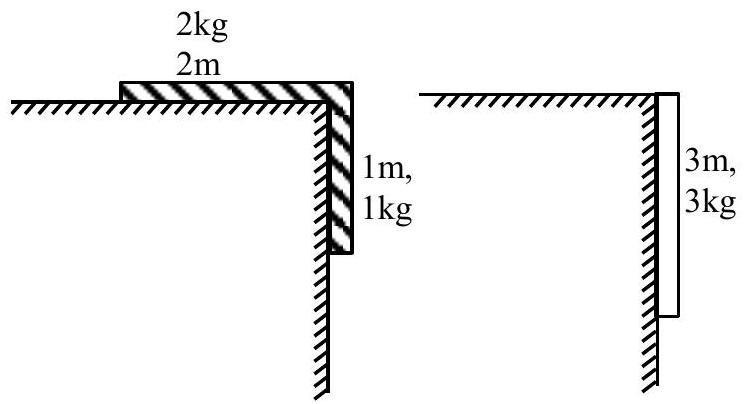
Question figure From energy conservation Ki+Ui=kf+Uf 0+(−1×10×12)=kf+(−3×10×32) −5=kf−45 kf=40 J Ans. 40.00
Question 56 / Numerical
Question 56
A body of mass 2 kg is driven by an engine delivering a constant power of 1 J/s. The body starts from rest and moves in a straight line. After 9 seconds, the body has moved a distance (in m ) .
Numerical answer: ____________________
Enter the requested value (an integer; 0 decimal places). Use the units and scaling stated in the question.
Correct answer: 18

Source solution

18 P = Fv = mav a=pmv dvdt=pmv ∫0uvdv=pm∫0tdt u22=pmt u=2pmt dxdt=φ¯mt ∫0xdx=2pm∫09tdt x=23[(9)1/2]3 =23×27 x=18 II-method Pt=w=12mv2−0 1×t=12×2×u2 u=t dxdt=t=∫01dx=∫09tdt x=[t3/2]0932=18 m
Question 57 / MCQ
Question 57
A block of mass 40 kg slides over a surface, when a mass of 4 kg is suspended through an inextensible massless string passing over frictionless pulley as shown below. The coefficient of kinetic friction between the surface and block is 0.02 . The acceleration of block is. (Given g=10 ms−2.)Question figure
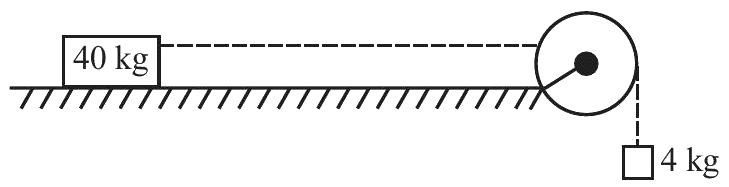
A.
1 ms−2
B.
1/5 ms−2
C.
4/5 ms−2
D.
8/11 ms−2
Correct answer: D

Source solution

For 4kg block: 4g−T=4a For 40kg block: T−40g⋅0.02=40a Adding both equations: 40−8=44a a=3244=811m/s2
Question 58 / Numerical
Question 58
A block of mass 5 kg starting from rest pulled up on a smooth incline plane making an angle of 30∘ with horizontal with an affective acceleration of 1 ms−2. The power delivered by the pulling force at t=10 s from the start is W. [Use g=10 ms−2 ] (calculate the nearest integer value)
Numerical answer: ____________________
Enter the requested value or coefficient rounded to the nearest integer (0 decimal places).
Correct answer: 300

Source solution

F−5 gsin⁡30∘=5a⇒F=5+25=30 N V10=u+at⇒v10=0+1(10)=10 m/s P10=Fv=300 W
Question 59 / MCQ
Question 59
The pressure and volume of an ideal gas are related as PV3/2=K (Constant). The work done when the gas is taken from state A(P1, V1, T1) to state B(P2, V2, T2) is :
A.
2(P1 V1−P2 V2)
B.
2(P2 V2−P1 V1)
C.
2(P1 V1−P2 V2)
D.
2(P2V2−P1V1)
Correct answer: A

Source solution

For PVx= constant If work done by gas is asked then W=nRΔ T1−x Here x=32 ∴W=P2 V2−P1 V1−12 =2(P1 V1−P2 V2)…. Option (1) is correct If work done by external is asked then W=−2(P1 V1−P2 V2)…. Option (2) is correct
Question 60 / Numerical
Question 60
A bi convex lens of focal length 10 cm is cut in two identical parts along a plane perpendicular to the principal axis. The power of each lens after cut is D.
Numerical answer: ____________________
Enter the requested value (an integer; 0 decimal places). Use the units and scaling stated in the question.
Correct answer: 5

Source solution
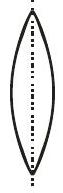
Question figure Let power of each part is P1, then P1+P1=P=1f 2P1=10.1=10 P1=5D
Choose another chapter