
Learne2i
Learne2i Guess Paper solutions
JEE Main 2026 / Session 1
All chapters

Physics

Mechanical Properties of Solids

Question 81 / MCQ
Question 81
A 3 m long wire of radius 3 mm shows an extension of 0.1 mm when loaded vertically by a mass of 50 kg in an experiment to determine Young's modulus. The value of Young's modulus of the wire as per this experiment is P×1011Nm−2, where the value of P is : ( Take g=3π m/s2)
A.
5
B.
10
C.
25
D.
2.5
Correct answer: A

Source solution

Sol. 50gπr2=y⋅Δℓℓ 50⋅3ππ⋅(3×10−3)2=P⋅1011⋅0.1×10−33 ⇒P=50⋅3⋅332⋅10−6⋅1011⋅0.1×10−3 P=5
Question 82 / Numerical
Question 82
A uniform heavy rod of mass 20 kg . Cross sectional area 0.4 m2 and length 20 m is hanging from a fixed support. Neglecting the lateral contraction, the elongation in the rod due to its own weight is x×10−9 m. The value of x is . :(Given. Young's modulus Y=2×10¹¹Nm−2 and g=10 ms−2 )
Numerical answer: ____________________
Enter the requested value (an integer; 0 decimal places). Use the units and scaling stated in the question.
Correct answer: 25

Source solution
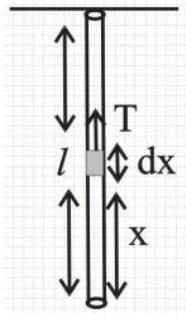
Question figure Y=TAdxdy m=20 kg A=0.4m2 1=20 m let extension is dy in length dx Y= stress  strain  Y=TAdydx=TA⋅dxdy dy=TdxAY Tension at a distance x from lower end =mgℓx So. ∫0Δldy=∫0ℓmgℓxdxAY Δℓ=mgℓAY[x22]0ℓ Δℓ=mgℓ2AY Δℓ=20×10×202×0.4×2×1011 2500×10−11 Δℓ=25×10−9 =x×10−9 x=25
Question 83 / MCQ
Question 83
An object of mass m is suspended at the end of a massless wire of length L and area of crosssection A. Young modulus of the material of the wire is Y. If the mass is pulled down slightly its frequency of oscillation along the vertical direction is:
A.
f=12πYAmL
B.
f=12π mLYA
C.
f=12πYLmA
D.
f=12πmAYL
Correct answer: A

Source solution

Young's modulus is Y=F/AΔL/L. Therefore, Y=FLAΔL, or F=YAΔLL. Hence, the effective spring constant of the wire is k=FΔL=YAL. The frequency of oscillation of a mass m attached to the wire is f=12πkm. Substituting k=YAL, we get f=12πYALm.
Question 84 / Numerical
Question 84
In a Young's double slit experiment, the intensity at a point is (14)th  of the maximum intensity, the minimum distance of the point from the central maximum is μm. (Given : λ=600 nm, d=1.0 mm,D=1.0 m )
Numerical answer: ____________________
Enter the requested value (an integer; 0 decimal places). Use the units and scaling stated in the question.
Correct answer: 200

Source solution

I=I0cos2⁡(Δϕ2) I04=cos2⁡(Δϕ2) Δϕ=2π3 2πλ(ydD)=2π3 y=λD3 d=600×10−9×13×10−3=2×10⁻⁴ m
Question 85 / Numerical
Question 85
In a Young's double slit experiment, the slits are separated by 0.3 mm and the screen is 1.5 m away from the plane of slits. Distance between fourth bright fringes on both sides of central bright is 2.4 cm . The frequency of light used is ×1014 Hz.
Numerical answer: ____________________
Enter the requested value (an integer; 0 decimal places). Use the units and scaling stated in the question.
Correct answer: 5

Source solution

8β=2.4 cm 8λΔ d=2.4 cm 8×1.5×c0.3×10−3×f=2.4×10⁻² f=5×10¹⁴ Hz
Question 86 / MCQ
Question 86
Match List-I with List-II. List-IList-II(a) Young's Modulus (Y)(i) [ML−1T−2](b) Co-efficient of Viscosity (\eta)(ii) [ML−1T−1](c) Planck's Constant (h)(iii) [ML2T−1](d) Work Function (\varphi)(iv) [ML2T−2] Choose the correct answer from the options given below:
A.
A-I, B-II, C-III, D-IV
B.
A-II, B-III, C-IV, D-I
C.
A-I, B-III, C-IV, D-II
D.
A-III, B-I, C-II, D-IV
Correct answer: D

Source solution

Young's modulus is Y=stressstrain. Since strain is dimensionless, [Y]=[stress]=[F][A]=MLT−2L2=ML−1T−2. From Stokes' law, F=6πηrv. Therefore, [η]=[F][r][v]=MLT−2L⋅LT−1=ML−1T−1. Planck's constant, h=Ef, so [h]=ML2T−2T−1=ML2T−1. Work function ϕ is an energy: [ϕ]=ML2T−2. Hence, [Y]=ML−1T−2,[η]=ML−1T−1,[h]=ML2T−1,[ϕ]=ML2T−2.
Choose another chapter