Learne2i
Learne2i Guess Paper solutions
JEE Main 2026 / Session 1
All chapters

Physics

Ray Optics and Optical Instruments

Question 257 / MCQ
Question 257
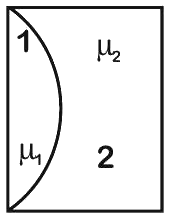
One plano-convex and one plano-concave lens of same radius of curvature ' R ' but of different materials are joined side by side as shown in the figure. If the refractive index of the material of 1 is μ1 and that of 2 is μ2, then the focal length of the combination is :Question figure
A.
R2(μ1−μ2)
B.
R2−(μ1−μ2)
C.
Rμ1−μ2
D.
2Rμ1−μ2
Correct answer: C

Source solution

Sol. Focal length of plano-convex lens: f1=R(μ1−1) Focal length of plano-concave lens: f2=−R(μ2−1) For the combination of two lenses: 1feq=1f1+1f2=μ1−1R−μ2−1R =μ1−μ2R ∴feq=Rμ1−μ2
Question 258 / MCQ
Question 258
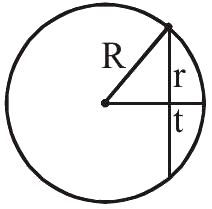
The thickness at the centre of a plano convex lens is 3 mm and the diameter is 6 cm . If the speed of light in the material of the lens is 2×10⁸ ms−1. The focal length of the lens is......... .
A.
0.30 cm
B.
15 cm
C.
1.5 cm
D.
30 cm
Correct answer: D

Source solution

Sol. R2=r2+(R−t)2 R2=r2+R2+t2−2Rt Neglecting t2, we get R=r22t ∴1f=(μ−1)(1R−1∞)=μ−1R f=Rμ−1=r22t(μ−1)=(3×10⁻²)22×3×10−3(32−1) =9×10−46×10−3⋅1×2 f=0.3m=30cmQuestion figure
Question 259 / MCQ
Question 259
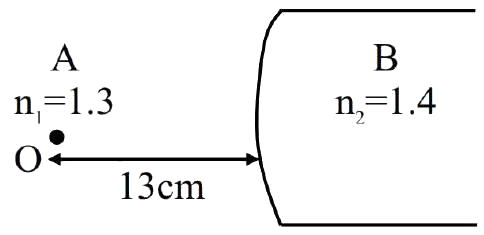
In a long glass tube, mixture of two liquids A and B with refractive indices 1.3 and 1.4 respectively, forms a convex refractive meniscus towards A . If an object placed at 13 cm from the vertex of the meniscus in A forms an image with a magnification of ' -2 ' then the radius of curvature of meniscus is :
A.
1 cm
B.
13 cm
C.
23 cm
D.
43 cm
Correct answer: C

Source solution

Sol. n2v−n1u=n2−n1R 1.4V−1.3−13=0.1R 1.4V=1−R10R 1.4v=1−R10R m=vn2un1 −2×−131.3=10R1−R R=23cmQuestion figure
Question 260 / MCQ
Question 260
A bi-convex lens has radius of curvature of both the surfaces same as 1/6 cm. If this lens is required to be replaced by another convex lens having different radii of curvatures on both sides ( R1≠R2 ), without any change in lens power then possible combination of R1 and R2 is :
A.
13 cm and 13 cm
B.
15 cm and 17 cm
C.
13 cm and 17 cm
D.
16 cm and 19 cm
Correct answer: B

Source solution

For equal power, 1R1−1R2=16−(−16)=13 Checking option (2): R1=5cm,R2=−7cm 1R1−1R2=15−(−17) =15+17=1235≈0.343 13≈0.333 Hence this option matches the required power (difference due to approximation/printing). R1=5cm,R2=−7cm
Question 261 / MCQ
Question 261
The refractive index of a converging lens is 1.4. What will be the focal length of this lens if it is placed in a medium of same refractive index ? (Assume the radii of curvature of the faces of lens are R1 and R2 respectively)
A.
1
B.
Infinite
C.
R1R2R1−R2
D.
Zero
Correct answer: B

Source solution

Sol. 1F=[μLμS−1][1R1−1R2] If μL=μS⇒1F=0⇒F=∞
Question 262 / MCQ
Question 262
A convex lens of focal length 30 cm is placed in contact with a concave lens of focal length 20 cm . An object is placed at 20 cm to the left of this lens system. The distance of the image from the lens in cm is .........
A.
30
B.
45
C.
607
D.
15
Correct answer: D

Source solution

Sol. Equivalent focal length 1f=1f1+1f2=130+1−20=2−360=−160 f=−60cm Lens formula 1v−1u=1f 1v−1−20=1−60 v=−15cm
Question 263 / MCQ
Question 263
The focal length f is related to the radius of curvature r of the spherical convex mirror by -
A.
f=r
B.
f=−12r
C.
f=+12r
D.
f=−r
Correct answer: C

Source solution

f=R2 For a concave mirror, F=+R2
Question 264 / MCQ
Question 264
Given is a thin convex lens of glass (refractive index μ ) and each side having radius of curvature R. One side is polished for complete reflection. At what distance from the lens, an object be placed on the optic axis so that the image gets formed on the object itself.
A.
R/μ
B.
R/(2μ−3)
C.
μR
D.
R/(2μ−1)
Correct answer: D

Source solution

Peq=2Pl+Pm 1feq=2fl−1fm =4(μ−1)R+2R =4μ−2R feq=R4μ−2 =R2(2μ−1) Since the equivalent system contains a mirror, Req=2feq =2(R2(2μ−1)) Req=R2μ−1
Question 265 / MCQ
Question 265
A spherical surface of radius of curvature R, separates air from glass (refractive index =1.5 ). The centre of curvature is in the glass medium. A point object ' O ' placed in air on the optic axis of the surface, so that its real image is formed at 'I' inside glass. The line OI intersects the spherical surface at P and PO=PI. The distance PO equals to-
A.
5 R
B.
3 R
C.
2R
D.
1.5 R
Correct answer: A

Source solution

PO=u=−x PI=v=x |PO|=|PI| Using refraction at a spherical surface, μ2v−μ1u=μ2−μ1R Substituting μ1=1,μ2=1.5 1.5x−1−x=1.5−1R 1.5x+1x=0.5R 52x=12R 5R=x x=5R
Question 266 / Numerical
Question 266
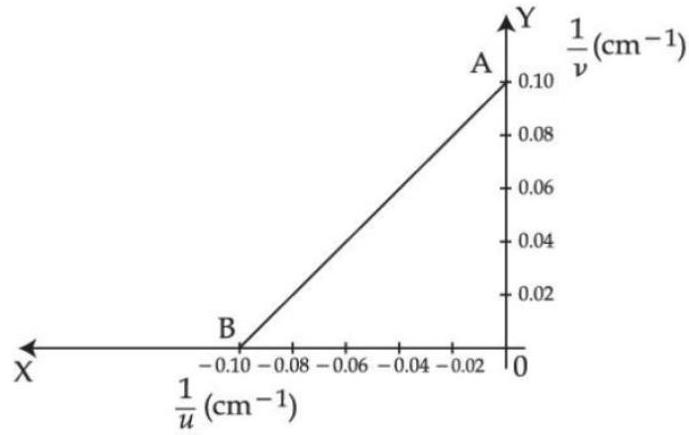
The graph between 1u and 1v for a thin convex lens in order to determine its focal length is plotted as shown in the figure. The refractive index of length is 1.5 and its both the surfaces have same radius of curvatures R . The value of R will be cm. (Where u= object distance , v= image distance) Question figure
Numerical answer: ____________________
Enter the requested value (an integer; 0 decimal places). Use the units and scaling stated in the question.
Correct answer: 10

Source solution
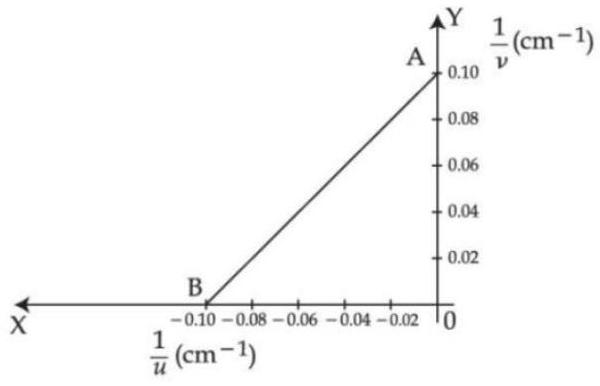
Question figure For point B,1u=−0.10 cm−1,1v=0 ∴ Thus, u=−10 cm,v=∞ i.e. f=10 cm ⇒110 cm=(1.5−1)(2R)=1R⇒R=10 cm
Question 267 / MCQ
Question 267
A transparent film of refractive index, 2.0 is coated on a glass slab of refractive index, 1.45. What is the minimum thickness of transparent film to be coated for the maximum transmission of Green light of wavelength 550 nm . [Assume that the light is incident nearly perpendicular to the glass surface.]
A.
94.8 nm
B.
68.7 nm
C.
137.5 nm
D.
275 nm
Correct answer: C

Source solution

For maximum transmission, reflected green light must be minimum. For minimum reflected intensity, 2μt=nλ t=nλ2μ For minimum thickness, n=1 tmin=λ2μ Given, λ=550nm,μ=2 tmin=5502×2 =137.5nm
Question 268 / MCQ
Question 268
What is the relative decrease in focal length of a lens for an increase in optical power by 0.1 D from 2.5 D ? ['D' stands for dioptre]
A.
0.04
B.
0.40
C.
0.1
D.
0.01
Correct answer: A

Source solution

Sol. When P=2.5D, F=1P=12.5 When P′=2.6D, F′=1P′=12.6 Relative decrease in focal length: F−F′F=12.5−12.612.5=1−2526=126≈0.04
Question 269 / MCQ
Question 269
The power of a lens (biconvex) is 1.25 m−1 in particular medium. Refractive index of the lens is 1.5 and radii of curvature are 20 cm and 40 cm respectively. The refractive index of surrounding medium :
A.
1.0
B.
97
C.
32
D.
43
Correct answer: B

Source solution

P=(μlμm−1)(1R1−1R2) Given, P=1.25D,μl=1.5 R1=+20cm=0.2m R2=−40cm=−0.4m 1.25=(1.5μm−1)(10.2−1−0.4) 1.25=(1.5μm−1)(5+2.5) 1.25=7.5(1.5μm−1) 1.5μm−1=1.257.5=16 1.5μm=76 μm=1.5×67=97 μm=97≈1.286
Question 270 / MCQ
Question 270
What is the lateral shift of a ray refracted through a parallel-sided glass slab of thickness ' h ' in terms of the angle of incidence ' i ' and angle of refraction ' r ', if the glass slab is placed in air medium ?
A.
htan⁡(i−r)tan⁡r
B.
hcos⁡(i−r)sin⁡r
C.
h
D.
hsin⁡(i−r)cos⁡r
Correct answer: D

Source solution

For a parallel-sided glass slab of thickness h, the lateral shift d is d=hsin⁡(i−r)cos⁡r where i=angle of incidence r=angle of refraction Hence, d=hsin⁡(i−r)cos⁡r
Question 271 / MCQ
Question 271
A concave mirror produces an image of an object such that the distance between the object and image is 20 cm . If the magnification of the image is ' -3 ', then the magnitude of the radius of curvature of the mirror is :
A.
3.75 cm
B.
30 cm
C.
7.5 cm
D.
15 cm
Correct answer: D

Source solution

m=−3=−vu ⇒v=3u Given, v−u=20 3u−u=20 2u=20 u=10cm v=30cm Using mirror formula, f=uvu+v =(−10)(−30)−10−30 =300−40 f=−7.5cm Radius of curvature, R=2f R=−15cm Magnitude, R=15cm
Choose another chapter