
Learne2i
Learne2i Guess Paper solutions
JEE Main 2026 / Session 1
All chapters

Physics

Wave Optics

Question 272 / MCQ
Question 272
Given below are two statements : one is labelled as Assertion (A) and the other is labelled as Reason (R).Assertion (A) : If Young's double slit experiment is performed in an optically denser medium than air, then the consecutive fringes come closer.Reason (R) : The speed of light reduces in an optically denser medium than air while its frequency does not change.In the light of the above statements, choose the most appropriate answer from the options given below:
A.
Both (A) and (R) are true and (R) is the correct explanation of (A)
B.
(A) is false but (R) is true.
C.
Both (A) and (R) are true but (R) is not the correct explanation of (A)
D.
(A) is true but (R) is false.
Correct answer: A

Source solution

Assertion (A): If Young's double-slit experiment is performed in an optically denser medium than air, the consecutive fringes come closer. In YDSE, β=λDd. In a medium of refractive index μ, λm=λμ. Therefore, βm=λmDd=λDμd=βμ. Since μ>1, βm<β. Hence, the fringe width decreases and the consecutive fringes come closer. Assertion (A) is true. Reason (R): In an optically denser medium, v=cμ, so the speed of light decreases, while the frequency remains unchanged. Since λ=vf, a decrease in v with constant f causes the wavelength to decrease. As fringe width is proportional to wavelength, β∝λ, the fringes come closer together. Reason (R) is true and correctly explains Assertion (A).
Question 273 / MCQ
Question 273
In a double slit experiment, when a thin film of thickness t having refractive index μ is introduced in front of one of the slits, the maximum at the centre of the fringe pattern shifts by one fringe width. The value of t is ( λ is the wavelength of the light used) :
A.
2λ(μ−1)
B.
λ2(μ−1)
C.
λ(2μ−1)
D.
λ(μ−1)
Correct answer: D

Source solution

μt−t=λ t(μ−1)=λ t=λμ−1
Question 274 / MCQ
Question 274
In a Young's double slit experiment, 16 fringes are observed in a certain segment of the screen when light of wavelength 700 nm is used. If the wavelength of light is changed to 400 nm , the number of fringes observed in the same segment of the screen would be:
A.
28
B.
24
C.
30
D.
18
Correct answer: A

Source solution

y=Dλd For the fringes of two wavelengths to coincide at the same position, n1(Dλ1d)=n2(Dλ2d) n1λ1=n2λ2 n1n2=λ2λ1 n2=n1λ1λ2 =16⋅700400=28 n2=28
Question 275 / MCQ
Question 275
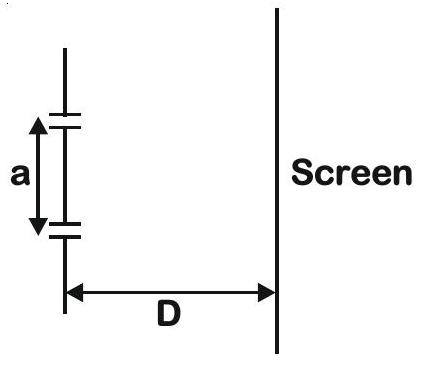
The figure shows a Young's double slit experimental setup. It is observed that when a thin transparent sheet of thickness t and refractive index μ is put in front of one of the slits, the central maximum gets shifted by a distance equal to n fringe widths. If the wavelength of light used is λ, t will be Question figure
A.
nλμ−1
B.
2Dλa(μ−1)
C.
nDλa(μ−1)
D.
Dλa(μ−1)
The original exam question had no correct option and was marked BONUS. For this corrected practice version, option 1 has been replaced with the correct value; the original statement and the other three options are retained.
Correct answer: A

Source solution

The inserted sheet adds optical path (μ−1)t. A shift of n fringe widths corresponds to path difference nλ. Thus t=nλ/(μ−1), independent of D and slit separation a.
Question 276 / MCQ
Question 276
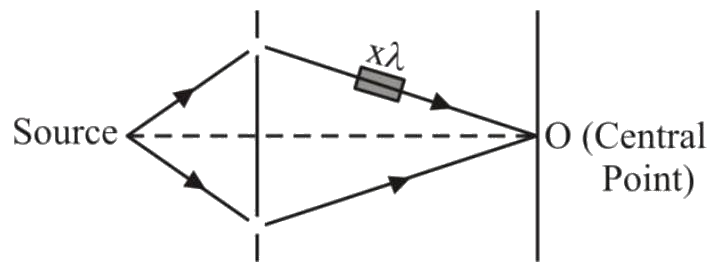
In young's double slit experiment performed using a monochromatic light of wavelength λ, when a glass plate (μ=1.5) of thickness xλ is introduced in the path of the one of the interfering beams, the intensity at the position where the central maximum occurred previously remains unchanged. The value of x will be:
A.
3
B.
2
C.
1.5
D.
0.5
Correct answer: B

Source solution

Sol. Path difference at O=(μ−1)t. If the intensity at O remains (maximum) unchanged, path difference must be nλ. (μ−1)t=nλ (1.5−1)⋅xλ=nλ ⇒x=2n For n=1, x=2Question figure
Question 277 / MCQ
Question 277
In the Young's double slit experiment, the distance between the slits varies in time as d(t)=d0+a0sin⁡ωt; where d0,ω and a0 are constants. The difference between the largest fringe width and the smallest fringe width obtained over time is given as :
A.
2λD(d0)(d02−a02)
B.
2λDa0( d02−a02)
C.
λDd02a0
D.
λDd0+a0
Correct answer: B

Source solution

Fringe Width, β=λDd βmax⇒dmin and βmin⇒dmaxd=d0+a0sin⁡ωtdmax=d0+a0 and dmin=d0−a0∴βmin=λDd0+a0 and βmax=λDd0−a0∴βmax−βmin=λDd0−a0−λDd0+a0=2λDa0d02−a02
Question 278 / MCQ
Question 278
Given below are two statements. On is labelled as Assertion (A) and the other is labelled as Reason (R). Assertion (A) : In Young's double slit experiment, the fringes produced by red light are closer as compared to those produced by blue light.Reason (R) : The fringe width is directly proportional to the wavelength of light.In the light of above statements, choose the correct answer from the options given below :
A.
Both (A) and (R) are true and (R) is the correct explanation of (A)
B.
(A) is false but (R) is true.
C.
Both (A) and (R) are true but (R) is NOT the correct explanation of (A).
D.
(A) is true but (R) is false.
Correct answer: B

Source solution

Assertion (A): In Young's double-slit experiment, the fringes produced by red light are closer as compared to those produced by blue light. The fringe width is given by β=λDd. Since λred>λblue, we have βred>βblue. Therefore, the fringes produced by red light are farther apart, not closer. Assertion (A) is false. Reason (R): The fringe width is β=λDd. Hence, β∝λ. Therefore, the fringe width is directly proportional to the wavelength of light. Reason (R) is true. Assertion (A) is false, but Reason (R) is true.
Question 279 / MCQ
Question 279
In a Young's double slit experiment with slit separation 0.1 mm , one observes a bright fringe at angle 140 rad by using light of wavelength λ1. When the light of wavelength λ2 is used a bright fringe is seen at the same angle in the same set up. Given that λ1 and λ2 are in visible range ( 380 nm to 740 nm ), their values are :
A.
380 nm,500 nm
B.
625 nm,500 nm
C.
380 nm,525 nm
D.
400 nm,500 nm
Correct answer: B

Source solution

Path difference dsin⁡θ≈dθ=0.1×140mm=0.0025mm=2500nm For a bright fringe, the path difference must be an integral multiple of the wavelength. Therefore, 2500=nλ1=mλ2 Thus, λ1=2500n=25004=625nm and λ2=2500m=25005=500nm λ1=625nm,λ2=500nm (for n=4 and m=5).
Question 280 / MCQ
Question 280
In Young's double slit experiment, light from two identical sources are superimposing on a screen. The path difference between the two lights reaching at a point on the screen is 7λ4. The ratio of intensity of fringe at this point with respect to the maximum intensity of the fringe is :
A.
1/2
B.
3/4
C.
1/3
D.
1/4
Correct answer: A

Source solution

Δx=7λ4 ϕ=2πλΔx=2πλ⋅7λ4=7π2 I=Imaxcos2(ϕ2) IImax=cos2(ϕ2)=cos2(7π4) =cos2(2π−π4) =cos2(π4) =(12)2=12 IImax=12
Choose another chapter