
Learne2i
Learne2i Guess Paper solutions
JEE Main 2026 / Session 2
All chapters

Chemistry

Chemical Bonding and Molecular Structure

Question 17 / MCQ
Question 17
An element ' E ' has the ionisation enthalpy value of 374 kJ mol−1. 'E' reacts with elements A, B, C and D with electron gain enthalpy values of −328,−349, -325 and −295 kJ mol−1, respectively. The correct order of the products EA, EB, EC and ED in terms of ionic character is :
A.
EB>EA>EC>ED
B.
ED>EC>EA>EB
C.
EA>EB>EC>ED
D.
ED>EC>EB>EA
Correct answer: A

Source solution

Solution Ionisation enthalpy of E=374 kJmol−1 Electron gain enthalpies are A=−328,B=−349 C=−325,D=−295 kJmol−1 Greater the difference between I.E. of cation-forming atom and E.G.E. of anion-forming atom, greater is the ionic character. ΔA=374−328=46 ΔB=374−349=25 ΔC=374−325=49 ΔD=374−295=79 Smaller the value of (I.E.−|E.G.E.|), greater is the tendency for ionic bond formation. 25<46<49<79 ∴ EB>EA>EC>ED EB>EA>EC>ED Correct Option : (1)
Question 18 / MCQ
Question 18
The bond order and magnetic behaviour of O2−ion are, respectively :
A.
1.5 and paramagnetic
B.
1.5 and diamagnetic
C.
2 and diamagnetic
D.
1 and paramagnetic
Correct answer: A

Source solution

Sol. O2−=(σ1 s)2(σ1 s∗)2(σ2 s)2(σ2 s∗)2(σ2pz)2 (π2px2=π2py2)(π2px∗2=π2py∗1) Bond order =10−72=1.5 and paramagnetic
Question 19 / MCQ
Question 19
Match List-I with List-II List-I (Molecule/Ion)List-II (Hybridisation)A. PF5I. dsp2B. SF6II. sp3dC. Ni(CO)4III. sp3d2D. [PtCl4]2−IV. sp3 Choose the correct answer from the options given below.
A.
A-II, B-III, C-IV, D-I
B.
A-IV, B-I, C-II, D-III
C.
A-I, B-II, C-III, D-IV
D.
A-III, B-I, C-IV, D-II
Correct answer: A

Source solution

Solution: PF5 5 bond pairs +0 lone pair ⇒sp3d A→II SF6 6 bond pairs +0 lone pair ⇒sp3d2 B→III Ni(CO)4 Tetrahedral complex ⇒sp3 C→IV [PtCl4]2− Square planar complex ⇒dsp2 D→I A−II,B−III,C−IV,D−I Correct Option (1)
Question 20 / MCQ
Question 20
Match List-I with List-II List-IList-IIA. SO2Cl2I. ParamagneticB. NOII. DiamagneticC. NO2−III. TetrahedralD. I3−IV. Linear Choose the correct answer from the options given below :
A.
A-IV, B-I, C-III, D-II
B.
A-III, B-I, C-II, D-IV
C.
A-II, B-III, C-I, D-IV
D.
A-III, B-IV, C-II, D-I
Correct answer: B

Source solution

Solution SO2Cl2⇒Tetrahedral⇒(III) NO⇒One unpaired electron⇒Paramagnetic⇒(I) NO2−⇒All electrons paired⇒Diamagnetic⇒(II) I3−⇒Linear⇒(IV) ∴A−III,B−I,C−II,D−IV Correct Answer : (2)
Question 21 / MCQ
Question 21
Match List-I with List-II List-IList-IIA. Molecules obeying octet ruleI. NO, NO2B. Molecules with incomplete octetII. BCl3, AlCl3C. Molecules with odd electronIII. H2SO4, PCl5D. Molecules with expanded octetIV. CCl4, CO2 Choose the correct answer from the options given below :
A.
A-IV, B-II, C-I, D-III
B.
A-III, B-II, C-I, D-IV
C.
A-IV, B-I, C-III, D-II
D.
A-II, B-IV, C-III, D-I
Correct answer: A

Source solution

Solution A. Molecules obeying octet rule CCl4, CO2 ⇒(IV) B. Molecules with incomplete octet BCl3, AlCl3 ⇒(II) C. Molecules with odd electron NO, NO2 ⇒(I) D. Molecules with expanded octet H2SO4, PCl5 ⇒(III) ∴ A−IV,B−II,C−I,D−III Correct Answer : (1)
Question 22 / MCQ
Question 22
Match List-I with List-II
List-I (Species) List-II (Hybrid Orbitals)
(a)SF4(i)sp3 d2
(b)IF 5(ii)d2sp3
\multirow[t]{2}{*}{(c)}\multirow[t]{2}{*}{NO2+}(iii)sp3 d
(iv)sp3
(d)NO4+(v)sp
Choose the correct answer from the options given below :
A.
(a)-( i), (b)-( ii), (c)-(v) and (d)-(iii)
B.
(a)-(ii), (b)-(i), (c)-(iv) and (d)-(v)
C.
(a)-(iii), (b)-( i), (c)-( v) and (d)-(iv)
D.
(a)-(iv), (b)-(iii), (c)-(ii) and (d)-(v)
Correct answer: C

Source solution

(a) SF4−SP3 d hybridisation IF5−sp3 d2 hybridisation NO2+−sp hybridisation NO4+−sp3 hybridisation
Question 23 / MCQ
Question 23
Match List-I with List-II List-IList-II (B.P. : L.P.)A. ICl2−I. 4:2B. H2OII. 4:1C. SO2III. 2:3D. XeF4IV. 2:2 Choose the correct answer from the options given below :
A.
A-IV, B-III, C-II, D-I
B.
A-III, B-IV, C-II, D-I
C.
A-III, B-IV, C-I, D-II
D.
A-II, B-I, C-IV, D-III
Correct answer: B

Source solution

Solution ICl2− Central atom = I B.P. : L.P.=2:3 ⇒(III) H2O Central atom = O B.P. : L.P.=2:2 ⇒(IV) SO2 Central atom = S B.P. : L.P.=2:1 Steric number=3 ⇒(II) XeF4 Central atom = Xe B.P. : L.P.=4:2 ⇒(I) ∴ A−III,B−IV,C−II,D−I Correct Answer : (2)
Question 24 / Numerical
Question 24
Consider the following sequence of reactions. Question figure Total number of sp3 hybridised carbon atoms in the major product C formed is .
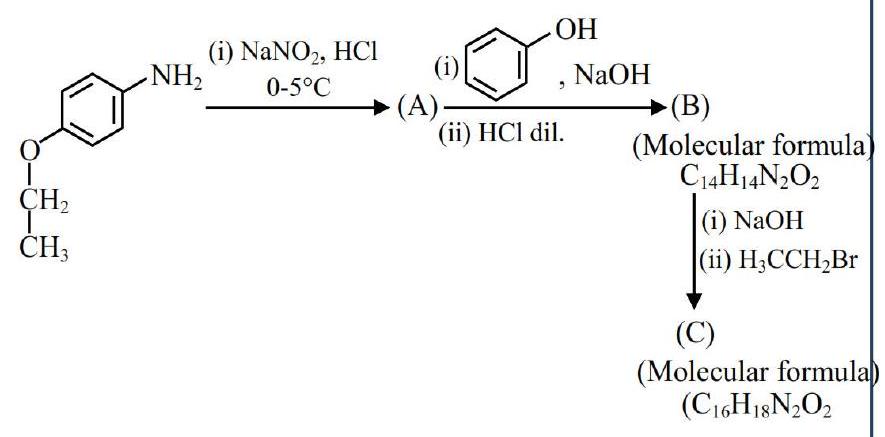
Numerical answer: ____________________
Enter the requested value (an integer; 0 decimal places). Use the units and scaling stated in the question.
Correct answer: 4

Source solution
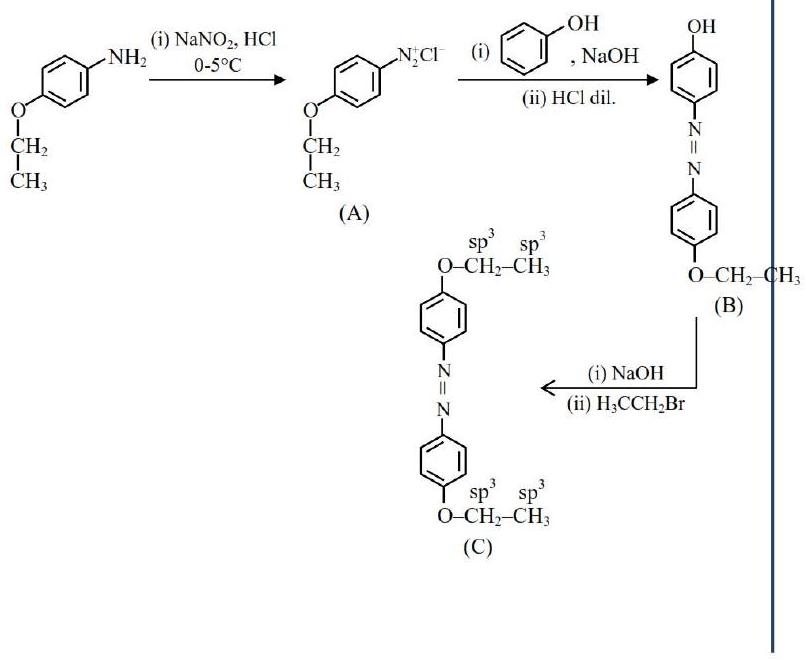
Question figure
Question 25 / MCQ
Question 25
Match List - I with List - II List - IList - II (A)ΨMO=ΨA−ΨB(I)Dipole moment(B)μ=Q×r(II)Bonding molecular orbital(C)Nb−Na2(III)Anti-bonding molecular orbital(D)ΨMO=ΨA+ΨB(IV)Bond order
A.
(A)-(II), (B-(I), (C)-(IV), (D)-(III)
B.
(A)-(III), (B)-(IV), (C)-(I), (D)-(II)
C.
(A)-(III), (B)-(I), (C)-(IV), (D)-(II)
D.
(A)-(III), (B)-(IV), (C)-(II), (D)-(I)
Correct answer: C

Source solution

Solution: In molecular orbital (MO) theory: ΨMO=ΨA+ΨB⇒Bonding molecular orbital ΨMO=ΨA−ΨB⇒Anti-bonding molecular orbital μ=Q×r⇒Dipole moment Bond order=Nb−Na2 where Nb is the number of electrons in bonding orbitals and Na is the number of electrons in anti-bonding orbitals. Therefore, the correct matching is: (A)→(III),(B)→(I),(C)→(IV),(D)→(II)
Choose another chapter