Learne2i
Learne2i Guess Paper solutions
JEE Main 2026 / Session 2
All chapters

Chemistry

Equilibrium

Question 36 / MCQ
Question 36
For the reaction, 2SO2(g)+O2(g)⇌2SO3(g), ΔH=−57.2 kJ mol−1 and Kc=1.7×10¹⁶. Which of the following statement is INCORRECT?
A.
The equilibrium constant is large suggestive of reaction going to completion and so no catalyst is required.
B.
The addition of inert gas at constant volume will not affect the equilibrium constant.
C.
The equilibrium will shift in forward direction as the pressure increases.
D.
The equilibrium constant decreases as the temperature increases.
Correct answer: A

Source solution

Sol. 2SO2(g)+O2(g)⇌2SO3(g) Kc=1.7×10¹⁶ i.e. reaction goes to completion. Equilibrium constant has no relation with catalyst. Catalyst only affects the rate with which a reaction proceeds. For the given reaction, catalyst V2O5 is used to speed up the reaction (Contact process).
Question 37 / MCQ
Question 37
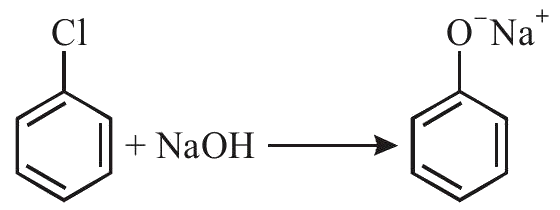
The above reaction requires which of the following reaction conditions?Question figure
A.
573 K,Cu,300 atm
B.
623 K,Cu,300 atm
C.
573 K,300 atm
D.
623 K,300 atm
Correct answer: D

Source solution

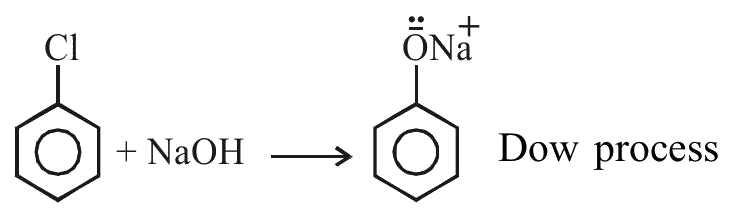
Sol. Temperature =623 K Pressure =300 atmQuestion figure
Question 38 / Numerical
Question 38
When 5.1 g of solid NH4HS is introduced into a two litre evacuated flask at 27∘C,20% of the solid decomposes into gaseous ammonia and hydrogen sulphide. The Kp for the reaction at 27∘C is x×10−2. The value of x is . (Integer answer) [Given R=0.082 L atm K−1 mol−1 ]
Numerical answer: ____________________
Enter the requested integer (0 decimal places).
Correct answer: 6

Source solution

moles of NH4HS initially taken =5.1 g51 g/mol =0.1 mol volume of vessel =2ℓ
NH4HS(s)⇌NH3( g)+H2 S(g)
t=00.1 mol
t=∞0.1(1−0.2)0.1×0.20.1×0.2
⇒ partial pressure of each component P=nRTV=0.1×0.2×0.082×3002 =0.246 atm ⇒kP=PNH3×PH2 S=(0.246)2=0.060516 =6.05×10⁻² ⇒6
Question 39 / Numerical
Question 39
Dissociation of a gas A2 takes place according to the following chemical reactions. At equilibrium, the total pressure is 1 bar at 300K. A2( g)⇌2 A( g) The standard Gibbs energy of formation of the involved substances has been provided below:
SubstanceΔGt∘/kJmol−1
A2-100.00
A-50.832
The degree of dissociation of A2( g) is given by (x×10−2)1/2 where x= ________ . (Nearest integer). [Given : R=8 J mol−1 K−1,log⁡2=0.3010, log⁡3=0.48 ]
Numerical answer: ____________________
Enter an integer. Use the units and scaling requested in the question.
Correct answer: 33

Source solution

−1.664×103=−8.3×300lnKp ln⁡Kp=0.693 Kp=2 2=4α2P01−α2 α=13 α=(1003×10−2)1/2=(33.33×10−2)1/2
Question 40 / MCQ
Question 40
Consider the general reaction given below at 400 K xA( g)⇌yB( g) The values of Kp and Kc are studied under the same condition of temperature but variation in x and y. (i) Kp=85.87 and Kc=2.586 appropriate units (ii) Kp=0.862 and Kc=28.62 appropriate units The value of x and y in (i) and (ii) respectively are:
A.
(i) 3, 1 ; (ii) 3, 1
B.
(i) 4, 1 ; (ii) 4, 1
C.
(i) 1, 3 ; (ii) 2, 1
D.
(i) 1, 2 ; (ii) 2, 1
Correct answer: D

Source solution

For reaction (i): Kp>Kc Δng>0y−x>0.85.87=2.586(0.0821×400)y−x Solving y−x≃1 For reaction (ii) : Kp<Kc y−x<0. SECTION-B
Question 41 / Numerical
Question 41
The OH−concentration in a mixture of 5.0 mL of 0.0504MNH4Cl and 2 mL of 0.0210MNH3 solution is x×10−6M. The value of x is . (Nearest integer) [Given Kw=1×10⁻¹⁴ and Kb=1.8×10⁻⁵ ]
Numerical answer: ____________________
Enter the requested integer (0 decimal places).
Correct answer: 3

Source solution

[NH4+]=0.0504&[NH3]=0.0210 So Kb=[NH4+][HO−][NH3] [HO−]=Kb×[NH3][NH4+]=1.8×10−5×25×210504 =3×10⁻⁶
Question 42 / Numerical
Question 42
The equilibrium composition for the reaction PCl3+Cl2⇌PCl5 at 298 K is given below. [PCl3]eq =0.2 mol L−1[Cl2]eq =0.1 mol L−1, [PCl5]eq=0.40 mol L−1 If 0.2 mol of Cl2 is added at the same temperature, the equilibrium concentrations of PCl5 is ×10−2 mol L−1. Given : Kc for the reaction at 298 K is 20
Numerical answer: ____________________
Enter the requested value (an integer; 0 decimal places). Use the units and scaling stated in the question.
Correct answer: 48

Source solution

PCl3+Cl2⇌PCl5
0.2 M & (0.1+0.2)M & 0.4 M Eqm⋅0.2−x & 0.3−x & 0.4+x
(0.4+x)(0.2−x)(0.3−x)=20
⇒x≃0.086
[PCl5]eq =0.486M=48.6×10⁻²M
Question 43 / Numerical
Question 43
37.8 g N2O5 was taken in a 1 L reaction vessel and allowed to undergo the following reaction at 500 K 2 N2O5( g)→2 N2O4( g)+O2( g) The total pressure at equilibrium was found to be 18.65 bar. Then, Kp= ×10−2 [nearest integer] Assume N2O5 to behave ideally under these conditions Given : R=0.082 bar Lmol−1 K−1
Numerical answer: ____________________
Enter the requested value (an integer; 0 decimal places). Use the units and scaling stated in the question.
Correct answer: 962

Source solution

Initial pressure of N2O5 =37.8108×0.082×5001=14.35 bar 2 N2O5⇌2 N2O4+O2t=014.35t= eq 14.35−2P2PPPTotal  at eqb =14.35+P=18.65P=4.3PN2O5=5.75 bar PN2O4=8.6 bar PO2=4.3 bar kp=(8.6)2×(4.3)(5.75)2=9.619=x×10−2x=961.9≈962 Ans. 962
Question 44 / Numerical
Question 44
For complete combustion of ethene. C2H4( g)+3O2( g)→2CO2( g)+2H2O(l) the amount of heat produced as measured in bomb calorimeter is 1406 kJ mol−1 at 300 K . The minimum value of TΔS needed to reach equilibrium is (−) kJ. (Nearest integer) Given : R=8.3JK−1 mol−1
Numerical answer: ____________________
Enter the requested value (an integer; 0 decimal places). Use the units and scaling stated in the question.
Correct answer: 1411

Source solution

C2H4( g)+3O2( g)⟶2CO2( g)+2H2O(ℓ) ΔU=−1406KJmol−1, T=300 K ΔH=ΔU+ΔngRT ΔH=−1406+(−2)×8.3×300=−1406−4.98 =−1410.98KJmol−1≈−1411 ΔH=TΔS=−1411KJmol−1
Question 45 / Numerical
Question 45
Assuming that Ba(OH)2 is completely ionised in aqueous solution under the given conditions the concentration of H3O+ions in 0.005 M aqueous solution of Ba(OH)2 at 298 K is ____ ×10−12 mol L−1. (Nearest integer)
Numerical answer: ____________________
Enter the requested integer (0 decimal places).
Correct answer: 1

Source solution

Ba(OH)2→Ba+2+2OH 2×0.005↓=0.01=10−2 At 298 K : in aq. solution [H3O+][OH−]=10−14 [H3O+]=10−1410−2=10−12
Question 46 / Numerical
Question 46
Consider the following reaction approaching equilibrium at 27∘C and 1 atm pressure A+B⇌kf=103kr=102C+D The standard Gibb's energy change ( ΔrGθ ) at 27∘C is (-) KJmol−1 (Nearest integer). (Given: R=8.3 J K−1 mol−1 and ln⁡10=2.3 )
Numerical answer: ____________________
Enter the requested value (an integer; 0 decimal places). Use the units and scaling stated in the question.
Correct answer: 6

Source solution

6 Keq =KfKb=103102=10 ΔG0=−RTln⁡Keq =−8.3×300ln⁡10 =−8.3×300×2.3 =−5.72×10+3 J =5.72KJ
Question 47 / MCQ
Question 47
Match List I with List II
LIST ILIST II
A.ChlorophyllI.Na2CO3
B.Soda ashII.CaSO4
C.Dentistry, Ornamental workIII.Mg2+
D.Used in white washingIV.Ca(OH)2
Choose the correct answer from the options given below:
A.
A-II, B-I, C-III, D-IV
B.
A-III, B-I, C-II, D-IV
C.
A-II, B-III, C-IV, D-I
D.
A-III, B-IV, C-I, D-II
Correct answer: B

Source solution

Chlrophyl →Mg2+ Sodaash →Na2CO3 Destistry & ornamental work →CaSO4 White washing →Ca(OH)2
Question 48 / Numerical
Question 48
Major product B of the following reaction has π-bond. Question figure
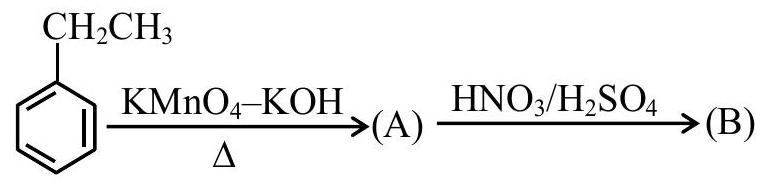
Numerical answer: ____________________
Enter the requested value (an integer; 0 decimal places). Use the units and scaling stated in the question.
Correct answer: 5

Source solution

Major product B is → Question figure Total number of π bonds in B are 5
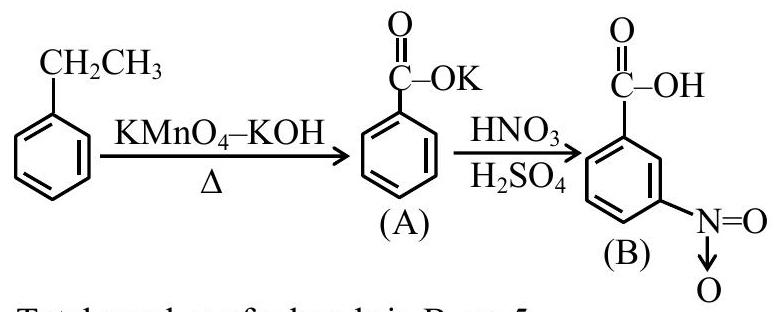
Question 49 / MCQ
Question 49
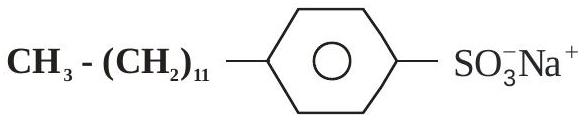
Match List-I with List-II List-I (A) Question figure Br− (B) Question figure (C) C17H35COO−Na++Na2CO3+ Rosinate (D) CH3(CH2)16COO(CH2CH2O)nCH2CH2OH List-II (I) Dishwashing powder (II) Toothpaste (III) Laundry soap (IV) Hair conditioner
A.
- (III), (B) - (II), (C) - (IV), (D) - (I)
B.
(A) - (IV), (B) - (II), (C) - (III), (D) - (I)
C.
(A) - (IV), (B) - (III), (C) - (II), (D) - (I)
D.
(A) - (III), (B) - (IV), (C) - (I), (D) - (II)
Correct answer: B

Source solution

(A) [CH3(CH2)15−N(CH3)3]+Br− is cationic detergents used in hair conditioner (B) Question figure Is anionic detergent used in tooth pastes (C) C17H35COO−Na++Na2CO3+ Rosinate is used as laundary soap (D) CH3(CH2)16COO(CH2CH2O)NCH2CH2OH is non-ionic detergents formed from stearic acid and poly ethylene glycol used as liquid dishwashing detergents
Question 50 / MCQ
Question 50
Match List - I with List II :
List - IList - II
(a)Li(i)photoelectric cell
(b)Na(ii)absorbent of CO2
(c)K(iii) coolant in fast breeder nuclear reactor
(d)Cs(iv)treatment of cancer
(v)bearings for motor engines
Choose the correct answer from the options given below: TEST PAPER WITH ANSWER
A.
(a) - (v), (b) - (i), (c) - (ii), (d) - (iv)
B.
(a) - (v), (b) - (ii), (c) - (iv), (d) - (i)
C.
(a) - (iv), (b) - (iii), (c) - (i), (d) - (ii)
D.
(a) - (v), (b) - (iii), (c) - (ii), (d) - (i)
Correct answer: D

The source provides a brief answer only. A detailed worked solution is not available for this question.

Source solution

Choose another chapter