Learne2i
Learne2i Guess Paper solutions
JEE Main 2026 / Session 2
All chapters

Chemistry

Coordination Compounds

Question 215 / MCQ
Question 215
Match the metals (Column I) with the coordination compound(s) / enzyme(s) (Column II) Column-I} Metals} (A) Co (B) Zn (C) Rh (D) Mg Column-II} Coordination} compound(s) / Enzyme(s)(i) Wilkinson catalyst (ii) Chlorophyll (iii) Vitamin B12 (iv) Carbonic anhydrase
A.
A-ii ; B-i ; C-iv ; D-iii
B.
A-iii ; B-iv ; C-i ; D-ii
C.
A-iv ; B-iii ; C-i ; D-ii
D.
A-i ; B-ii ; C-iii ; D-iv
Correct answer: B

Source solution

Column I (Metals) and Column II (Compounds/Enzymes) (A) Co→Vitamin B12 (iii) (B) Zn→Carbonic anhydrase (iv) (C) Rh→Wilkinson catalyst (i) (D) Mg→Chlorophyll (ii) \vspace{0.4cm} A→iii,B→iv,C→i,D→ii
Question 216 / MCQ
Question 216
The d-electron configuration of [Ru(en)3]Cl2 and [Fe(H2O)6]Cl2, respectively are:
A.
t2g4eg2 and t2g6eg0
B.
t2g6eg0 and t2g6eg0
C.
t2g4eg2 and t2g4eg2
D.
t2g6eg0 and t2g4eg2
Correct answer: D

Source solution

[Fe2+(en)3]2+→t2g6eg0(low spin) [Fe(H2O)6]2+→t2g4eg2(high spin) (4)t2g6eg0 and t2g4eg2
Question 217 / MCQ
Question 217
Identify the diamagnetic octahedral complex ions from below ; A. [Mn(CN)6]3− B. [Co(NH3)6]3+ C. [Fe(CN)6]4 D. [Co(H2O)3 F3] Choose the correct answer from the options given below:
A.
B and D Only
B.
A and D Only
C.
A and C Only
D.
B and C Only
Correct answer: D

Source solution

A. [Mn(CN)6]3− Oxidation state of Mn: x+6(−1)=−3 x=+3 Mn3+:3d4 CN− is a strong field ligand, so the complex is low spin: t2g4eg0 It contains 2 unpaired electrons. ∴Paramagnetic --- B. [Co(NH3)6]3+ Oxidation state of Co: Co3+:3d6 NH3 acts as a sufficiently strong field ligand with Co3+. t2g6eg0 No unpaired electrons. ∴Diamagnetic --- C. [Fe(CN)6]4− Oxidation state of Fe: x+6(−1)=−4 x=+2 Fe2+:3d6 CN− is a strong field ligand. t2g6eg0 No unpaired electrons. ∴Diamagnetic --- D. [Co(H2O)3F3] Both H2O and F− are weak field ligands. Assuming Co is in the +3 oxidation state, Co3+:3d6 High-spin configuration: t2g4eg2 contains 4 unpaired electrons. ∴Paramagnetic Diamagnetic complexes are B and C only.
Question 218 / MCQ
Question 218
Match list I with List II
\multirow{2}{*}{LIST I Coordination entity}\multirow{2}{*}{ LIST II Wavelength of light absorbed in nm }
A.[CoCl(NH3)5]2+I.310
B.[Co(NH3)6]3+II.475
C.[Co(CN)6]3−III.535
D.[Cu(H2O)4]2+IV.600
Choose the correct answer from the options given below:
A.
A-III, B-I, C-II, D-IV
B.
A-IV, B-I, C-III, D-II
C.
A-III, B-II, C-I, D-IV
D.
A-II, B-III, C-IV, D-I
Correct answer: C

Source solution

Δo↑λ↓  (splitting energy =hcλabs ) 
Question 219 / MCQ
Question 219
Given following complexes: I. Na4[Fe(CN)6] II. [Cr(H2O)6]Cl2 III. (NEt4)2[CoCl4] IV. Na3[Fe(C2O4)3](Δ0>P) The correct order of spin only magnetic moment for the above complexes
A.
(II) > (II) > (IV) > (I)
B.
(II) > (IV) > (III) > (I)
C.
(I) > (III) > (III) > (II)
D.
(II) > (I) > (IV) > (III)
Correct answer: A

Source solution

[Fe(CN)6]4− x+6(−1)=−4⇒x=+2 Fe2+:3d6 CN⁻ is strong field ligand → low spin octahedral t2g6eg0⇒n=0 μ=0(0+2)=0 \vspace{0.3cm} \section*{II. } [\mathrm{Cr(H_2O)_6}]Cl_2 [Cr(H2O)6]2+ x=+2⇒Cr2+:3d4 H₂O is weak field ligand → high spin octahedral t2g3eg1⇒n=4 μ=4(4+2)=24≈4.9B.M. \vspace{0.3cm} \section*{III. } (\mathrm{NEt_4})_2[\mathrm{CoCl_4}] [CoCl4]2− x+4(−1)=−2⇒x=+2 Co2+:3d7 Tetrahedral complex with weak field ligand → high spin n=3 μ=3(3+2)=15≈3.87B.M. \vspace{0.3cm} \section*{IV. } \mathrm{Na_3[Fe(C_2O_4)_3]} [Fe(C2O4)3]3− x+3(−2)=−3⇒x=+3 Fe3+:3d5 Given Δ0>P⇒ low spin octahedral t2g5eg0⇒n=1 μ=1(1+2)=3≈1.73B.M. \vspace{0.5cm} \section*{Comparison of magnetic moments} II(4.9)>III(3.87)>IV(1.73)>I(0) \vspace{0.3cm} Final Order: II > III > IV > I
Question 220 / MCQ
Question 220
List-I (Complex)List-II (Primary, Secondary Valency)A[Co(NH3)6]Cl3I3,6B[Pt(NH3)2Cl(NO2)]II3,4CHg[Co(SCN)4]III2,6D[Mg(EDTA)]2−IV2,4
A.
(A)-(III), (B)-(I), (C)-(II), (D)-(IV)
B.
(A)-(I), (B)-(IV), (C)-(II), (D)-(III)
C.
(A)-(I), (B)-(III), (C)-(II), (D)-(IV)
D.
(A)-(II), (B)-(III), (C)-(IV), (D)-(I)
Correct answer: B

Source solution

Primary valency=Oxidation state Secondary valency=Coordination number A. [Co(en)2Cl2]Cl Primary valency=3,Secondary valency=6 A→I --- B. [Pt(NH3)2Cl(NO2)] Primary valency=2,Secondary valency=4 B→IV --- C. Hg[Co(SCN)4] Primary valency=3,Secondary valency=4 C→II --- D. [Mg(EDTA)]2− Primary valency=2,Secondary valency=6 D→III --- A−I,B−IV,C−II,D−III
Question 221 / MCQ
Question 221
Given below are two statements : Statement I : [Mn(CN)6]3−,[Fe(CN)6]3− and [Co(C2O4)3]3− are d2sp3 hybridised. Statement II : [MnCl6]3− and [FeF6]3− are paramagnetic and have 4 and 5 unpaired electrons, respectively. In the light of the above statements, choose the correct answer from the options given below :
A.
Statement I is correct but statement II is false
B.
Both statement I and statement II are false
C.
Statement I is incorrect but statement II is true
D.
Both statement I and statement II are are true
Correct answer: D

Source solution

[Mn(CN)6]3−,[Fe(CN)6]3−,[Co(C2O4)3]3− Oxidation states: Mn3+:d4,Fe3+:d5,Co3+:d6 CN^- and C_2O_4^{2-} are strong field ligands⇒low spin octahedral complexes ⇒d2sp3 hybridisation for all three complexes ∴Statement I is TRUE Statement II: [MnCl6]3−⇒Mn3+:d4 Cl− is weak field ligand⇒high spin⇒4 unpaired electrons [FeF6]3−⇒Fe3+:d5 F− is weak field ligand⇒high spin⇒5 unpaired electrons ∴Statement II is TRUE Both Statement I and Statement II are correct
Question 222 / MCQ
Question 222
LIST-IComplexLIST-IIHybridisationAK2[Ni(CN)4]Isp3B[Ni(CO)4]IIsp3d2C[Co(NH3)6]Cl3IIIdsp2DNa3[CoF6]IVd2sp3 Choose the correct answer from the options given below:
A.
A-III, B-I, C-II, D-IV
B.
A-III, B-II, C-IV, D-I
C.
A-I, B-III, C-II, D-IV
D.
A-III, B-I, C-IV, D-II
Correct answer: D

Source solution

(A) K2[Ni(CN)4] Ni2+:[Ar]3d8 CN^- is a strong field ligand → pairing occurs 3d electrons pair up Hybridisation: dsp2 Geometry: Square planar \vspace{0.4cm} (B) [Ni(CO)4] Ni:[Ar]3d84s2 CO is a strong field ligand → pairing occurs Pre-hybridisation: 3d10 Hybridisation: sp3 Geometry: Tetrahedral \vspace{0.4cm} (C) [Co(NH3)6]Cl3 Co3+:[Ar]3d6 NH_3 acts as a strong field ligand with Co^{3+} → low spin complex t2g6eg0 Hybridisation: d2sp3 Geometry: Octahedral (inner orbital complex) \vspace{0.4cm} (D) Na3[CoF6] Co3+:[Ar]3d6 F^- is a weak field ligand → no pairing t2g4eg2 Hybridisation: sp3d2 Geometry: Octahedral (outer orbital complex)
Question 223 / MCQ
Question 223
Identify the CORRECT set of details from the following : A. [Co(NH3)6]3+ : Inner orbital complex ; d2sp3 hybridized B. [MnCl6]3− Outer orbital complex; sp3 d2 hybridized C. [CoF6]3 : Outer orbital complex ; d2sp3 hybridized D. [FeF6]3− : Outer orbital complex: sp3 d2 hybridized E. [Ni(CN)]2− : Inner orbital complex ; sp3 hybridized Choose the correct answer from the options given below:
A.
C & D only
B.
A, B & D only
C.
A, C & E only
D.
A, B, C, D & E
Correct answer: B

Source solution

(A) Co3+:−3 d6 NH3⇒ S.F.L Hybridisation ⇒d2sp3, Inner orbital complex (B) Mn3+:−3 d4 Cl−⇒ W.F.L Hybridisation ⇒sp3 d2, Outer orbital complex (C) Co3+:−3 d6 F−⇒ W.F.L Hybridisation ⇒sp3 d2, Outer orbital complex (D) Fe3+:−3 d5 F−⇒ W.F.L Hybridisation ⇒sp3 d2, Outer orbital complex (E) Ni2+:−3 d8 CN−⇒ S.F.L Hybridisation ⇒dsp2, Inner orbital complex
Question 224 / MCQ
Question 224
List I (Complex)List II (Hybridisation)(A) [CoF6]3−(I) d2sp3(B) [NiCl4]2−(II) sp3(C) [Co(NH3)6]3+(III) sp3d2(D) [Ni(CN)4]2−(IV) dsp2
A.
(A)-(I), (B)-(IV), (C)-(III), (D)-(II)
B.
(A)-(III), (B)-(II), (C)-(I), (D)-(IV)
C.
(A)-(I), (B)-(II), (C)-(III), (D)-(IV)
D.
(A)-(III), (B)-(IV), (C)-(I), (D)-(II)
Correct answer: B

Source solution

(A) [CoF6]3− Co3+:d6, F− weak field⇒octahedral high spin⇒sp3d2⇒(III) (B) [NiCl4]2− Ni2+:d8, Cl− weak field⇒tetrahedral⇒sp3⇒(II) (C) [Co(NH3)6]3+ Co3+:d6, NH3 strong field⇒inner orbital complex⇒d2sp3⇒(I) (D) [Ni(CN)4]2− Ni2+:d8, CN− strong field⇒square planar⇒dsp2⇒(IV) Final Matching: A→III,B→II,C→I,D→IV
Question 225 / MCQ
Question 225
Given below are two statements: Statement I: The hybridisation, shape and spin-only magnetic moment of K3[Co(CO3)3] are sp3d2, octahedral and 4.9BM, respectively. Statement II: The geometry, hybridisation and spin-only magnetic moment (BM) of the ions [Ni(CN)4]2−, [MnBr4]2− and [CoF6]3− are square planar, tetrahedral and octahedral; dsp2, sp3 and sp3d2; and 0, 5.9 and 4.9, respectively. In the light of the above statements, choose the correct answer from the options given below.
A.
Both statement-I and statement-II are false
B.
Statement I is false but statement-II is true
C.
Both statement-I and statement-II are true
D.
Statement-I is true but statement-II is false
Correct answer: C

Source solution

In K3[Co(CO3)3]⇒sp3 d2 hybridized, octahedral ⇒4 unpaired electron ⇒4.9 B.M. [Ni(CN)4]2−⇒dsp2 hybridized, square planar ⇒0 unpaired electron ⇒0 B.M.  [MnBr4]2−⇒sp3 hybridized , tetrahedral ⇒5 unpaired electron ⇒5.9 B.M.  [CoF6]3−⇒sp3 d2 hybridized, octahedral ⇒4 unpaired electron ⇒4.9 B.M. 
Question 226 / MCQ
Question 226
Match List I with List II LIST-I (Substances) A.Ziegler catalyst B.Blood Pigment C.Wilkinson catalyst D.Vitamin B12 LIST-II (Element Present) I.Rhodium II. Cobalt III.Iron IV.Titanium Choose the correct answer from the options given below:
A.
A-II, B-IV, C-I, D-III
B.
A-II, B-III, C-IV, D-I
C.
A-III, B-II, C-IV, D-I
D.
A-IV, B-III, C-I, D-II
Correct answer: D

Source solution

Ziegler catalyst → Titanium Blood pigment → Iron Wilkinson catalyst → Rhodium Vitamin B12→ Cobalt TEST PAPER WITH SOLUTION
Question 227 / MCQ
Question 227
Match the LIST-I with LIST-II
LIST-I (Complex/Species) LIST-II (Shape & magnetic moment)
A.[Ni(CO)4]I.Tetrahedral, 2.8 BM
B.[Ni(CN)4]2−II.Square planar, 0 BM
C.[NiCl4]2−III.Tetrahedral, 0 BM
D.[MnBr4]2−IVTetrahedral, 5.9 BM
Choose the correct answer from the options given below :
A.
A-III, B-IV, C-II, D-I
B.
A-I, B-II, C-III, D-IV
C.
A-III, B-II, C-I, D-IV
D.
A-IV, B-I, C-III, D-II
Correct answer: C

Source solution

A. [Ni(CO)4] Ni is in 0 oxidation state: 3d84s2→d10 (after bonding picture), CO is strong field → tetrahedral, diamagnetic A→III \vspace{0.3cm} B. [Ni(CN)4]2− Ni²⁺ = 3d8, CN⁻ strong field → square planar, all paired B→II \vspace{0.3cm} C. [NiCl4]2− Cl⁻ weak field → tetrahedral, 2 unpaired electrons μ≈2.8 BM C→I \vspace{0.3cm} D. [MnBr4]2− Mn²⁺ = 3d5, tetrahedral high spin → 5 unpaired electrons μ≈5.9 BM D→IV \vspace{0.4cm} A→III,B→II,C→I,D→IV
Question 228 / MCQ
Question 228
Match List-I with List-II. List-I (Complex) (A) [CoF6]3− (B) [NiCl4]2− (C) [Co(NH3)6]3+ (D) [Ni(CN)4]2− List-II (Hybridisation of central metal ion) (I) d2sp3 (II) sp3 (III) sp3 d2 (IV) dsp2 Choose the correct answer from the options given below:
A.
-(I), (B)-(IV), (C)-(III), (D)-(II)
B.
(A)-(III), (B)-(II), (C)-(I), (D)-(IV)
C.
(A)-(I), (B)-(II), (C)-(III), (D)-(IV)
D.
(A)-(III), (B)-(IV), (C)-(I), (D)-(II)
Correct answer: B

Source solution

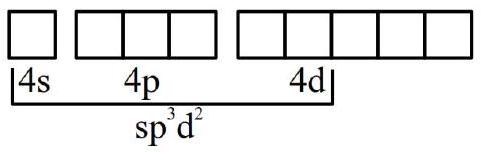
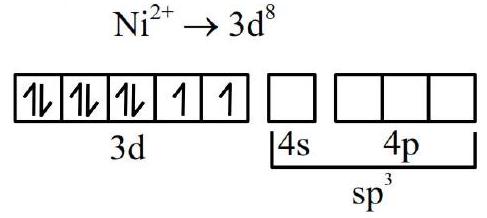
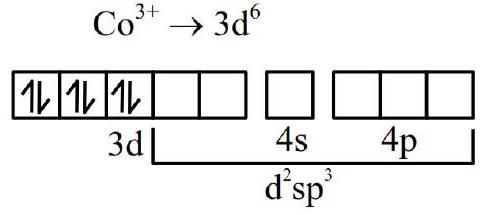
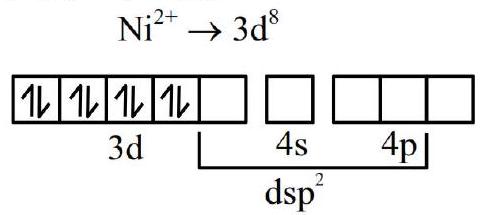
(A) [CoF6]−3 [ ] Question figure (B) [NiCl4]2− Question figure (C) [Co(NH3)6]3+ Question figure (D) [Ni(CN)4]2− Question figure
Question 229 / MCQ
Question 229
Match List - I with List - II List - I(Complex)List - II(Hybridization) (A)Ni(CO)4(I)sp3(B)[Ni(CN)4]2−(II)sp3d2(C)[Co(CN)6]3−(III)d2sp3(D)[CoF6]3−(IV)dsp2 Choose the correct answer from the options given below.
A.
A-IV, B-I, C-III, D-II
B.
A-I. B-IV, C-III, D-II
C.
A-I. B-IV, C-II, D-III
D.
A-IV, B-I, C-II. D-III
Correct answer: B

Source solution

Step 1: Determine hybridisation based on ligand field strength and geometry (A) Ni(CO)4 Ni0:d10CO is strong field ligand Geometry: tetrahedral⇒sp3 (A)→(I) (B) [Ni(CN)4]2− Ni2+:d8CN^- strong field ligand Geometry: square planar⇒dsp2 (B)→(IV) (C) [Co(CN)6]3− Co3+:d6CN^- strong field ligand Geometry: octahedral low spin⇒d2sp3 (C)→(III) (D) [CoF6]3− Co3+:d6F^- weak field ligand Geometry: octahedral high spin⇒sp3d2 (D)→(II) Final Matching: A→I,B→IV,C→III,D→II
Choose another chapter