
Mathematics
Permutations and Combinations
Question 19 / MCQ
Let
Correct answer: A
Source solution
Sol.Question 20 / Numerical
Total numbers of 3-digit numbers that are divisible by 6 and can be formed by using the digits
Numerical answer: ____________________
Enter the requested value (an integer; 0 decimal places). Use the units and scaling stated in the question.
Correct answer: 16
Source solution
For number to be divisible by '6' unit digit should be even and sum of digit is divisible by 3 .Question 21 / Numerical
The number of 4-letter words, with or without meaning, each consisting of 2 vowels and 2 consonants, which can be formed from the letters of the word UNIVERSE without repetition is
Numerical answer: ____________________
Enter the requested value (an integer; 0 decimal places). Use the units and scaling stated in the question.
Correct answer: 432
Source solution
UNIVERSE Vowels: E, I, U Consonants: N, V, R, SQuestion 22 / MCQ
If the sum and product of four positive consecutive terms of a G.P., are 126 and 1296 , respectively, then the sum of common ratios of all such GPs is
Correct answer: A
Source solution
Sol. (1) Four term of G.P.Question 23 / Numerical
The number of numbers greater than 5000, less
than 9000 and divisible by 3, that can be formed
using the digits 0, 1, 2, 5, 9, if the repetition of the
digits is allowed, is
________
Numerical answer: ____________________
Enter an integer. Use the units and scaling requested in the question.
Correct answer: 42
Source solution
(1) all differentQuestion 24 / MCQ
The largest
Correct answer: A
Source solution
Exponent of 7 in 101!Question 25 / MCQ
The number of numbers, strictly between 5000 and 10000 can be formed using the digits
Correct answer: C
Source solution
Sol. (3)} No. of ways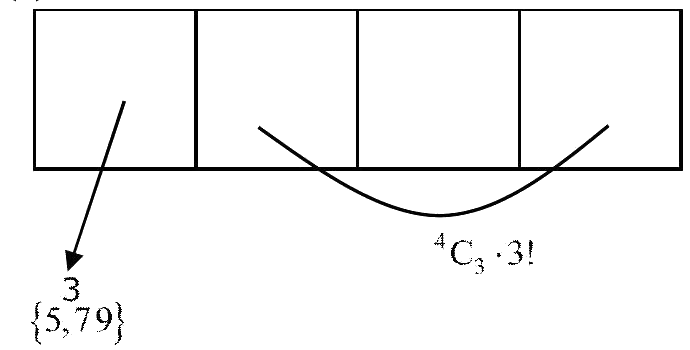
Question 26 / MCQ
The number of integers, greater than 7000 that can be formed, using the digits
Correct answer: A
Source solution
Sol. 1 C-1Question 27 / Numerical
The total number of six digit numbers, formed using the digits
Numerical answer: ____________________
Enter the requested value (an integer; 0 decimal places). Use the units and scaling stated in the question.
Correct answer: 81
Source solution
81 We have, For this, 4 will be fixed as unit place digit Total number Case I: 4'sQuestion 28 / Numerical
Let 5 digit numbers be constructed using the digits
Numerical answer: ____________________
Enter the requested value (an integer; 0 decimal places). Use the units and scaling stated in the question.
Correct answer: 2997
Source solution
2997Question 29 / Numerical
Five digit numbers are formed using the digits
Numerical answer: ____________________
Enter the requested value (an integer; 0 decimal places). Use the units and scaling stated in the question.
Correct answer: 1436
Source solution
1436 Number starting with Number starting with
Question 30 / Numerical
The number of 3 -digit numbers, that are divisible by either 2 or 3 but not divisible by 7 , is
Numerical answer: ____________________
Enter the requested value (an integer; 0 decimal places). Use the units and scaling stated in the question.
Correct answer: 514
Source solution
514 3 digit numbers divisible by either 2 or 3Question 31 / Numerical
Number of 4-digit numbers (the repeation of digits is allowed) which are made using the digits
Numerical answer: ____________________
Enter the requested value (an integer; 0 decimal places). Use the units and scaling stated in the question.
Correct answer: 21
Source solution
21| 5 |
| Remaining 3 digits | Arrange |
Question 32 / MCQ
The number of 3 digit numbers, that are divisible by either 3 or 4 but not divisible by 48 , is
Correct answer: B
Source solution
Sol. (2)} Nos div. by 3 102, 105, 108 999 A.P.Question 33 / Numerical
The number of 9 digit numbers, that can be formed using all the digits of the number 123412341 so that the even digits occupy only even places, is
Numerical answer: ____________________
Enter the requested value (an integer; 0 decimal places). Use the units and scaling stated in the question.
Correct answer: 60
Source solution
(60) 44
33
4 even place can be occupied by 4 even digits
No of always