Learne2i
Learne2i Guess Paper solutions
JEE Main 2026 / Session 2
All chapters

Physics

Mechanical Properties of Solids

Question 80 / MCQ
Question 80
Two wires A and B made of different materials of length 6.0 cm and 5.4 cm, respectively and area of cross sections 3.0×10⁻⁵ m2 and 4.5×10⁻⁵ m2, respectively are stretched by the same magnitude under a given load. The ratio of the Young's modulus of A to that of B is x:3. The value of x is ________.
A.
1
B.
4
C.
2
D.
5
Correct answer: D

Source solution

T=F/AΔℓ/ℓ⇒Y=FℓAΔℓ YAYB=ℓAℓB(ABAA)=65.4(4.5×10−53×10−5)=95.4=53⇒x3=53x=5
Question 81 / MCQ
Question 81
A 3 m long wire of radius 3 mm shows an extension of 0.1 mm when loaded vertically by a mass of 50 kg in an experiment to determine Young's modulus. The value of Young's modulus of the wire as per this experiment is P×1011Nm−2, where the value of P is : ( Take g=3π m/s2)
A.
5
B.
10
C.
25
D.
2.5
Correct answer: A

Source solution

Sol. 50gπr2=y⋅Δℓℓ 50⋅3ππ⋅(3×10−3)2=P⋅1011⋅0.1×10−33 ⇒P=50⋅3⋅332⋅10−6⋅1011⋅0.1×10−3 P=5
Question 82 / Numerical
Question 82
One end of a metal wire is fixed to a ceiling and a load of 2 kg hangs from the other end. A similar wire is attached to the bottom of the load and another load of 1 kg hangs from this lower wire. Then the ratio of longitudinal strain of upper wire to that of the lower wire will be . [Area of cross section of wire =0.005 cm2, Y=2×10¹¹Nm−2 and g=10 ms−2 ]
Numerical answer: ____________________
Enter the requested value or coefficient rounded to the nearest integer (0 decimal places).
Correct answer: 3

Source solution

The upper wire supports both loads, so T1=30N; the lower wire supports the 1 kg load, so T2=10N. For identical wires, strain is T/(AY). The ratio is 30/10=3.
Question 83 / Numerical
Question 83
A uniform heavy rod of mass 20 kg . Cross sectional area 0.4 m2 and length 20 m is hanging from a fixed support. Neglecting the lateral contraction, the elongation in the rod due to its own weight is x×10−9 m. The value of x is . :(Given. Young's modulus Y=2×10¹¹Nm−2 and g=10 ms−2 )
Numerical answer: ____________________
Enter the requested value (an integer; 0 decimal places). Use the units and scaling stated in the question.
Correct answer: 25

Source solution
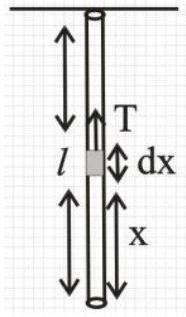
Question figure Y=TAdxdy m=20 kg A=0.4m2 1=20 m let extension is dy in length dx Y= stress  strain  Y=TAdydx=TA⋅dxdy dy=TdxAY Tension at a distance x from lower end =mgℓx So. ∫0Δldy=∫0ℓmgℓxdxAY Δℓ=mgℓAY[x22]0ℓ Δℓ=mgℓ2AY Δℓ=20×10×202×0.4×2×1011 2500×10−11 Δℓ=25×10−9 =x×10−9 x=25
Question 84 / MCQ
Question 84
An object of mass m is suspended at the end of a massless wire of length L and area of crosssection A. Young modulus of the material of the wire is Y. If the mass is pulled down slightly its frequency of oscillation along the vertical direction is:
A.
f=12πYAmL
B.
f=12π mLYA
C.
f=12πYLmA
D.
f=12πmAYL
Correct answer: A

Source solution

Young's modulus is Y=F/AΔL/L. Therefore, Y=FLAΔL, or F=YAΔLL. Hence, the effective spring constant of the wire is k=FΔL=YAL. The frequency of oscillation of a mass m attached to the wire is f=12πkm. Substituting k=YAL, we get f=12πYALm.
Question 85 / Numerical
Question 85
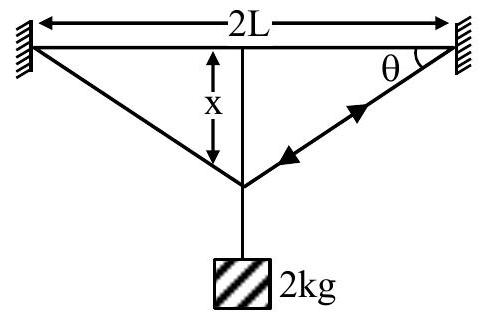
A wire of cross sectional area A, modulus of elasticity 2×10¹¹Nm−2 and length 2 m is stretched between two vertical rigid supports. When a mass of 2 kg is suspended at the middle it sags lower from its original position making angle θ=1100 radian on the points of support. The value of A is ×10−4 m2 (consider x≪L ). (given : g=10 m/s2 ) Question figure
Numerical answer: ____________________
Enter the requested value (an integer; 0 decimal places). Use the units and scaling stated in the question.
Correct answer: 1

Source solution
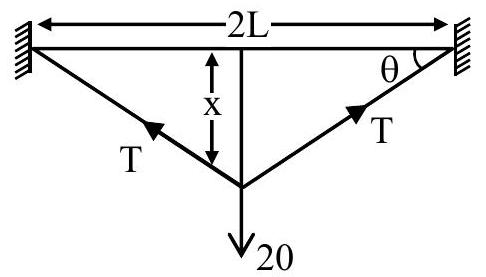
Question figure In vertical derection 2 Tsin⁡θ=20 using small angle approximation sin⁡θ=θ θ=1100 ∴T=10θ T=1000 N Change in length ΔL=2x2+L2−2 L =2 L[1+x22 L2−1] ΔL=x2 L ∴ Modulus of elasticity = stress  strain  2×1011=103 A×x2 L×2 L ∴A=1×10⁻⁴ m2
Question 86 / MCQ
Question 86
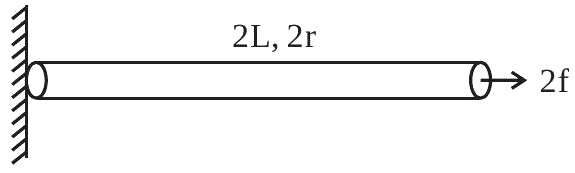
A wire of length ' L ' and radius ' r ' is clamped rigidly at one end. When the other end of the wire is pulled by a force f , its length increases by ' ℓ '. Another wire of same material of length ' 2 L ' and radius ' 2r ' is pulled by a force ' 2f '. Then the increase in its length will be :
A.
2ℓ
B.
ℓ
C.
4ℓ
D.
ℓ/2
Correct answer: B

Source solution

Sol. fπr2=YℓL 2fπ(2r)2=Yℓ′2L ⇒21=2ℓ′ℓ⇒ℓ′=ℓQuestion figure
Question 87 / Numerical
Question 87
Two wires each of radius 0.2 cm and negligible mass,one made of steel and other made of brass are loaded as shown in the figure.The elongation of the steel wire is ×10−6 m .[Young's modulus for steel =2×10¹¹Nm−2 and g=10 ms−2] Question figure
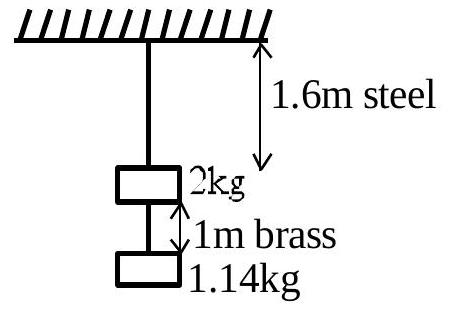
Numerical answer: ____________________
Enter the requested value (an integer; 0 decimal places). Use the units and scaling stated in the question.
Correct answer: 20

Source solution

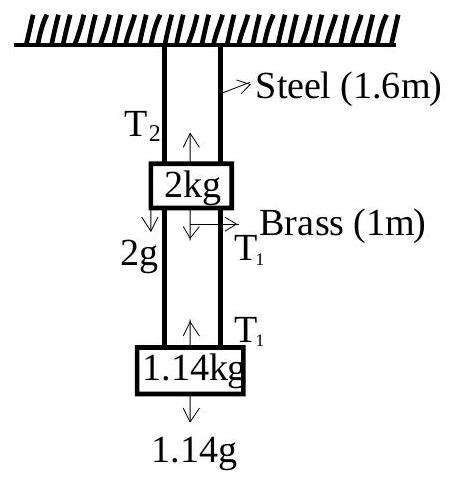
Tension in steel wire T2=2 g+T1 T2=20+11.4 =31.4 N Question figure Elongation in steel wire ΔL=T2 LAy ΔL=31.4×1.6π(0.2×10⁻²)2×2×1011 ΔL=162×4×10−6×1011 =2×10⁻⁵ m =20×10−6 m
Question 88 / Numerical
Question 88
In a Young's double slit experiment, the slits are separated by 0.3 mm and the screen is 1.5 m away from the plane of slits. Distance between fourth bright fringes on both sides of central bright is 2.4 cm . The frequency of light used is ×1014 Hz.
Numerical answer: ____________________
Enter the requested value (an integer; 0 decimal places). Use the units and scaling stated in the question.
Correct answer: 5

Source solution

8β=2.4 cm 8λΔ d=2.4 cm 8×1.5×c0.3×10−3×f=2.4×10⁻² f=5×10¹⁴ Hz
Question 89 / Numerical
Question 89
In a Young's double slit experiment, the intensity at a point is (14)th  of the maximum intensity, the minimum distance of the point from the central maximum is μm. (Given : λ=600 nm, d=1.0 mm,D=1.0 m )
Numerical answer: ____________________
Enter the requested value (an integer; 0 decimal places). Use the units and scaling stated in the question.
Correct answer: 200

Source solution

I=I0cos2⁡(Δϕ2) I04=cos2⁡(Δϕ2) Δϕ=2π3 2πλ(ydD)=2π3 y=λD3 d=600×10−9×13×10−3=2×10⁻⁴ m
Question 90 / MCQ
Question 90
Match List-I with List-II. List-IList-II(a) Angular momentum(i) [ML2T−1](b) Torque(ii) [ML2T−2](c) Stress(iii) [ML−1T−2](d) Pressure gradient(iv) [ML−2T−2] Choose the correct answer from the options given below:
A.
A - III, B - I, C - IV, D - II
B.
A - II, B - III, C - IV, D - I
C.
A - IV, B - II, C - I, D - III
D.
A - I, B - IV, C - III, D - II
Correct answer: A

Source solution

Angular momentum: L=mvr [L]=[M][LT−1][L]=ML2T−1. Torque: τ=rF [τ]=[L][MLT−2]=ML2T−2. Stress: Stress=FA [Stress]=MLT−2L2=ML−1T−2. Pressure gradient: dPdx [dPdx]=[P][L]=ML−1T−2L=ML−2T−2. =ML2T−1,[τ]=ML2T−2,[Stress]=ML−1T−2,[dPdx]=ML−2T−2.
Choose another chapter