
Learne2i
Learne2i Guess Paper solutions
JEE Main 2026 / Session 2
All chapters

Physics

Thermodynamics

Question 99 / MCQ
Question 99
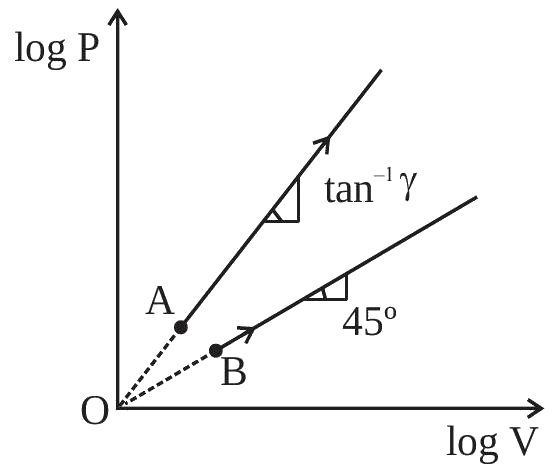
Two thermodynamical process are shown in the figure. The molar heat capacity for process A and B are CA and CB. The molar heat capacity at constant pressure and constant volume are represented by CP and CV, respectively. Choose the correct statement.Question figure
A.
CB=∞,CA=0
B.
CA=0 and CB=∞
C.
CP>CB>CA>CV
D.
CA>CP>CV
Correct answer: C

Source solution

For process A, Given log⁡P=γlog⁡V, we have P=Vγ,(γ>1). Hence, PV−γ=constant. For a polytropic process PVn=constant, the molar heat capacity is C=CV+R1−n. Here, n=−γ. Therefore, (i)CA=CV+R1+γ. Similarly, for process B, P∝V or PV−1=constant. Thus, n=−1, and (ii)CB=CV+R1−(−1)=CV+R2. Also, (iii)CP=CV+R. Since γ>1, R2>R1+γ>0. Therefore, CP=CV+R>CV+R2>CV+R1+γ>CV. Hence, CP>CB>CA>CV.
Question 100 / Numerical
Question 100
A sample of gas with γ=1.5 is taken through an adiabatic process in which the volume is compressed from 1200 cm3 to 300 cm3. If the initial pressure is 200 kPa . The absolute value of the workdone by the gas in the process = J.
Numerical answer: ____________________
Enter the requested value (an integer; 0 decimal places). Use the units and scaling stated in the question.
Correct answer: 480

Source solution

v=1.5 p1 V1v=p2 V2v (200) (1200)1.5=P2(300)1.5 P2=200[4]3/2=1600kPa ∣ W.D. |=p2v2−p1v1v−1=(480−2400.5)=480 J
Question 101 / MCQ
Question 101
A diatomic gas (γ=1.4) does 200 J of work when it is expanded isobarically. The heat given to the gas in the process is :
A.
850 J
B.
800 J
C.
600 J
D.
700 J
Correct answer: D

Source solution

γ=1+2f. Given, γ=1.4. Therefore, 1.4=1+2f 2f=0.4 f=5. For an ideal gas, CP=(f+22)R. Substituting f=5, CP=72R. Given that nRΔT=200J, the heat supplied at constant pressure is Q=nCPΔT. Hence, Q=(72)nRΔT=(72)(200). Q=700J. Therefore, Q=700J.
Question 102 / MCQ
Question 102
Match List-I with List-II. List-IList-II(a) Isothermal(i) Pressure constant(b) Isochoric(ii) Temperature constant(c) Adiabatic(iii) Volume constant(d) Isobaric(iv) Heat content is constant Choose the correct answer from the options given below:
A.
(a) - (ii), (b) - (iv), (c) - (iii), (d) - (i)
B.
(a) - (ii), (b) - (iii), (c) - (iv), (d) - (i)
C.
(a) - (i), (b) - (iii), (c) - (ii), (d) - (iv)
D.
(a) - (iii), (b) - (ii), (c) - (i), (d) - (iv)
Correct answer: B

Source solution

The meanings of the thermodynamic processes are: Isothermal⇒Temperature remains constant,Isochoric⇒Volume remains constant,Adiabatic⇒No heat is exchanged with the surroundings,Isobaric⇒Pressure remains constant. Therefore, the correct matching is (a) Isothermal⟶(ii) Temperature constant,(b) Isochoric⟶(iii) Volume constant,(c) Adiabatic⟶(iv) No heat exchange,(d) Isobaric⟶(i) Pressure constant. Hence, (a)→(ii),(b)→(iii),(c)→(iv),(d)→(i)
Question 103 / MCQ
Question 103
Match List-I with List-II. List-IList-II(a) Isothermal Process(i) No change in internal energy(b) Adiabatic Process(ii) Work done by the gas decreases internal energy(c) Isochoric Process(iii) No work is done on or by the gas(d) Isobaric Process(iv) The heat absorbed goes partly to increase internal energy and partly to do work Choose the correct answer from the options given below:
A.
A-I, B-II, C-III, D-IV
B.
A-II, B-I, C-IV, D-III
C.
A-II, B-I, C-III, D-IV
D.
A-I, B-II, C-IV, D-III
Correct answer: B

Source solution

For an isothermal process, T=constant. For an ideal gas, the internal energy depends only on temperature. Hence, ΔU=0. By the first law of thermodynamics, Q=W. Thus, the heat absorbed is completely converted into work. (a) Isothermal Process⟶(ii) For an adiabatic process, Q=0. Hence, ΔU=−W. Therefore, work done by the gas decreases its internal energy. (b) Adiabatic Process⟶(i) For an isochoric process, ΔV=0. Therefore, W=∫PdV=0. All the heat supplied is used to increase the internal energy. (c) Isochoric Process⟶(iv) For an isobaric process, P=constant. The gas expands against a constant pressure and work is done during the process. (d) Isobaric Process⟶(iii) Hence, the correct matching is A−II,B−I,C−IV,D−III
Question 104 / MCQ
Question 104
Match List-I with List-II. List-IList-II(A) Pressure varies inversely with volume of an ideal gas(III) Isothermal process(B) Heat absorbed goes partly to increase internal energy and partly to do work(IV) Isobaric process(C) Heat is neither absorbed nor released by a system(I) Adiabatic process(D) No work is done on or by a gas(II) Isochoric process Choose the correct answer from the options given below:
A.
A-I, B-IV, C-II, D-III
B.
A-III, B-I, C-IV, D-II
C.
A-I, B-III, C-II, D-IV
D.
A-III, B-IV, C-I, D-II
Correct answer: D

Source solution

\textbf{(A) Pressure varies inversely with volume of an ideal gas} For an ideal gas undergoing an isothermal process, PV=constant. Hence, P∝1V. Therefore, (A)→(III). \textbf{(B) Heat absorbed goes partly to increase internal energy and partly to do work} In an isobaric process, ΔQ=ΔU+PΔV. Thus, the heat supplied is used partly to increase internal energy and partly to perform work. (B)→(IV). \textbf{(C) Heat is neither absorbed nor released by a system} For an adiabatic process, ΔQ=0. Hence, (C)→(I). \textbf{(D) No work is done on or by a gas} For an isochoric process, ΔV=0. Therefore, W=∫PdV=0. Hence, (D)→(II). Thus, the correct matching is A→III,B→IV,C→I,D→II
Question 105 / MCQ
Question 105
Match List I with List II
LIST ILIST II
A.Isothermal ProcessI.Work done by the gas decreases internal energy
B.Adiabatic ProcessII.No change in internal energy
C.Isochoric ProcessIII.The heat absorbed goes partly to increase internal energy and partly to do work
D.Isobaric ProcessIV.No work is done on or by the gas
Choose the correct answer from the options given below:
A.
A-I, B-II, C-III, D-IV
B.
A-II, B-I, C-IV, D-III
C.
A-II, B-I, C-III, D-IV
D.
A-I, B-II, C-IV, D-III
Correct answer: B

Source solution

By theory Isonormal →Δu=0 A→ II Adiabatic →ΔQ=O,Δw(+) so Δu(−)↓B→I Isochoric =ΔV=0 ΔV=0→Δw=0 C→ IV Isobasic →PΔu≠O Δv≠0 D → III
Question 106 / MCQ
Question 106
Match List-I with List-II. List-IList-II(A) Isothermal(IV) ΔU=0(B) Adiabatic(II) ΔQ=0(C) Isobaric(III) ΔU≠0(D) Isochoric(I) ΔW=0 Choose the correct answer from the options given below:
A.
(A)-(III), (B)-(II), (C)-(I), (D)-(IV)
B.
(A)-(IV), (B)-(I), (C)-(III), (D)-(II)
C.
(A)-(IV), (B)-(II), (C)-(III), (D)-(I)
D.
(A)-(II), (B)-(IV), (C)-(I), (D)-(III)
Correct answer: C

Source solution

\textbf{(A) Isothermal Process} For an ideal gas undergoing an isothermal process, ΔT=0. Since internal energy depends only on temperature, ΔU=0. Hence, (A)→(IV). \textbf{(B) Adiabatic Process} For an adiabatic process, ΔQ=0. Hence, (B)→(II). \textbf{(C) Isobaric Process} For an isobaric process, P=constant. In general, the temperature changes, therefore ΔU=nCVΔT≠0. Hence, (C)→(III). \textbf{(D) Isochoric Process} For an isochoric process, ΔV=0. Therefore, ΔW=∫PdV=0. Hence, (D)→(I). Thus, the correct matching is A→IV,B→II,C→III,D→I
Question 107 / MCQ
Question 107
Match List-I with List-II. List-IList-II(A) Isobaric(IV) ΔQ=ΔU+PΔV(B) Isochoric(II) ΔQ=ΔU(C) Adiabatic(III) ΔQ=0(D) Isothermal(I) ΔQ=ΔW Where: ΔQ=Heat supplied,ΔW=Work done by the system,ΔU=Change in internal energy,P=Pressure of the system,ΔV=Change in volume of the system. Choose the correct answer from the options given below:
A.
(A)-(IV), (B)-(III), (C)-(II), (D)-(I)
B.
(A)-(IV), (B)-(I), (C)-(III), (D)-(II)
C.
(A)-(IV), (B)-(II), (C)-(III), (D)-(I)
D.
(A)-(II), (B)-(IV), (C)-(III), (D)-(I)
Correct answer: C

Source solution

\textbf{(A) Isobaric Process} For an isobaric process, W=PΔV. Using the first law of thermodynamics, ΔQ=ΔU+ΔW=ΔU+PΔV. Hence, (A)→(IV). \textbf{(B) Isochoric Process} For an isochoric process, ΔV=0. Therefore, W=0. Thus, ΔQ=ΔU. Hence, (B)→(II). \textbf{(C) Adiabatic Process} For an adiabatic process, ΔQ=0. Hence, (C)→(III). \textbf{(D) Isothermal Process} For an ideal gas in an isothermal process, ΔU=0. Therefore, ΔQ=ΔW. Hence, (D)→(I). Therefore, the correct matching is A→IV,B→II,C→III,D→I
Question 108 / MCQ
Question 108
The initial pressure and volume of an ideal gas are P0 and V0. The final pressure of the gas when the gas is suddenly compressed to volume V04 will be : (Given γ= ratio of specific heats at constant pressure and at constant volume)Option :}
A.
P0(4)1γ
B.
P0(4)γ
C.
P0
D.
4P0
Correct answer: B

Source solution

Since the gas is compressed suddenly, the process is adiabatic. For an adiabatic process, PVγ=constant. Therefore, P1V1γ=P2V2γ. Substituting P1=P0,V1=V0,V2=V04, we get P0V0γ=P2(V04)γ. Hence, P2=P0V0γ(V04)γ=P04γ. Therefore, P2=P04γ.
Question 109 / MCQ
Question 109
An ideal gas goes from an initial state to final state. During the process, the pressure of gas increases linearly with temperature (A) The work done by gas during the process is zero. (B) The heat added to gas is different from change in its internal energy (C) The volume of the gas is increased (D) The internal energy of the gas is increased (E) The process is isochoric (constant volume process)Choose the correct answer from the options given below :-
A.
A, B, C, D Only
B.
A, D, E Only
C.
E Only
D.
A, C Only
Correct answer: B

Source solution

Given that the pressure increases linearly with temperature, P∝T. Using the ideal gas equation, PV=nRT. ::contentReference[oaicite:0]{index=0} Since PT=constant, from PV=nRT, we get V=nRP/T=constant. Hence, the process is isochoric. (E) is correct. Since the volume remains constant, W=∫PdV=0. Therefore, (A) is correct. As pressure increases linearly with temperature, T increases. For an ideal gas, ΔU=nCVΔT. Since ΔT>0, ΔU>0. Thus, (D) is correct. Also, for an isochoric process, W=0, and by the first law, Q=ΔU. Therefore, statement (B) is false. Since the volume remains constant, (C) is false. Hence, the correct statements are A, D and E.
Question 110 / Numerical
Question 110
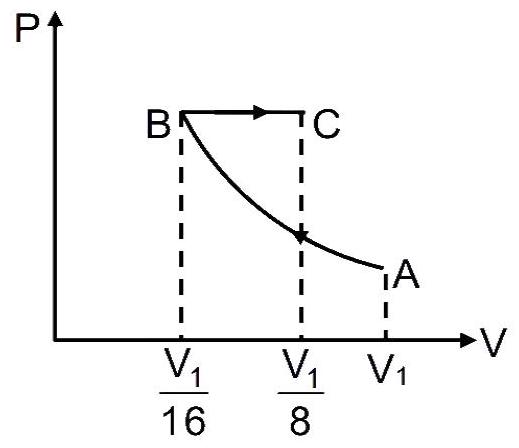
An ideal gas at an initial temperature 300K is compressed adiabatically ( γ=1.4 ) to its initial volume. The gas is then expanded isobarically to double its volume. Then the final temperature of the gas rounded off to nearest integer is.
Numerical answer: ____________________
Enter the requested value (an integer; 0 decimal places). Use the units and scaling stated in the question.
Correct answer: 1819

Source solution

(1819 K) Question figure PVγ= Constant TV(γ−1)= constant 300(V1)(1.4−1)=TB(V116)25TB=300×2(85) Now for BC process VBTB=VCTC TC=VCTBTB=2×300×2(85)TC=1819 K
Question 111 / MCQ
Question 111
Given below are two statements. One is labelled as Assertion (A) and the other is labelled as Reason (R).Assertion (A) : With the increase in the pressure of an ideal gas, the volume falls off more rapidly in an isothermal process in comparison to the adiabatic process.Reason (R) : In isothermal process, PV= constant, while in adiabatic process PVγ= constant. Here γ is the ratio of specific heats, P is the pressure and V is the volume of the ideal gas.In the light of the above statements, choose the correct answer from the options given below :
A.
Both (A) and (R) are true but (R) is NOT the correct explanation of (A)
B.
(A) is true but (R) is false
C.
Both (A) and (R) are true and (R) is the correct explanation of (A).
D.
(A) is false but (R) is true
Correct answer: C

Source solution

Assertion (A): For an isothermal process, PV=constant or V∝1P. For an adiabatic process, PVγ=constant, so that V∝P−1/γ. Since γ>1, we have 1γ<1. Therefore, as pressure increases, P−1 decreases more rapidly than P−1/γ. Hence, the volume decreases more rapidly in an isothermal process than in an adiabatic process. Assertion (A) is true. Reason (R): For an isothermal process, PV=constant, while for an adiabatic process, PVγ=constant. Reason (R) is true. The reason correctly explains why the volume falls more rapidly with pressure in the isothermal case than in the adiabatic case. Therefore, Both A and R are true, and R is the correct explanation of A.
Choose another chapter