Learne2i
Learne2i Priority Practice solutions
JEE Main 2025 / Session 2
All chapters

Chemistry

Coordination Compounds

Question 211 / MCQ
Question 211
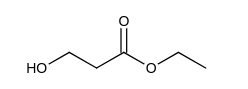
Identify the coordination complexes in which the central metal ion has d4 configuration. (A) [FeO4]2− (B) [Mn(CN)6]3− (C) [Fe(CN)6]3− (D) (E) [NiF6]2− Choose the correct answer from the options given below:Question figure
A.
(C) and (E) only
B.
(B), (C) and (D) only
C.
(B) and (D) only
D.
(A), (B) and (E) only
Correct answer: C

Source solution

Step 1: d-electron count in each complex (A) [FeO4]2− Fe6+:d2⇒not d4 (B) [Mn(CN)6]3− Mn3+:25−3=22⇒d4 (C) [Fe(CN)6]3− Fe3+:d5⇒not d4 (D) (assumed correct option)⇒d4 configuration complex (E) [NiF6]2− Ni4+:d6⇒not d4 Hence, d4 complexes are: B and D
Question 212 / MCQ
Question 212
Identify the homoleptic complexes with odd number of d electrons in the central metal. (A) [FeO4]2− (B) [Fe(CN)6]3− (C) [Fe(CN)5NO]2− (D) [CoCl4]2− (E) [Co(H2O)3 F3] Choose the correct answer from the options given below :
A.
(B) and (D) only
B.
(C) and (E) only
C.
(A), (B) and (D) only
D.
(A), (C) and (E) only
Correct answer: A

Source solution

(A) [FeO4]2− Fe6+:d2⇒even (B) [Fe(CN)6]3− Fe3+:d5⇒odd (C) [Fe(CN)5NO]2− NO acts as NO^+ (strong field ligand) Fe2+:d6⇒even (D) [CoCl4]2− Co2+:d7⇒odd (E) [Co(H2O)3F3] Co3+:d6⇒even Final Answer: (B),(D)
Question 213 / MCQ
Question 213
Identify the homoleptic complex(es) that is/are low spin. (A) [Fe(CN)5NO]2− (B) [CoF6]3− (C) [Fe(CN)6]4− (D) [Co(NH3)6]3+ (E) [Cr(H2O)6]2+ Choose the correct answer from the options given below:
A.
(B) and (E) only
B.
(A) and (C) only
C.
(C) and (D) only
D.
(C) only
Correct answer: C

Source solution

Condition for low spin complexes: Strong field ligands (CN^- , CO, NO^+ , NH_3 (for Co^{3+}) )⇒low spin (A) [Fe(CN)5NO]2− CN− and NO+ are strong field ligands⇒low spin (B) [CoF6]3− F− is weak field ligand⇒high spin (not low spin) (C) [Fe(CN)6]4− CN− strong field⇒low spin (D) [Co(NH3)6]3+ Co3+ has high effective nuclear charge, NH3 acts as strong field⇒low spin (E) [Cr(H2O)6]2+ H2O is weak field ligand⇒high spin (not low spin) C and D
Question 214 / MCQ
Question 214
Match List-I with List-II. List-I (Complex) (A) [CoF6]3− (B) [NiCl4]2− (C) [Co(NH3)6]3+ (D) [Ni(CN)4]2− List-II (Hybridisation of central metal ion) (I) d2sp3 (II) sp3 (III) sp3 d2 (IV) dsp2 Choose the correct answer from the options given below:
A.
-(I), (B)-(IV), (C)-(III), (D)-(II)
B.
(A)-(III), (B)-(II), (C)-(I), (D)-(IV)
C.
(A)-(I), (B)-(II), (C)-(III), (D)-(IV)
D.
(A)-(III), (B)-(IV), (C)-(I), (D)-(II)
Correct answer: B

Source solution

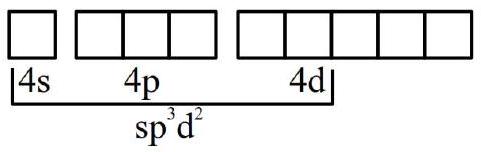
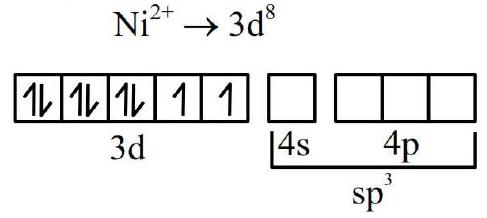
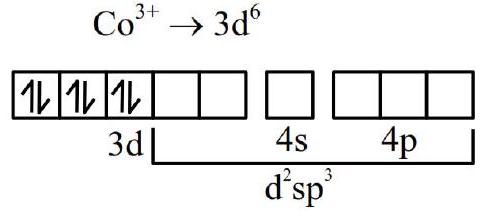
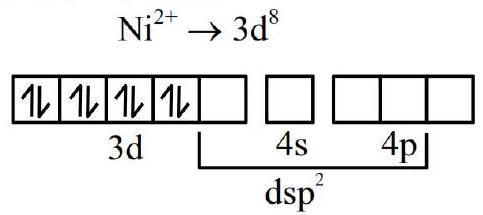
(A) [CoF6]−3 [ ] Question figure (B) [NiCl4]2− Question figure (C) [Co(NH3)6]3+ Question figure (D) [Ni(CN)4]2− Question figure
Question 215 / MCQ
Question 215
The correct order of the following complexes in terms of their crystal field stabilization energies is :
A.
[Co(NH3)4]2+<[Co(NH3)6]2+<[Co(en)3]3+<[Co(NH3)6]3+
B.
[Co(NH3)4]2+<[Co(NH3)6]2+<[Co(NH3)6]3+<[Co(en)3]3+
C.
[Co(NH3)6]2+<[Co(NH3)6]3+<[Co(NH3)4]2+<[Co(en)3]3+
D.
[Co(en)3]3+<[Co(NH3)6]3+<[Co(NH3)6]2+<[Co(NH3)4]2+
Correct answer: B

Source solution

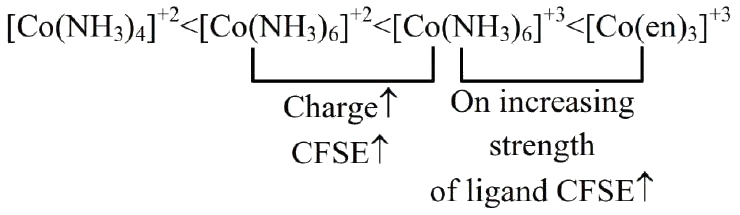
Sol. Order of CFSE SFL : NH3< enQuestion figure
Question 216 / MCQ
Question 216
List I (Complex)List II (Hybridisation)(A) [CoF6]3−(I) d2sp3(B) [NiCl4]2−(II) sp3(C) [Co(NH3)6]3+(III) sp3d2(D) [Ni(CN)4]2−(IV) dsp2
A.
(A)-(I), (B)-(IV), (C)-(III), (D)-(II)
B.
(A)-(III), (B)-(II), (C)-(I), (D)-(IV)
C.
(A)-(I), (B)-(II), (C)-(III), (D)-(IV)
D.
(A)-(III), (B)-(IV), (C)-(I), (D)-(II)
Correct answer: B

Source solution

(A) [CoF6]3− Co3+:d6, F− weak field⇒octahedral high spin⇒sp3d2⇒(III) (B) [NiCl4]2− Ni2+:d8, Cl− weak field⇒tetrahedral⇒sp3⇒(II) (C) [Co(NH3)6]3+ Co3+:d6, NH3 strong field⇒inner orbital complex⇒d2sp3⇒(I) (D) [Ni(CN)4]2− Ni2+:d8, CN− strong field⇒square planar⇒dsp2⇒(IV) Final Matching: A→III,B→II,C→I,D→IV
Question 217 / MCQ
Question 217
The correct increasing order of stability of the complexes based on Δo value is : (I) [Mn(CN)6]3− (II) [Co(CN)6]4− (III) [Fe(CN)6]4 (IV) [Fe(CN)6]3−
A.
II < III < I < IV
B.
IV < III < II < I
C.
I < II < IV < III
D.
III < II < IV < I
Correct answer: C

Source solution

Given complexes: (I) [Mn(CN)6]3−⇒Mn3+:d4 (II) [Co(CN)6]4−⇒Co2+:d7 (III) [Fe(CN)6]4−⇒Fe2+:d6 (IV) [Fe(CN)6]3−⇒Fe3+:d5 Step 1: CN^- is strong field ligand⇒all are low spin octahedral Step 2: CFSE values (low spin octahedral) d4(Mn3+):t2g4eg0⇒highest CFSE among given set d5(Fe3+):t2g5 d6(Fe2+):t2g6⇒maximum stability in this group d7(Co2+):t2g6eg1⇒lowest stability due to eg electron Step 3: Stability order (increasing CFSE) (I)<(II)<(IV)<(III)
Question 218 / MCQ
Question 218
List-I (Complex)List-II (Hybridisation & Magnetic)(A)[MnBr4]2−(I)d2sp3 & diamagnetic(B)[FeF6]3−(II)sp3d2 & paramagnetic(C)[Co(C2O4)3]3−(III)sp3 & diamagnetic(D)[Ni(CO)4](IV)sp3 & paramagnetic
A.
(A)-(III), (B)-(II), (C)-(I), (D)-(IV)
B.
(A)-(III), (B)-(I), (C)-(II), (D)-(IV)
C.
(A)-(IV), (B)-(I), (C)-(II), (D)-(III)
D.
(A)-(IV), (B)-(II), (C)-(I), (D)-(III)
Correct answer: D

Source solution

Step 1: Determine oxidation state, geometry and magnetic nature (A) [MnBr4]2− Mn2+:d5Br− is weak field ligand ⇒tetrahedral complex, sp3 High spin d5⇒paramagnetic ⇒(A)→(IV) (B) [FeF6]3− Fe3+:d5F− weak field ligand ⇒octahedral, high spin⇒sp3d2 paramagnetic ⇒(B)→(II) (C) [Co(C2O4)3]3− Co3+:d6C2O42− is moderate/strong field ligand ⇒low spin octahedral⇒d2sp3 diamagnetic ⇒(C)→(I) (D) [Ni(CO)4] Ni0:d10CO strong field ligand ⇒tetrahedral, sp3 diamagnetic ⇒(D)→(III) Final Matching: (A)−(IV), (B)−(II), (C)−(I), (D)−(III)
Question 219 / Numerical
Question 219
Consider the following low-spin complexes K3[Co(NO2)6],K4[Fe(CN)6],K3[Fe(CN)6], Cu2[Fe(CN)6] and Zn2[Fe(CN)6]. The sum of the spin-only magnetic moment values of complexes having yellow colour is B.M. (answer is nearest integer)
Numerical answer: ____________________
Enter the requested value (an integer; 0 decimal places). Use the units and scaling stated in the question.
Correct answer: 0

The source provides a brief answer only. A detailed worked solution is not available for this question.

Source solution

Choose another chapter