
Learne2i
Learne2i Priority Practice solutions
JEE Main 2025 / Session 2
All chapters

Mathematics

Vector Algebra

Question 132 / MCQ
Question 132
Let a→=3i^−j^+2k^,b→=a→×(i^−2k^) and c→=b→×k^. Then the projection of c→−2j^ on a→ is:
A.
37
B.
14
C.
214
D.
27
Correct answer: C

Source solution

Sol. b˙=a→×(i^−3k^) =|i^j^k^3−1210−2|=2i^+8j^+k^ c→=b→×k^=8i^−2j^ c→−2j^=8i^−4j^ Projection of (i^−2j^) on a→ (c→−2j^)⋅a^=⟨8,−4,0⟩⋅⟨3,−1,2⟩14 =2814=214
Question 133 / MCQ
Question 133
Let a→=2i^+λ1j^+3k^,b→=4i^+(3−λ2)j^+6k^ and c→=3i^+6j^+(λ3−1)k^ be three vectors such that b→=2a→ and a→ is perpendicular to c→. Then a possible value of ( λ1,λ2,λ3 ) is :-
A.
(12,4,−2)
B.
(−12,4,0)
C.
(1,3,1)
D.
(1,5,1)
Correct answer: B

Source solution

Sol. 4i^+(3−λ2)j^+6k^=4i^+2λ1j^+6k^ (1)⇒3−λ2=2λ1⇒2λ1+λ2=3 Given a→.c→=0 ⇒6+6λ1+3(λ3−1)=0 (2)⇒2λ1+λ3=−1 Now (λ1,λ2,λ3)=(λ1,3−2λ1,−1−2λ1) Option (2) is correct
Question 134 / MCQ
Question 134
Let a→=i^+j^−k^ and c→=2i^−3j^+2k^. Then the number of vectors b→ such that b→×c→=a→ and |b→|∈{1,2,……,10} is :
A.
0
B.
1
C.
2
D.
3
Correct answer: A

Source solution

Sol. a→=i+j−k c→=2i−3j+2k b→×c→=a→ |b→|∈{1,2…….10} ∵b→×c→=a→ ⇒a→ is perpendicular to b→ as well as a→ is perpendicular to C→ Now a→⋅c→=2−3−2=−3≠0 This b→×c→=a→ is not possible. No. of vectors b→=0
Question 135 / MCQ
Question 135
The shortest distance between the lines x−32=y−23=z−1−1 and x+32=y−61=z−53 is :
A.
185
B.
2235
C.
4635
D.
63
Correct answer: A

Source solution

Sol. x−32=y−23=z−1−1 x+32=y−61=z−53 A=(3,2,1) B=(−3,6,5) n1→=2i^+3j^−k^ n2→=2i^+j^−3k^ BA→=6i^−4j^−4k^ SHORTEST DISTANCE =[BA→n1→n2→]|n1→×n2→| n1→×n2→=|i^j^k^23−1213| =10i^−8j^−4k^ [BA→n1→n2→]=60+32+16=108 |n1→×n2→|=100+64+16=180 S.D =108180=10865=185
Question 136 / Numerical
Question 136
Let the line of the shortest distance between the lines L1:r→=(i^+2j^+3k^)+λ(i^−j^+k^) and L2:r→=(4i^+5j^+6k^)+μ(i^+j^−k^) intersect L1 and L2 at P and Q respectively. If (α,β,γ) is the midpoint of the line segment PQ , then 2(α+β+γ) is equal to .
Numerical answer: ____________________
Enter the requested value (an integer; 0 decimal places). Use the units and scaling stated in the question.
Correct answer: 21

Source solution
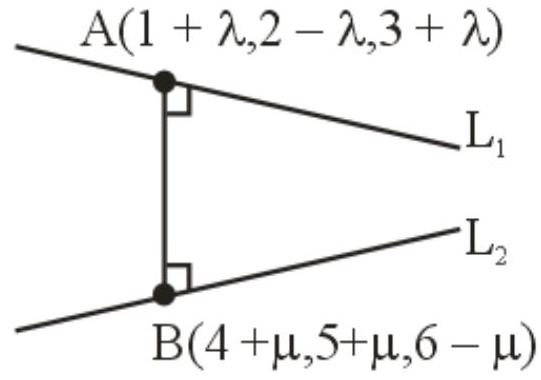
Question figure b→=i^−j^+k^(DR′s of L1) d→=i^+j^−k^( DR's of L2) b→×d→=|i^j^k^1−1111−1| =0i^+2j^+2k^ (DR's of Line perpendicular to L1 and L2 ) DR of AB line =(0,2,2)=(3+μ−λ,3+μ+λ,3−μ−λ) 3+μ−λ0=3+μ+λ2=3−μ−λ2 Solving above equation we get μ=−32 and λ=32 point A=(52,12,92) B=(52,72,152) Point of AB =(52,2,6)=(α,β,γ) 2(α+β+γ)=5+4+12=21
Question 137 / MCQ
Question 137
Let α→=3i^+j^ and β→=2i^−j^+3k^. If β→=β→1−β→2, where β→1 is parallel to α→ and β→2 is perpendicular to α→, then β→1×β→2 is equal to:
A.
12(3i^−9j^+5k^)
B.
12(−3i^+9j^+5k^)
C.
−3i^+9j^+5k^
D.
3i^−9j^−5k^
Correct answer: B

Source solution

Sol. β→=β1→−β2→ (i)∴β2→⋅α→=0 and Let β1→=λα→ α→⋅β→=α→⋅β1→−α→⋅β2→ ⇒5=λα2 ⇒5=λ×10 ⇒λ=12 ∴β1→=α→2 Cross product with β1→ in equation (i) ⇒β→×β1→=−β2→×β1→ ⇒β→×β1→=β1→×β2→=(β→×α→)2 ⇒β1→×β2→=12|i^j^k^2−13310| =12[−3i^−j^(−9)+k^(5)]=12[−3i^+9j^+5k^]
Question 138 / MCQ
Question 138
Let a→=2i^+3j^+4k^,b→=2i^−2j^−2k^ and c→=−i^+4j^+3k^. If d→ is a vector perpendicular to both b→ and c→ and a→⋅d→=18, Then |a→×d→|2 is equal to
A.
640
B.
760
C.
680
D.
720
Correct answer: D

Source solution

Sol. a=λ(b×c) b→×c→=|i^j^k^1−2−2−143|=2i^−j^+2k^ d→=λ(2i^−j^+2k^) a→⋅d→=18 λ=2 So d→=2(2i^−j^+2k^) d→×a→=|i^j^k^4−24234|=−20i^−8j^+16k^ |d→×a→|2=720
Question 139 / Numerical
Question 139
Let a→=i^+j^+k^,b→ and c→=j^−k^ be three vectors such that a→×b→=c→ and a→.b→=1. If the length of projection vector of the vector b→ on the vector a→×c→ is l, then the value of 3l2 is equal to ____.
Numerical answer: ____________________
Enter the requested integer (0 decimal places).
Correct answer: 2

Source solution

a→×b→=c Take Dot with c→ (a→×b→)⋅c→=|c→|2=2 Projection of b→ or a→×c→=ℓ |b→⋅(a→×c→)||a→×c→|ℓ∴ℓ=26⇒ℓ2=463ℓ2=2
Question 140 / Numerical
Question 140
Let P be a plane passing through the points (1, 0, 1), (1, -2, 1) and (0, 1, -2). let a vector a→=αi^+βj^+γk^ be such that a→ is parallel to the plane P , perpendicular to (i^+2j^+3k^) and a→(i^+j^+2k^)=2, then (α−β+γ)2 equals ____.
Numerical answer: ____________________
Enter the requested integer (0 decimal places).
Correct answer: 81

Source solution

Equation of plane : |x−1y−0z−11−121−11−00−11+2|=0⇒3x−z−2=0a→=αi^+βj^+γk^‖ to 3x−z−2=0⇒3α−γ=0a→⊥i+2j^+3k^⇒α+2β+3γ=0a→(i^+j^+3k^)=0⇒α+β+2γ=2 on solving 1,2 & 3 α=1,β=−5,γ=3 So (α−β+γ)=81
Question 141 / MCQ
Question 141
Let α→=(λ−2)a→+b→ and β→=(4λ−2)a→+3b→ be two given vectors where vectors a→ and b→ are non-collinear. The value of λ for which vectors α→ and β→ are collinear, is :
A.
-3
B.
4
C.
3
D.
-4
Correct answer: D

Source solution

Sol. α→=(λ−2)α→+b→ β→=(4λ−2)α→+3b→ λ−24λ−2=13 3λ−6=4λ−2 λ=−4 ∴ Option (4)
Question 142 / MCQ
Question 142
Let a^,b^ be unit vectors. If c→ be a vector such that the angle between a^ and c→ is π12, and b^=c→+2(c→×a^), then |6c→|2 is equal to
A.
6(3−3)
B.
3+3
C.
6(3+3)
D.
6(3+1)
Correct answer: C

Source solution

Sol. |b^|2=|c→+2(c→×a^)|2 |b^|2=|c|2+4|c→×a^|2+4c→.(c→×a^) 1=|c|2+4|c|2sin2⁡π12+0 1=|c|2+4|c|2(3−122)2 |c|2=13−3=3+36 So 62|c|2=6(3+3)
Question 143 / Numerical
Question 143
Let a→=6i^+9j^+12k^,b→=αi^+11j^−2k^ and c→ be vectors such that a→×c→=a→×b→. If a→.c→=−12, c→⋅(i^−2j^+k^)=5, then c→⋅(i^+j^+k^) is equal to
Numerical answer: ____________________
Enter the requested value (an integer; 0 decimal places). Use the units and scaling stated in the question.
Correct answer: 11

The source provides a brief answer only. A detailed worked solution is not available for this question.

Source solution

Question 144 / MCQ
Question 144
Let a→ be a vector which is perpendicular to the vector 3i^+12j^+2k^. If a→×(2i^+k^)=2i^−13j^−4k^, then the projection of the vector a→ on the vector 2i^+2j^+k^ is
A.
13
B.
1
C.
53
D.
73
Correct answer: C

Source solution

Sol. (a→×(2i^+k^))×(3i^+12j^+2k^) =(2i^−13j^−4k^)×(3i^+12j^+2k^) −(6+2)a→=|i^j^k^2−13−43122| a→=3i^+2j^−5k^ Projection of a→ on vector 2i^+2j^+k^ is a→⋅(2i^+2j^+k^)3=53
Question 145 / MCQ
Question 145
Let a→=2i^+αj^+k^,b˙=−i^+k^,c→=βj^−k^, where α and β are integers and αβ=−6. Let the values of the ordered pair ( α,β ) for which the area of the parallelogram of diagonals a→+b→ and b→+c→ is 212, be ( α1,β1 ) and ( α2,β2 ). Then α12+β12−α2β2 is equal to
A.
17
B.
24
C.
21
D.
19
Correct answer: D

Source solution

Sol. Area of parallelogram =12|d→1×d→2 A=12|(a→+b→)×(b→+c→)|=212 so, a→+b→=i^+αj^+2k^ b→+c→=−i^+βj^ (a→+b→)×(b→+c→)=|i^j^k^1α2−1β0| =i^(−2β)−j^(2)+k^(β+α) |(a→+b→)×(b→+c→)|=4β2+4+(α+β)2=21 4β2+4+α2+β2+2αβ=21 α2+5β2−12=17 α2+5β2=29 and αβ=−6 and given αiβ are integers so, α=−3,β=2 or α=3,β=−2 (α1,β1)=(−3,2) (α2,β2)=(3,−2) α12+β12−α2β2=9+4+6=19
Question 146 / Numerical
Question 146
Let c→ be the projection vector of b→=λi^+4k^,λ>0, on the vector a→=i^+2j^+2k^. If |a→+c→|=7, then the area of the parallelogram formed by the vectors b→ and c→ is .
Numerical answer: ____________________
Enter the requested value (an integer; 0 decimal places). Use the units and scaling stated in the question.
Correct answer: 16

Source solution

c→=(b→⋅a→|a→|)a→|a→| =(λ+89)(i^+2j^+2k^) |a→+c→|−=7⇒λ=4 Area of parallelogram =|b→×c→|=||i^j^k^438383404|| =16
Choose another chapter