Learne2i
Learne2i Priority Practice solutions
JEE Main 2025 / Session 2
All chapters

Mathematics

Mathematical Reasoning

Question 294 / MCQ
Question 294
The compound statement (∼(P∧Q))∨((∼P)∧Q)⇒((∼P)∧(∼Q)) is equivalent to
A.
(∼Q)∨P
B.
((∼P)∨Q)∧(∼Q)
C.
(∼P)∨Q
D.
((∼P)∨Q)∧((∼Q)∨P)
Correct answer: D

Source solution

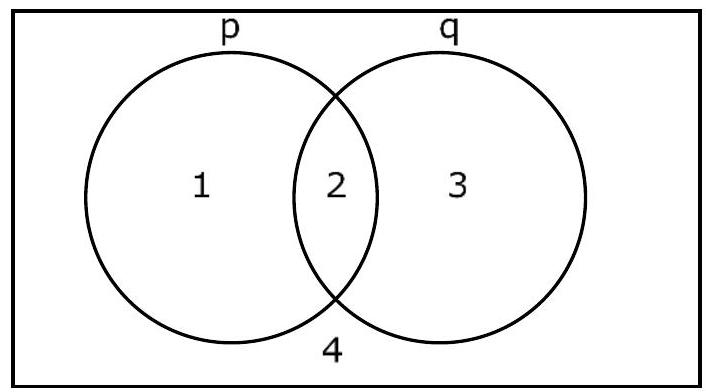
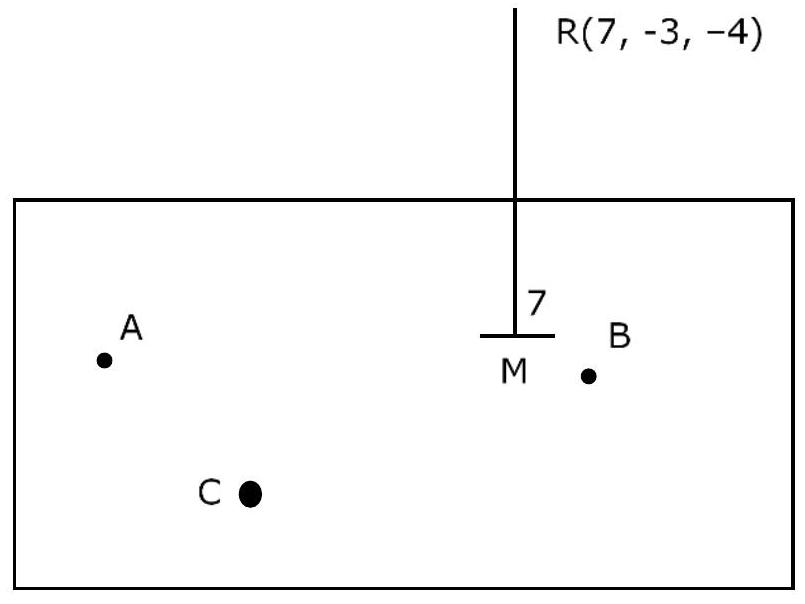
(∼(p∧q)∨(∼p∧q))→∼p∧∼q Question figure (1+2+4)+2⇒4(1+2+4)⇒4=∼(1+2+4)+4=3+4 Ans. 4 8o. The distance of the point (7,−3,−4) from the plane passing through the points (2,−3,1),(−1,1,−2) and (3,−4,2) is : (1) 5 (2) 4 (3) 52 (4) 42 Sol. (3) Question figure n―p=AB―×DC―=|i^j^k3−43−11−1|=⟨1,0,−1⟩ Equation of plane P:1(x−2)+0(y+3)−(z−1)=0P:x−z−1=0 d(RM)=|7+4−12|=52
Question 295 / MCQ
Question 295
The statement (p∧(∼q))⇒(p⇒(∼q)) is
A.
a tautology
B.
a contradiction
C.
equivalent to p∨q
D.
equivalent to (∼p)∨(∼q)
Correct answer: A

Source solution

(p∧(∼q))⇒(p⇒(∼q))
Pq∼qp∧∼qp⇒∼q(p∧∼q)⇒(p⇒∼q)
TTFFFT
TFTTTT
FTFFTT
FFTFTT
Tautology
Question 296 / MCQ
Question 296
(S1)(p⇒q)∨(p∧(∼q)) is a tautology (S2) ((∼p)⇒(∼q))∧((∼p)∨q) is a contradiction. Then
A.
both (S1) and (S2) are correct
B.
only ( S1) is correct
C.
only (S2) is correct
D.
both (S1) and (S2) are wrong
Correct answer: B

Source solution

S1:(P⇒q)V(P∧(∼q))
PqP⇒q∼qP∧∼q(P⇒q)V(P∧∼q)
TTTFFT
TFFTTT
FTTFFT
FFTTFT
S1 is a tautology S2:((∼P)⇒(∼q))∧((∼P)∨q)
∼P∼q∼P⇒∼q∼Pvq((∼P)⇒(∼q))Λ(∼P)vq)
FFTTT
FTTFF
TFFTF
TTTTT
S2 is not a contradiction
Question 297 / MCQ
Question 297
The negation of the expression q∨((∼q)∧p) is equivalent to
A.
(∼p)∨(∼q)
B.
p∧(∼q)
C.
(∼p)∨q
D.
(∼p)∧(∼q)
Correct answer: D

Source solution

∼(q∨(∼q)∧p)=∼q∧(q∨∼p)=(∼q∧q)∨(∼q∧∼p)=F∨(∼q∧∼p)=(∼q)∧(∼p)
Question 298 / MCQ
Question 298
The statement B⇒((∼A)∨B) is equivalent to :
A.
A⇒(A⇔B)
B.
A⇒((∼A)⇒B)
C.
A∧B
D.
A∨B
The original exam question has multiple correct choices and a conflicting printed ALLEN answer label. Independent truth-table verification establishes that original options 2, 3 and 4 are equivalent. In this corrected single-answer practice version, original options 1 and 2 are preserved; options 3 and 4 are replaced by A AND B and A OR B. Only option 2 is correct. The original defective choices remain in the review evidence.
Correct answer: B

Source solution

The target is ¬B∨¬A∨B, a tautology. Option 2 is ¬A∨A∨B, also a tautology. Option 1 reduces to ¬A∨B and is false at A=true, B=false. Option 3 is false at A=false, B=false, and option 4 is also false there. Therefore only option 2 is equivalent for every truth assignment.
Question 299 / MCQ
Question 299
Which of the following statements is a tautology ?
A.
p∨(p∧q)
B.
(p∧(p→q))→∼q
C.
(p∧q)→(∼(p)→q)
D.
p→(p∧(p→q))
Correct answer: C

Source solution

(i) p→(p∧(p→q)) ( ∼p)∨(p∧(∼p∨q)) ( ∼p)∨(f∨(p∧q)) ∼p∨(p∧q)=(∼p∨p)∧(∼p∨q) =∼p∨q (ii) (p∧q)→(∼p→q) ∼(p∧q)∨(p∨q)=t {a,b,d}∨{a,b,c}=V Tautology (iii) (p∧(p→q))→∼q ∼(p∧(∼p∨q))∨∼q=∼(p∧q)∨∼q=∼p∨∼q Not tautology (iv) pV(p∧q)=p Not tautology. So, option (2) is correct.
Question 300 / MCQ
Question 300
Consider the following statements: P : I have fever Q: I will not take medicine R : I will take rest. The statement "If I have fever, then I will take medicine and I will take rest" is equivalent to:
A.
((∼P)∨∼Q)∧((∼P)∨R)
B.
(P∨Q)∧((∼P)∨R)
C.
((∼P)∨∼Q)∧((∼P)∨∼R)
D.
(P∨∼Q)∧(P∨∼R)
Correct answer: A

Source solution

P→(∼Q∧R)∼PV(∼Q∧R)⇒((∼P)V(∼Q))∧((∼P)vR)
Choose another chapter