Learne2i
Learne2i Priority Practice solutions
JEE Main 2025 / Session 2
All chapters

Physics

Motion in a Plane

Question 21 / MCQ
Question 21
A body is projected at t=0 with a velocity 10 ms−1 at an angle of 60∘ with the horizontal. The radius of curvature of its trajectory at t=1 s is R . Neglecting air resistance and taking acceleration due to gravity g=10 ms−2, the value of R is :
A.
2.5 m
B.
10.3 m
C.
2.8 m
D.
5.1 m
Correct answer: C

Source solution

Sol. Initial velocity components: vx=10cos⁡60∘=5m s−1 vy=10sin⁡60∘=53m s−1 After t=1s, vx=5m s−1 vy=53−10 |vy|=10−53 Hence, v2=vx2+vy2 =25+(10−53)2 =25+100+75−1003 =200−1003 Let θ be the angle made by the velocity with the horizontal. tan⁡θ=10−535=2−3 θ=15∘ Normal acceleration: an=gcos⁡θ =10cos⁡15∘ Using an=v2R R=v2an=200−100310cos⁡15∘ =100(2−3)10cos⁡15∘ R≈2.8m
Question 22 / MCQ
Question 22
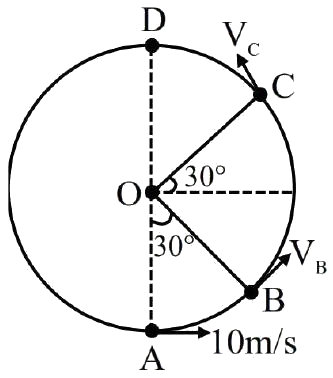
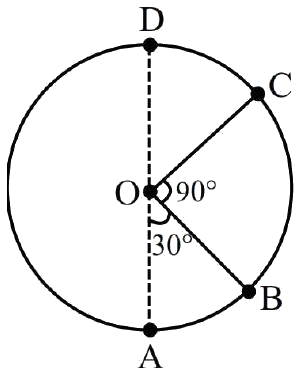
A body of mass 100 g is moving in circular path of radius 2 m on vertical plane as shown in figure. The velocity of the body at point A is 10 m/s. The ratio of its kinetic energies at point B and C is :(Take acceleration due to gravity as 10 m/s2 )Question figure
A.
2+33
B.
2+23
C.
3+32
D.
3−22
Correct answer: C

Source solution

12m×100+0=12mVB2+mg(R−R32) 100=VB2+2gR(1−32) VB2=100−20(2−3) VB2=60+203 K⋅EB=12mVB2=m2(60+203) 12m(100)=12mVC2+mg(3R2) 100=VC2+60 VC2=40 K⋅EC=12mVC2=12m(40) K⋅EB=60+20340=32+32=3+32Question figure
Question 23 / MCQ
Question 23
A projectile is projected at 30∘ from horizontal with initial velocity 40 ms−1. The velocity of the projectile at t=2 s from the start will be:(Given g=10 m/s2 )
A.
203 ms−1
B.
403 ms−1
C.
20 ms−1
D.
Zero
Correct answer: A

Source solution

Sol. Time to reach maximum height: tmax=usin⁡θg =40sin⁡30∘10=2s Hence, at t=2s, the particle is at the highest point of its trajectory. At maximum height, vy=0 and only the horizontal component remains: v=vx=ucos⁡θ =40cos⁡30∘ =40⋅32 =203m s−1
Question 24 / MCQ
Question 24
A man carrying a monkey on his shoulder does cycling smoothly on a circular track of radius 9 m and completes 120 revolutions in 3 minutes. The magnitude of centripetal acceleration of monkey is (in m/s2 ) :
A.
zero
B.
16π2 ms−2
C.
4π2 ms−2
D.
57600π2 ms−2
Correct answer: B

Source solution

Given, R=9m and 120 revolutions in 3 min Angular speed: ω=120×2π3×60 =4π3rad s−1 Centripetal acceleration is ac=ω2R =(4π3)2×9 =16π29×9 =16π2m s−2
Question 25 / MCQ
Question 25
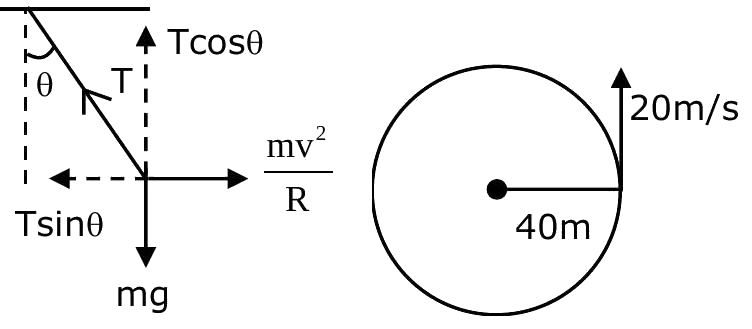
A car is moving with a constant speed of 20 m/s in a circular horizontal track of radius 40 m . A bob is suspended from the roof of the car by a massless string. The angle made by the string with the vertical will be: (Take g= 10 m/s2 )
A.
π3
B.
π2
C.
π4
D.
π6
Correct answer: C

Source solution

Sol. 3 (i)Tcos⁡θ=mg (ii)Tsin⁡θ=mv2R eq(i)eq(ii);cos⁡θsin⁡θ=gRv2 tan⁡θ=v2Rg=40040×10=1 θ=π4Question figure
Question 26 / Numerical
Question 26
The resultant of two vectors A→ and B→ is perpendicular to A→ and its magnitude is half that of B→. The angle between vectors A→ and B→ is
Numerical answer: ____________________
Enter the requested value (an integer; 0 decimal places). Use the units and scaling stated in the question.
Correct answer: 150

Source solution
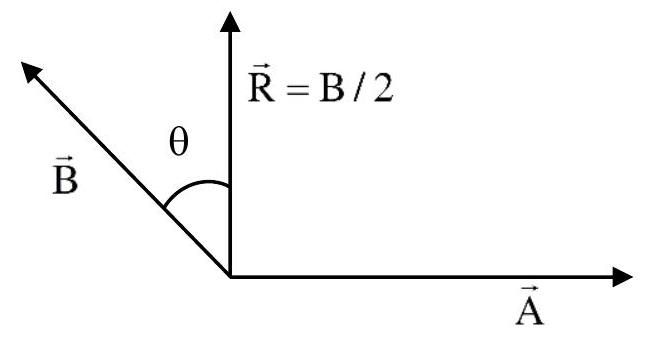
Question figure Bcos⁡θ=B2 ⇒θ=60∘ So, angle between A→& B→ is 90∘+60∘=150∘
Question 27 / Numerical
Question 27
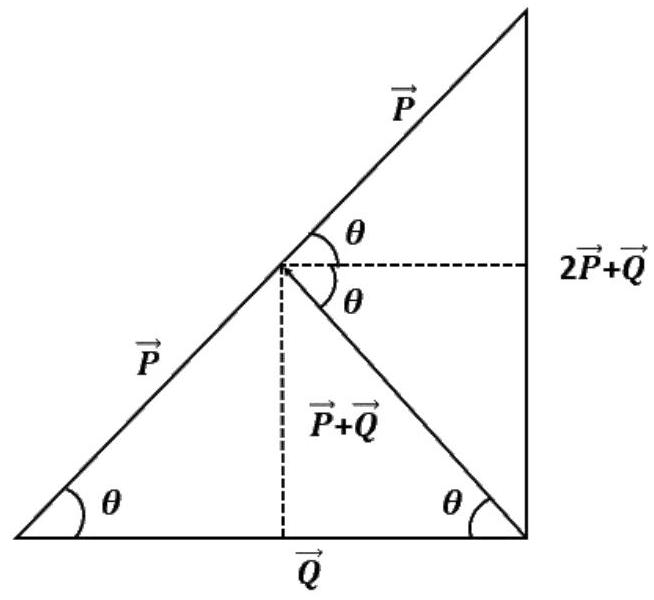
Magnitude of resultant of two vectors P→ and Q→ is equal to magnitude of P→. Find the angle between Q→ and resultant of 2P→ and Q→.
Numerical answer: ____________________
Enter the requested value (an integer; 0 decimal places). Use the units and scaling stated in the question.
Correct answer: 90

Source solution

( 90∘ ) Question figure
Choose another chapter