Learne2i
Learne2i Priority Practice solutions
JEE Main 2025 / Session 2
All chapters

Physics

Laws of Motion

Question 28 / Numerical
Question 28
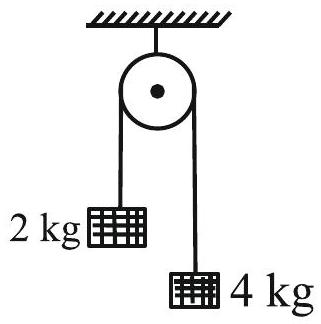
Two blocks of mass 2 kg and 4 kg are connected by a metal wire going over a smooth pulley as shown in figure. The radius of wire is 4.0×10⁻⁵ m and Young's modulus of the metal is 2.0×10¹¹ N/m2. The longitudinal strain developed in the wire is 1απ. The value of α is . [Use g=10 m/s2 ) Question figure
Numerical answer: ____________________
Enter the requested value (an integer; 0 decimal places). Use the units and scaling stated in the question.
Correct answer: 12

Source solution

T=(2 m1 m2 m1+m2)g=803 N A=πr2=16π×10−10 m2 Strain =Δℓℓ=FAY=TAY =80/316π×10−10×2×1011=112π α=12
Question 29 / Numerical
Question 29
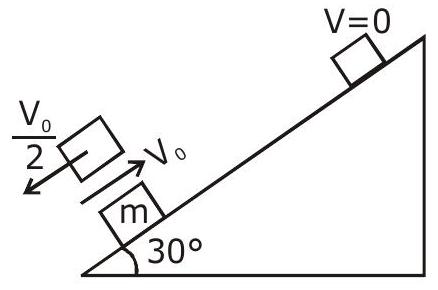
A block starts moving up an inclined plane of inclination 30∘ with an initial velocity of v0. It comes back to its initial position with velocity v02. The value of the coefficient of kinetic friction between the block and the inclined plane is close to I1000. The nearest integer to I is .
Numerical answer: ____________________
Enter the requested value (an integer; 0 decimal places). Use the units and scaling stated in the question.
Correct answer: 346

Source solution

346 Question figure a=gsin⁡30+μgcos⁡30 V02=2ad d=V022a Wf=kf−ki −2μmgcos⁡30 V022a=12 m V024−12mV02 +2μ gcos⁡30a=+34 8μ gcos⁡30=3 gsin⁡30+3μ gcos⁡30 5μ gcos⁡30=3 gsin⁡30 μ=3tan⁡305=35 35=I1000 I=346
Question 30 / MCQ
Question 30
A bullet of mass 0.1 kg moving horizontally with speed 400 ms−1 hits a wooden block of mass 3.9 kg kept on a horizontal rough surface. The bullet gets embedded into the block and moves 20 m before coming to rest. The coefficient of friction between the block and the surface is ......... .(Given g=10 ms2 )
A.
0.50
B.
0.90
C.
0.65
D.
0.25
Correct answer: D

Source solution

Using conservation of momentum during collision: Pi=Pf (0.1)(400)=(0.1+3.9)v 40=4v v=10m/s After collision, the system moves with retardation due to friction: a=μmgm=μg Using equation of motion: v2=u2+2as Final velocity becomes zero after distance s=20m: 0=(10)2−2μg⋅20 100=40μg Taking g=10m/s2: 100=40μ⋅10 100=400μ μ=14
Question 31 / Numerical
Question 31
A mass of 10 kg is suspended vertically by a rope of length 5 m from the roof. A force of 30 N is applied at the middle point of rope in horizontal direction. The angle made by upper half of the rope with vertical is θ=tan−1⁡(x×10−1). The value of x is . (Given g=10 m/s2 )
Numerical answer: ____________________
Enter the requested value (an integer; 0 decimal places). Use the units and scaling stated in the question.
Correct answer: 3

Source solution
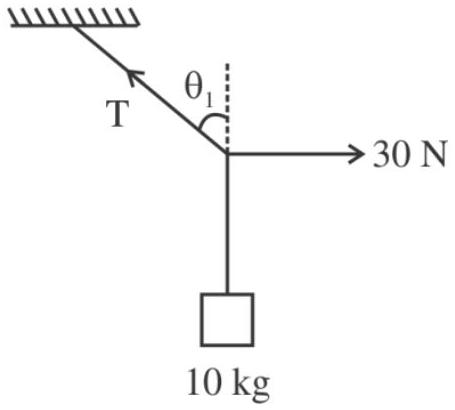
Question figure Tsin⁡θ=30 Tcos⁡θ=100 ⇒tan⁡θ=0.3
Question 32 / Numerical
Question 32
A rectangular block of mass 5 kg attached to a horizontal spiral spring executes simple harmonic motion of amplitude 1 m and time period 3.14 s . The maximum force exerted by spring on block is N.
Numerical answer: ____________________
Enter the requested value (an integer; 0 decimal places). Use the units and scaling stated in the question.
Correct answer: 20

Source solution

∴T=3.14=π T=π=2πω⇒ω=2 Fmax=mamax=m( Aω2)=mA(2)2=5×1×4=20 N
Question 33 / MCQ
Question 33
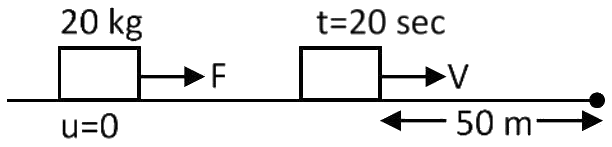
A force acts for 20 s on a body of mass 20 kg , starting from rest, after which the force ceases and then body describes 50 m in the next 10 s . The value of force will be:
A.
40 N
B.
5 N
C.
20 N
D.
10 N
Correct answer: B

Source solution

Sol. (2) 50=V×10V=5m/sV=0+a×205=a×20a=14m/s2F=ma=20×14=5NQuestion figure
Question 34 / Numerical
Question 34
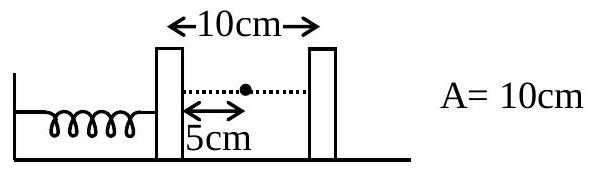
A block is fastened to a horizontal spring. The block is pulled to a distance x=10 cm from its equilibrium position (at x=0 ) on a frictionless surface from rest. The energy of the block at x=5 cm is 0.25 J . The spring constant of the spring is Nm−1
Numerical answer: ____________________
Enter the requested value (an integer; 0 decimal places). Use the units and scaling stated in the question.
Correct answer: 50

Source solution

(50) Given Question figure At any instant total energy for free oscillation remains constant =12kA2 ⇒12kA2=0.25 J ⇒12kA2=0.25 J⇒ K=0.25×2 A2 ⇒k=0.50(10 cm)2=0.50(10×10−2)=0.50×104100 k=0.50×100=50 N/m
Question 35 / Numerical
Question 35
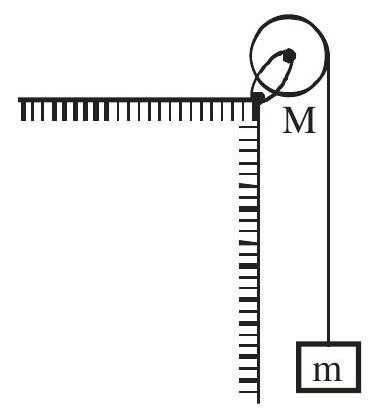
A uniform disc with mass M=4 kg and radius R= 10 cm is mounted on a fixed horizontal axle as shown in figure. A block with mass m=2 kg hangs from a massless cord that is wrapped around the rim of the disc. During the fall of the block, the cord does not slip and there is no friction at the axle. The tension in the cord is N. ( Take g=10 ms−2) Question figure
Numerical answer: ____________________
Enter the requested value (an integer; 0 decimal places). Use the units and scaling stated in the question.
Correct answer: 10

Source solution
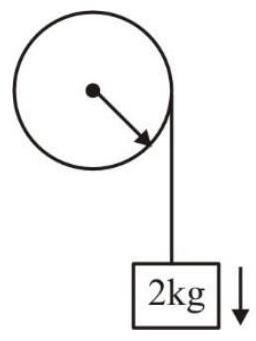
Question figure (1)2 g−T=2a (2)TR=MR22α (3)α=aR T=2a 2 g−T=2a T=g=10 N
Question 36 / Numerical
Question 36
A metal block of mass m is suspended from a rigid support through a metal wire of diameter 14 mm . The tensile stress developed in the wire under equilibrium state is 7×10⁵Nm−2. The value of mass m is kg. (Take, g=9.8 ms−2 and π=227 )
Numerical answer: ____________________
Enter the requested value (an integer; 0 decimal places). Use the units and scaling stated in the question.
Correct answer: 11

Source solution

Tensile stress, σ=FA=4mgπD2 ∴m=πD2σ4g=227×(14×10−3)2×7×1054×9.8=11 kg
Question 37 / Numerical
Question 37
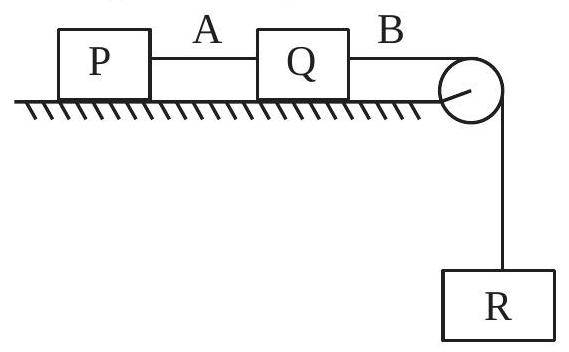
Each of three blocks P,Q and R shown in figure has a mass of 3 kg . Each of the wire A and B has cross-sectional area 0.005 cm2 and Young's modulus 2×10¹¹ N m−2. Neglecting friction, the longitudinal strain on wire B is ×10−4. (Take g=10 m/s2 ) Question figure
Numerical answer: ____________________
Enter the requested value (an integer; 0 decimal places). Use the units and scaling stated in the question.
Correct answer: 2

Source solution
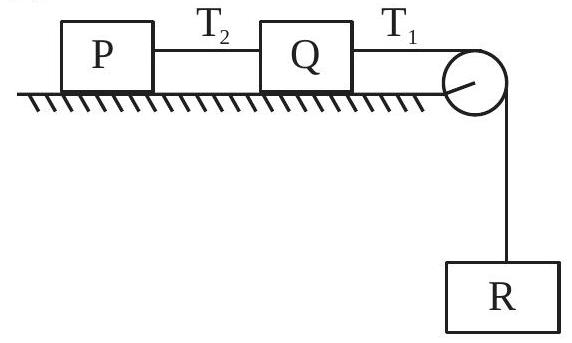
Question figure a=103 m/s2 30−T1=3×a T1=20 N strain = stress Y =2×10⁻⁴
Choose another chapter