
Learne2i
Learne2i Priority Practice solutions
JEE Main 2025 / Session 2
All chapters

Physics

Mechanical Properties of Solids

Question 65 / Numerical
Question 65
A uniform heavy rod of mass 20 kg . Cross sectional area 0.4 m2 and length 20 m is hanging from a fixed support. Neglecting the lateral contraction, the elongation in the rod due to its own weight is x×10−9 m. The value of x is . :(Given. Young's modulus Y=2×10¹¹Nm−2 and g=10 ms−2 )
Numerical answer: ____________________
Enter the requested value (an integer; 0 decimal places). Use the units and scaling stated in the question.
Correct answer: 25

Source solution
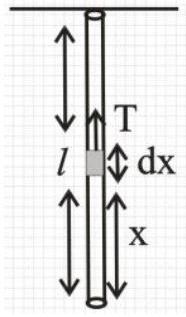
Question figure Y=TAdxdy m=20 kg A=0.4m2 1=20 m let extension is dy in length dx Y= stress  strain  Y=TAdydx=TA⋅dxdy dy=TdxAY Tension at a distance x from lower end =mgℓx So. ∫0Δldy=∫0ℓmgℓxdxAY Δℓ=mgℓAY[x22]0ℓ Δℓ=mgℓ2AY Δℓ=20×10×202×0.4×2×1011 2500×10−11 Δℓ=25×10−9 =x×10−9 x=25
Question 66 / Numerical
Question 66
One end of a metal wire is fixed to a ceiling and a load of 2 kg hangs from the other end. A similar wire is attached to the bottom of the load and another load of 1 kg hangs from this lower wire. Then the ratio of longitudinal strain of upper wire to that of the lower wire will be . [Area of cross section of wire =0.005 cm2, Y=2×10¹¹Nm−2 and g=10 ms−2 ]
Numerical answer: ____________________
Enter the requested value or coefficient rounded to the nearest integer (0 decimal places).
Correct answer: 3

Source solution

The upper wire supports both loads, so T1=30N; the lower wire supports the 1 kg load, so T2=10N. For identical wires, strain is T/(AY). The ratio is 30/10=3.
Question 67 / Numerical
Question 67
The speed of a transverse wave passing through a string of length 50 cm and mass 10 g is 60 ms−1. The area of cross-section of the wire is 2.0 mm2 and its Young's modulus is 1.2×10¹¹Nm−2. The extension of the wire over its natural length due to its tension will be x×10−5 m. The value of x is .
Numerical answer: ____________________
Enter the requested value (an integer; 0 decimal places). Use the units and scaling stated in the question.
Correct answer: 15

Source solution

Vw=Tμ 60=T10×10−3×0.5 T=(60)2×10−20.5=72 N Δℓ=FℓAY=72×0.52×10−6×1.2×1011 =72×524×10−5=15×10−5 Ans. 15
Question 68 / MCQ
Question 68
A 100 m long wire having cross-sectional area 6.25×10⁻⁴ m2 and Young's modulus is 1010Nm−2 is subjected to a load of 250 N , then the elongation in the wire will be:
A.
4×10⁻³ m
B.
6.25×10⁻³ m
C.
6.25×10⁻⁶ m
D.
4×10⁻⁴ m
Correct answer: A

Source solution

Using Stress=Y×Strain, WA=YΔℓℓ. Hence, Δℓ=WℓYA. Substituting W=250 N,ℓ=100 m, Y=1010 N m−2,A=6.25×10⁻⁴ m2, Δℓ=250×1001010×6.25×10−4. Δℓ=4×10⁻³ m. Δℓ=4×10⁻³ m or Δℓ=4 mm.
Question 69 / Numerical
Question 69
In a Young's double slit experiment, the slits are separated by 0.3 mm and the screen is 1.5 m away from the plane of slits. Distance between fourth bright fringes on both sides of central bright is 2.4 cm . The frequency of light used is ×1014 Hz.
Numerical answer: ____________________
Enter the requested value (an integer; 0 decimal places). Use the units and scaling stated in the question.
Correct answer: 5

Source solution

8β=2.4 cm 8λΔ d=2.4 cm 8×1.5×c0.3×10−3×f=2.4×10⁻² f=5×10¹⁴ Hz
Question 70 / Numerical
Question 70
In a Young's double slit experiment, the intensity at a point is (14)th  of the maximum intensity, the minimum distance of the point from the central maximum is μm. (Given : λ=600 nm, d=1.0 mm,D=1.0 m )
Numerical answer: ____________________
Enter the requested value (an integer; 0 decimal places). Use the units and scaling stated in the question.
Correct answer: 200

Source solution

I=I0cos2⁡(Δϕ2) I04=cos2⁡(Δϕ2) Δϕ=2π3 2πλ(ydD)=2π3 y=λD3 d=600×10−9×13×10−3=2×10⁻⁴ m
Question 71 / MCQ
Question 71
A steel wire having a radius of 2.0 mm , carrying a load of 4 kg , is hanging from a ceiling. Given that g=3.1π ms−2, what will be the tensile stress that would be developed in the wire?
A.
4.8×10⁶Nm−2
B.
3.1×10⁶Nm−2
C.
5.2×10⁶Nm−2
D.
6.2×10⁶Nm−2
Correct answer: B

Source solution

Stress is given by Stress=FA. Here, F=4×3.1π N, and the cross-sectional area is A=πr2=π(2×10⁻³)2. Therefore, Stress=4×3.1ππ(2×10⁻³)2. =12.44×10−6=3.1×10⁶ N m−2. Stress=3.1×10⁶ N m−2
Question 72 / Numerical
Question 72
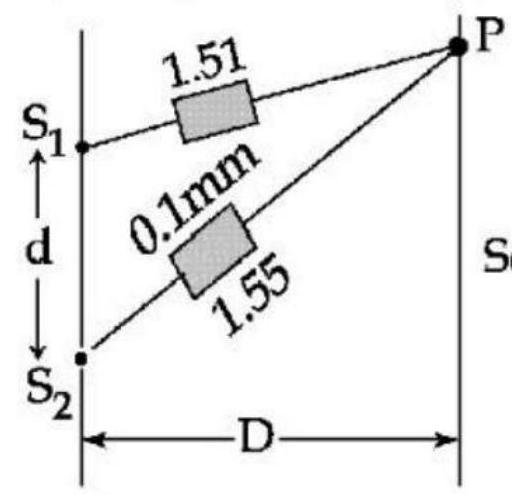
In Young's double slit experiment, two slits S1 and S2 are ' d ' distance apart and the separation from slits to screen is D (as shown in figure). Now if two transparent slabs of equal thickness 0.1 mm but refractive index 1.51 and 1.55 are introduced in the path of beam ( λ=4000\AA ) from S1 and S2 respectively. The central bright fringe spot will shift by number of fringes. Question figure creen
Numerical answer: ____________________
Enter the requested value (an integer; 0 decimal places). Use the units and scaling stated in the question.
Correct answer: 10

Source solution

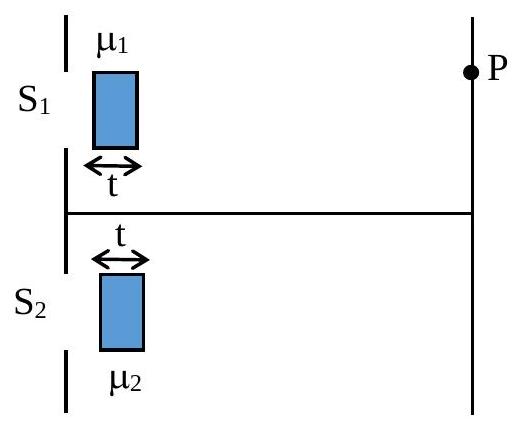
(10) Question figure μ1=1.51t=0.1 mmμ2=1.55λ=4000\AA Shifting central maxima Δx=[S1P+(μ1−1)t]−[S2P+(μ2−1)t] 0=(S1P−S2P)+(μ1−1)t−(μ2−1)t 0=ydD+(μ1−μ2)t (μ2−μ1)t=ydD (1.55−1.51)(0.1 mm)=y×dD (1)Dd(0.04×0.1)×10−3=y Now Fringe width ⇒β=λDd No. of fringes shifted =yβ=4×10−64000\AA=10 Ans. 10
Choose another chapter