Learne2i
Learne2i Priority Practice solutions
JEE Main 2025 / Session 2
All chapters

Physics

Electric Charges and Fields

Question 128 / Numerical
Question 128
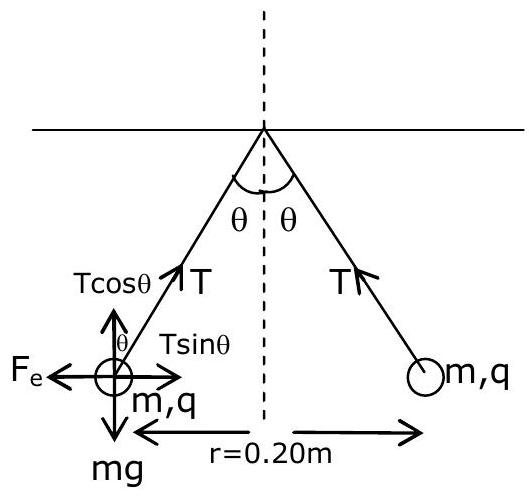
Two small spheres each of mass 10 mg are suspended from a point by threads 0.5 m long. They are equally charged and repel each other to a distance of 0.20 m . Then charge on each of the sphere is a21×10−8C. The value of 'a' will be .
Numerical answer: ____________________
Enter the requested value (an integer; 0 decimal places). Use the units and scaling stated in the question.
Correct answer: 20

Source solution

20 Question figure Tsin⁡θ=kq2r2 Tcos⁡θ=mg tan⁡θ=kq2mgr2 q2=tan⁡θmgr2k ∵tan⁡θ=0.10.5=15 q2=15×10×10−6×10×0.2×0.29×109 q=223×10−8 after comparison from the given equation a=20
Question 129 / MCQ
Question 129
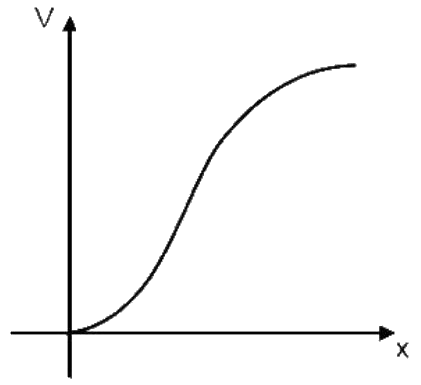
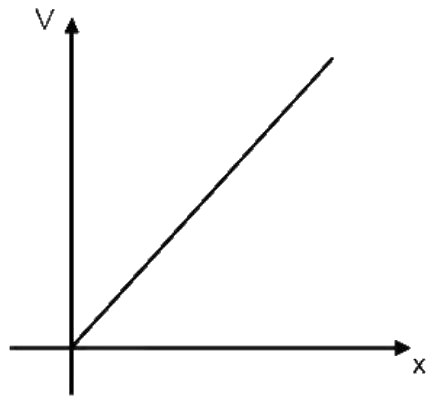
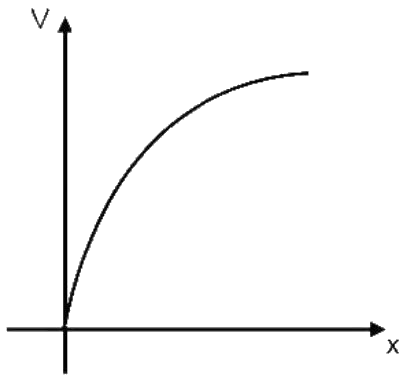
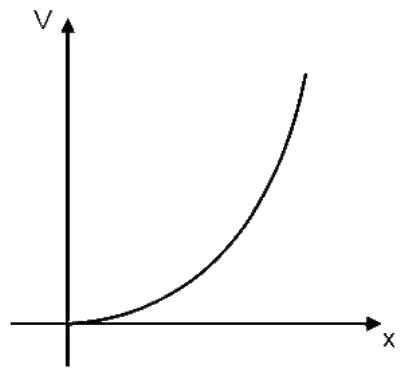
A charge particle of mass m and charge q is released from rest in uniform electric fiel(4) Its graph between velocity ( v ) and distance ( x ) will be :Question figure
A.
Question figure
B.
Question figure
C.
D.
Question figure
Correct answer: B

Source solution

Sol. Applying the work-energy theorem, qEx=12mv2⇒v2∝x Hence, the answer will be option (2).
Question 130 / Numerical
Question 130
A proton is moving undeflected in a region of crossed electric and magnetic fields at a constant speed of 2×10⁵ ms−1. When the electric field is switched off, the proton moves along a circular path of radius 2 cm . The magnitude of electric field is x×104 N/C. the value of x is . Take the mass of the proton =1.6×10⁻²⁷ kg.
Numerical answer: ____________________
Enter the requested value (an integer; 0 decimal places). Use the units and scaling stated in the question.
Correct answer: 2

Source solution

For uniform speed V=EB R=mVeB =mV2eE ⇒E=mV2eR =1.6×10−27×4×10101.6×10−19×2×10−2 =2×10⁴ N/C.
Question 131 / MCQ
Question 131
Two uniformly charged spherical conductors A and B of radii 5 mm and 10 mm are separated by a distance of 2 cm . If the spheres are connected by a conducting wire, then in equilibrium condition, the ratio of the magnitudes of the electric fields at the surface of the sphere A and B will be :
A.
1:2
B.
2:1
C.
1:1
D.
1:4
Correct answer: B

Source solution

VA=VB KQARA=KQBRBQAQB=RARB=12 EA=KQARA2,EB=KQBRB2 EAEB=QAQB⋅RB2RA2=RARB⋅RB2RA2=RBRA=21 EAEB=2
Question 132 / Numerical
Question 132
A particle of mass 1 mg and charge q is lying at the mid-point of two stationary particles kept at distance '2 m' when each is carrying same charge 'q'. If the free charged particle is displaced from its equilibrium position through distance 'x' (x≪1 m). The particle executes SHM. Its angular frequency of oscillation will be ____ ×105rad/s if q2=10C2
Numerical answer: ____________________
Enter the requested integer (0 decimal places).
Correct answer: 6

Source solution
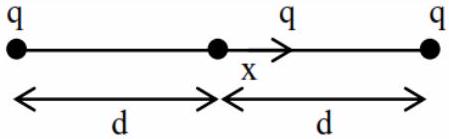
Question figure Net force on free charged particle F=kq2( d+x)2−kq2( d−x)2 F=−kq2[4dx( d2−x2)2]a=−4kq2 d m(x d4)a=−(4kq2md3)x So, angular frequency ω=4kq2md3ω=4×9×109×101×10−6×13ω=6×10⁸rad/sec
Question 133 / Numerical
Question 133
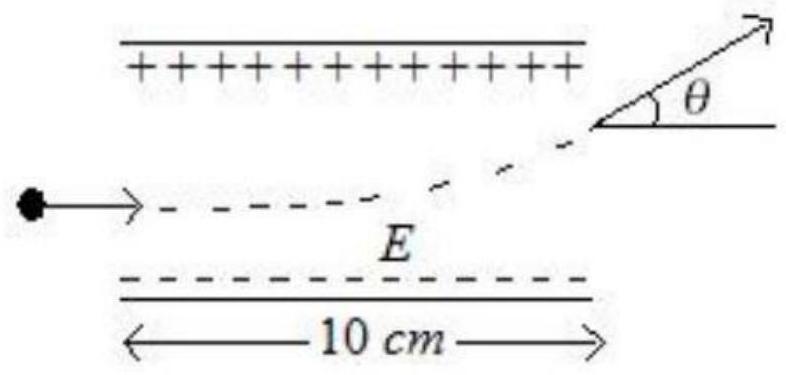
A uniform electric field of 10 N/C is created between two parallel charged pates (as shown in figure). An electron enters the field symmetrically between the plates with a kinetic energy 0.5 eV . The length of each pate is 10 cm . The angle ( θ ) of deviation of the path of electron as it comes out of the field is (in degree). Question figure
Numerical answer: ____________________
Enter the requested value (an integer; 0 decimal places). Use the units and scaling stated in the question.
Correct answer: 45

Source solution
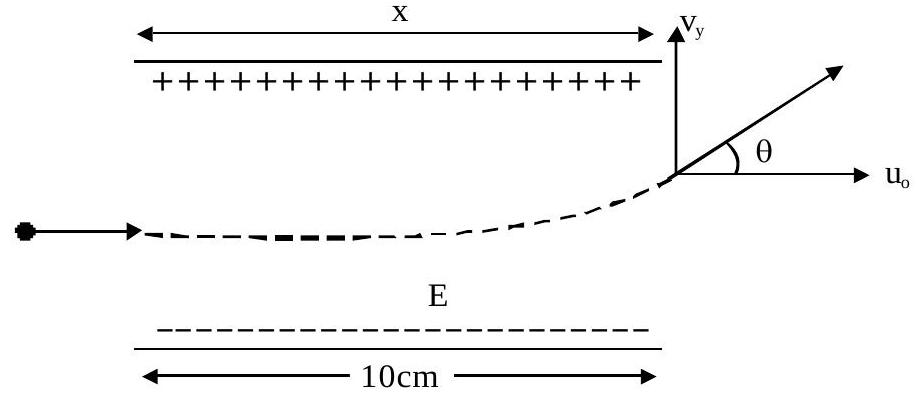
450 Question figure Force due to electric field is given by F→=qE→ ∴F=eE ⇒a=eEm The electron will take a parabolic path i.e., projectile motion. Here, sx=10 cm=0.1 m ∴t=0.1ux−−−−(i) Now vy=uy+ayt (ii)⇒vy=0+eEm×0.1ux Also KE=12mv2=12mux2 mux2=2×KE=2×0.5e=e−−−− (iii) From eq (i),(ii) and (iii), tan⁡θ=vyux=eEm×0.1ux×1ux=0.1eEmux2=0.1eEe=0.1×10=1 ⇒tan⁡θ=1 ∴θ=450
Question 134 / Numerical
Question 134
Three infinitely long charged thin sheets are placed as shown in figure. The magnitude of electric field at the point P is xσϵ0. The value of x is (all quantities are measured in SI units). Question figure
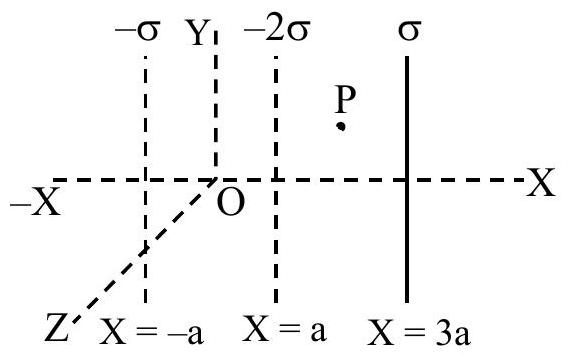
Numerical answer: ____________________
Enter the requested value (an integer; 0 decimal places). Use the units and scaling stated in the question.
Correct answer: 2

Source solution
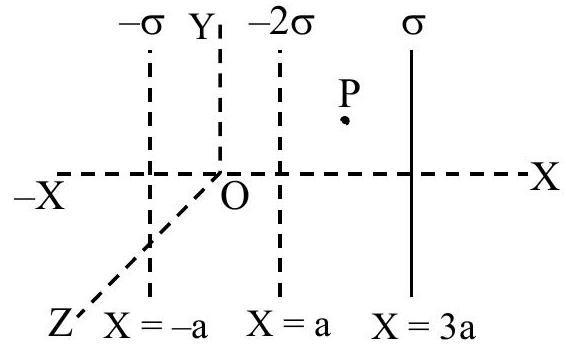
Question figure E→p=(σ2ε0+2σ2ε0+σ2ε0)(−i^)=−2σε0i^
Question 135 / MCQ
Question 135
Two charges q and 3 q are separated by a distance ' r ' in air. At a distance x from charge q, the resultant electric field is zero. The value of x is :
A.
(1+3)r
B.
r3(1+3)
C.
r(1+3)
D.
r(1+3)
Correct answer: C

Source solution

Sol. (E→net)P=0 kqx2=k⋅3q(r−x)2 (r−x)2=3x2 r−x=3x x=r3+1Question figure
Question 136 / MCQ
Question 136
Match List-I with List-II. List-IList-II(A) Electric field inside (r > 0) of a uniformly charged spherical shell(III) 0(B) Electric field at distance r > 0 from a uniformly charged infinite plane sheet(II) σ2ε0(C) Electric field outside (r > 0) of a uniformly charged spherical shell(IV) σε0r2(D) Electric field between two oppositely charged infinite plane parallel sheets(I) σε0 Choose the correct answer from the options given below:
A.
(A)-(IV), (B)-(I), (C)-(III), (D)-(II)
B.
(A)-(IV), (B)-(II), (C)-(III), (D)-(I)
C.
(A)-(II), (B)-(I), (C)-(IV), (D)-(III)
D.
(A)-(III), (B)-(II), (C)-(IV), (D)-(I)
Correct answer: D

Source solution

(A) Electric field inside a uniformly charged spherical shell By Gauss's law, E=0 for all points inside the shell. (A)→(III) \vspace{0.2cm} (B) Electric field due to an infinite plane sheet of charge E=σ2ε0 which is independent of the distance from the sheet. (B)→(II) \vspace{0.2cm} (C) Electric field outside a uniformly charged spherical shell The shell behaves like a point charge. E=14πε0Qr2 Since Q=4πR2σ, E=σR2ε0r2∝σε0r2 (C)→(IV) \vspace{0.2cm} (D) Electric field between two oppositely charged infinite parallel sheets The fields due to the two sheets add up: E=σ2ε0+σ2ε0=σε0 (D)→(I) Therefore, (A)→(III),(B)→(II),(C)→(IV),(D)→(I)
Choose another chapter