
Learne2i
Learne2i Priority Practice solutions
JEE Main 2025 / Session 2
All chapters

Physics

Wave Optics

Question 247 / MCQ
Question 247
In YDSE path difference at a point on the screen is 8λ. Find ratio of intensity at this point with maximum intensity.
A.
0.533
B.
0.853
C.
0.234
D.
0.123
Correct answer: B

Source solution

In YDSE, the intensity at a point on the screen varies with the phase difference between the interfering light waves as: I=I0cos2⁡(Δϕ2) Here, Δϕ= phase difference between the interfering waves and I0= maximum intensity on the screen. II0=cos2⁡[2πλ⋅Δx2]=cos2⁡(π8)II0=0.853
Question 248 / MCQ
Question 248
A single slit of width a is illuminated by a monochromatic light of wavelength 600 nm . The value of 'a' for which first minimum appears at θ=30∘ on the screen will be :
A.
0.6μ m
B.
1.2μ m
C.
1.8μ m
D.
3μ m
Correct answer: B

Source solution

For the first minimum in single-slit diffraction, asin⁡θ=λ Given, θ=30∘,λ=600×10−9m. Therefore, asin⁡30∘=600×10−9m a=600×10−9msin⁡30∘ =600×10−91/2 =1200×10−9m =1.2×10⁻⁶m=1.2μm. a=1.2μm
Question 249 / MCQ
Question 249
Young's double slit interference apparatus is immersed in a liquid of refractive index 1.44. It has slit separation of 1.5 mm . The slits are illuminated by a parallel beam of light whose wavelength in air is 690 nm . The fringe-width on a screen placed behind the plane of slits at a distance of 0.72 m , will be :
A.
0.23 mm
B.
0.33 mm
C.
0.63 mm
D.
0.46 mm
Correct answer: A

Source solution

β=(λ0μ)Dd Substituting the given values, β=690×10−9m×0.721.44×1.5×10−3m =496.8×10−92.16×10−3 =230×10−6m =0.23×10⁻³m=0.23mm. β=0.23mm
Question 250 / MCQ
Question 250
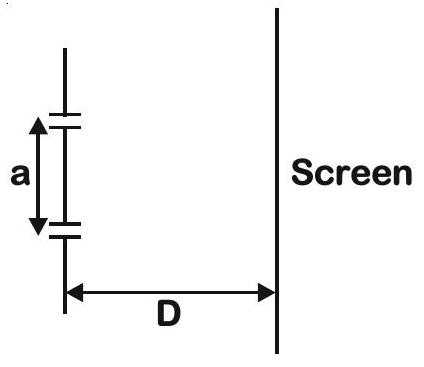
The figure shows a Young's double slit experimental setup. It is observed that when a thin transparent sheet of thickness t and refractive index μ is put in front of one of the slits, the central maximum gets shifted by a distance equal to n fringe widths. If the wavelength of light used is λ, t will be Question figure
A.
nλμ−1
B.
2Dλa(μ−1)
C.
nDλa(μ−1)
D.
Dλa(μ−1)
The original exam question had no correct option and was marked BONUS. For this corrected practice version, option 1 has been replaced with the correct value; the original statement and the other three options are retained.
Correct answer: A

Source solution

The inserted sheet adds optical path (μ−1)t. A shift of n fringe widths corresponds to path difference nλ. Thus t=nλ/(μ−1), independent of D and slit separation a.
Question 251 / MCQ
Question 251
In a double slit experiment, when a thin film of thickness t having refractive index μ is introduced in front of one of the slits, the maximum at the centre of the fringe pattern shifts by one fringe width. The value of t is ( λ is the wavelength of the light used) :
A.
2λ(μ−1)
B.
λ2(μ−1)
C.
λ(2μ−1)
D.
λ(μ−1)
Correct answer: D

Source solution

μt−t=λ t(μ−1)=λ t=λμ−1
Question 252 / MCQ
Question 252
In Young's double slit experiment, light from two identical sources are superimposing on a screen. The path difference between the two lights reaching at a point on the screen is 7λ4. The ratio of intensity of fringe at this point with respect to the maximum intensity of the fringe is :
A.
1/2
B.
3/4
C.
1/3
D.
1/4
Correct answer: A

Source solution

Δx=7λ4 ϕ=2πλΔx=2πλ⋅7λ4=7π2 I=Imaxcos2(ϕ2) IImax=cos2(ϕ2)=cos2(7π4) =cos2(2π−π4) =cos2(π4) =(12)2=12 IImax=12
Question 253 / MCQ
Question 253
The Young's double slit interference experiment is performed using light consisting of 480 nm and 600 nm wavelengths to form interference patterns. The least number of the bright fringes of 480 nm light that are required for the first coincidence with the bright fringes formed by 600 nm light is :-
A.
4
B.
8
C.
6
D.
5
Correct answer: D

Source solution

n1λ1Dd=n2λ2Dd n1λ1=n2λ2 Given, λ1=480nm,λ2=600nm. Therefore, 480n1=600n2 4n1=5n2. For the minimum values of n1 and n2, n1=5,n2=4. Hence, n1,min=5
Question 254 / MCQ
Question 254
In young's double slit experiment, the fringe width is 12 mm . If the entire arrangement is placed in water of refractive index 43, then the fringe width becomes (in mm )
A.
16
B.
9
C.
48
D.
12
Correct answer: B

Source solution

For a given light wavelength corresponding to a medium of refractive index μ, λmed=λvacuumμ and we know that fringe width β=λDd Therefore, βmed=βvacuumμ=12mm43=9mm
Question 255 / MCQ
Question 255
The width of fringe is 2 mm on the screen in a double slits experiment for the light of wavelength of 400 nm . The width of the fringe for the light of wavelength 600 nm will be:
A.
4 mm
B.
1.33 mm
C.
3 mm
D.
2 mm
Correct answer: C

Source solution

Fringe width (β)=Dλd ⇒β2β1=λ2λ1 ⇒β22mm=600nm400nm=32 ⇒β2=3mm
Question 256 / MCQ
Question 256
Interference fringes are observed on a screen by illuminating two thin slits 1 mm apart with a light source ( λ=632.8 nm ). The distance between the screen and the slits is 100 cm . If a bright fringe is observed on screen at a distance of 1.27 mm from the central bright fringe, then the path difference between the waves, which are reaching this point from the slits is close to:
A.
2.05μ m
B.
2.87 nm
C.
2 nm
D.
1.27μ m
Correct answer: D

Source solution

Given:d=1mm,λ=632.8nm,D=100cm,y=1.27mm Δx=dsin⁡θ Since θ is small, sin⁡θ≈tan⁡θ=yD. Therefore, Δx=dtan⁡θ=dyD. Δx=(1×10⁻³m)(1.27×10⁻³m)100×10−2m =1.27×10⁻⁶m=1.27μm. Δx=1.27μm
Question 257 / MCQ
Question 257
Using Young's double slit experiment, a monochromatic light of wavelength 5000\AA produces fringes of fringe width 0.5 mm . If another monochromatic light of wavelength 6000\AA is used and the separation between the slits is doubled, then the new fringe width will be :
A.
0.5 mm
B.
1.0 mm
C.
0.6 mm
D.
0.3 mm
Correct answer: D

Source solution

Fringe widthβ=Dλd For λ1=5000\AA, (I)β1=Dd(5000×10−10)=5×10⁻⁴m For λ2=6000\AA and slit separation 2d, (II)β2=D2d(6000×10−10)=x. Dividing Eq.~(II) by Eq.~(I), β2β1=D2d(6000×10−10)Dd(5000×10−10) =60002×5000=35. Hence, x5×10−4=35. x=35(5×10⁻⁴)=3×10⁻⁴m. x=0.3×10⁻³m=0.3mm. β2=3×10⁻⁴m=0.3mm
Question 258 / MCQ
Question 258
In a double-slit experiment, green light ( 5303\AA ) falls on a double slit having a separation of 19.44μ m and a width of 4.05μ m. The number of bright fringes between the first and the second diffraction minima is :-
A.
09
B.
10
C.
04
D.
05
Correct answer: D

Source solution

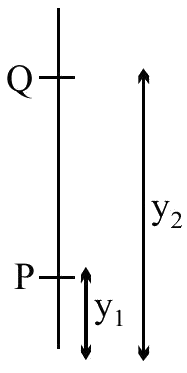
Sol. For diffraction location of 1st minima y1=Dλa=0.2469Dλ location of 2nd minima y2=2Dλa=0.4938Dλ Now for interference Path difference at P: dyD=4.8λ Path difference at Q: dyD=9.6λ So orders of maxima in between P and Q are 5,6,7,8,9 So 5 bright fringes are present between P and Q.Question figure
Question 259 / MCQ
Question 259
In a Young's double slit experiment, 16 fringes are observed in a certain segment of the screen when light of wavelength 700 nm is used. If the wavelength of light is changed to 400 nm , the number of fringes observed in the same segment of the screen would be:
A.
28
B.
24
C.
30
D.
18
Correct answer: A

Source solution

y=Dλd For the fringes of two wavelengths to coincide at the same position, n1(Dλ1d)=n2(Dλ2d) n1λ1=n2λ2 n1n2=λ2λ1 n2=n1λ1λ2 =16⋅700400=28 n2=28
Question 260 / MCQ
Question 260
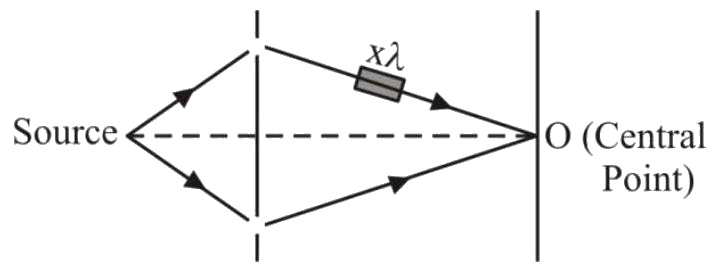
In young's double slit experiment performed using a monochromatic light of wavelength λ, when a glass plate (μ=1.5) of thickness xλ is introduced in the path of the one of the interfering beams, the intensity at the position where the central maximum occurred previously remains unchanged. The value of x will be:
A.
3
B.
2
C.
1.5
D.
0.5
Correct answer: B

Source solution

Sol. Path difference at O=(μ−1)t. If the intensity at O remains (maximum) unchanged, path difference must be nλ. (μ−1)t=nλ (1.5−1)⋅xλ=nλ ⇒x=2n For n=1, x=2Question figure
Question 261 / MCQ
Question 261
In a Young's double slit experiment, light of 500 nm is used to produce an interference pattern. When the distance between the slits is 0.05 mm , the angular width (in degree) of the fringes formed on the distance screen is close to :
A.
0.17∘
B.
0.07∘
C.
0.57∘
D.
1.7∘
Correct answer: C

Source solution

Sol. B=λDd θ=βD=(λd) θ=500×10−90.05×10−3 θ=5×10−25=5100×5 θ∘=5100⋅1805⋅π θ∘=0.57∘
Choose another chapter