Learne2i
Learne2i Priority Practice solutions
JEE Main 2026 / Session 1
All chapters

Chemistry

Classification of Elements and Periodicity in Properties

Question 9 / MCQ
Question 9
Which of the following reaction is correct?
A.
4LiNO3→Δ2Li2O+2 N2O4+O2
B.
2LiNO3→Δ2NaNO2+O2
C.
2LiNO3→2Li+2NO2+O2
D.
4LiNO3→Δ2Li2O+4NO2+O2
Correct answer: D

Source solution

4LiNO3→Δ2Li2O+4NO2+O2
Question 10 / MCQ
Question 10
Which of the following reaction is correct ?
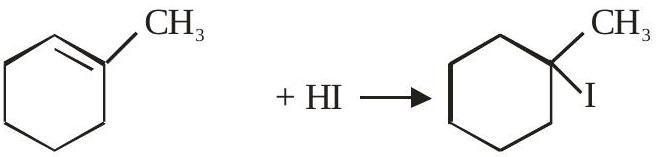
A.
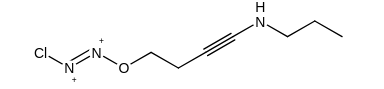
Question figure
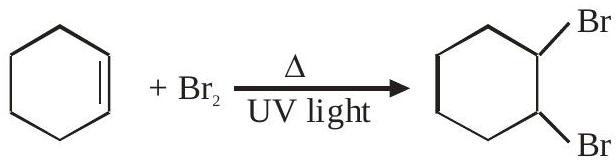
B.
Question figure
C.
Question figure
D.
C2H5CONH2+Br2+NaOH→C2H5CH2NH2+Na2CO3+NaBr+H2O
Correct answer: B

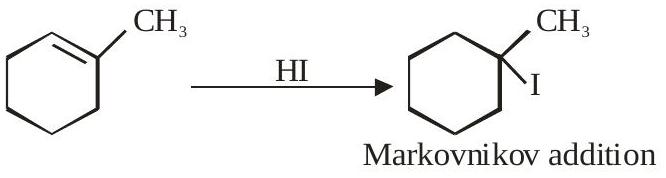
Source solution

Question figure
Question 11 / MCQ
Question 11
Given below are two statements : Statement I : Both CaCl2⋅6H2O and MgCl2⋅8H2O undergo dehydration on heating. Statement II : BeO is amphoteric whereas the oxides of other elements in the same group are acidic. In the light of the above statements, choose the correct answer from the options given below :
A.
Statement I is false but statement II is true
B.
Both statement I and statement II are false
C.
Both statement I and statement II are true
D.
Statement I is true but statement II is false TEST PAPER WITH ANSWER & SOLUTION
Correct answer: B

Source solution

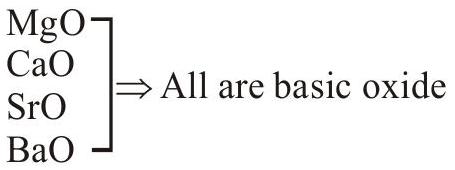
(a) CaCl2⋅6H2O→ΔCaCl2 (Anhydrous) +6H2O (b) MgCl2⋅8H2O→ΔMgO+2HCl+6H2O The dehydration of hydrated chloride of calcium can be achieved. The corresponding hydrated chloride of magnesium on heating suffer hydrolysis. (c) BeO→ Amphoteric Question figure
Question 12 / MCQ
Question 12
Match the LIST-I with LIST-II. LIST-IFamilyLIST-IISymbolA.Pnictogen (Group 15)I.TsB.ChalcogenII.OgC.HalogenIII.LvD.Noble GasIV.Mc Choose the correct answer from the options given below.
A.
A-IV, B-I, C-II, D-III
B.
A-IV, B-III, C-I, D-II
C.
A-III, B-I, C-IV, D-II
D.
A-II, B-III, C-IV, D-I
Correct answer: B

Source solution

Sol. A→Mc(115)B→Lv(116)C→Ts(117)D→Og(118) A−IV,B−III,C−I,D−II Correct Answer : (2)
Question 13 / MCQ
Question 13
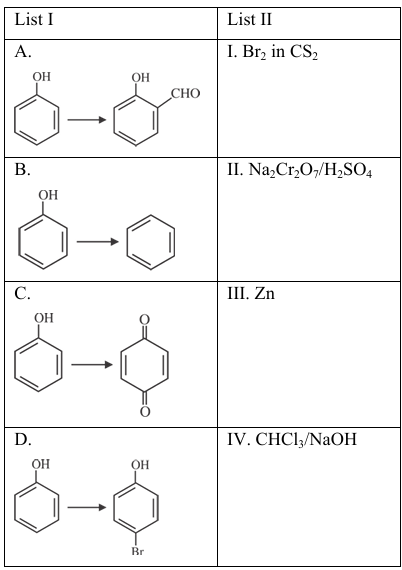
Match List I with List II Choose the correct answer from the options given below:Question figure
A.
A-IV, B-III, C-II, D-I
B.
A-IV, B-III, C-I, D-II
C.
A-II, B-III, C-I, D-IVQuestion figure
D.
A-IV, B-II, C-III, D-I
Correct answer: A

Source solution

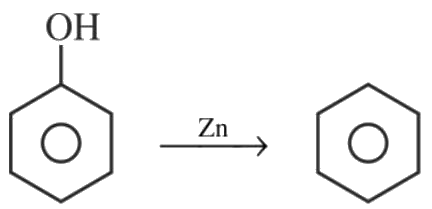
Sol. Identify each reaction: (A) Phenol is converted into salicylaldehyde (o-hydroxybenzaldehyde). This is the Reimer–Tiemann reaction, which uses CHCl3/NaOH Hence, A→IV \vspace{0.3cm} (B) Phenol is reduced to benzene by distillation with zinc dust. C6H5OH→ZnC6H6 Hence, B→III \vspace{0.3cm} (C) Phenol is oxidized to p-benzoquinone. This oxidation is carried out by Na2Cr2O7/H2SO4 Hence, C→II \vspace{0.3cm} (D) Phenol undergoes bromination in a non-polar solvent (CS2) to give mainly p-bromophenol. Br2 in CS2 Hence, D→I \vspace{0.3cm} Therefore, A−IV,B−III,C−II,D−I Correct Answer : (1)
Question 14 / MCQ
Question 14
Match List I with List II
List-IList-II
A.Melting point [K]I.Tl>In>Ga>Al>B
B.Ionic Radius [ M+3/pm ]II.B>Tl>Al≈Ga>In
C.ΔiH1 [ kJmol−1 ]III.Tl>In>Al>Ga>B
DAtomic Radius [pm]IV.B >Al>Tl>In>Ga
Choose the correct answer from the options given below:
A.
A-III, B-IV, C-I, D-II
B.
A-II, B-III, C-IV, D-I
C.
A-IV, B-I, C-II, D-III
D.
A-I, B-II, C-III, D-IV
Correct answer: C

Source solution

Melting point : B>Aℓ>Tℓ>In>Ga Ionic radius (M+3/pm):Tℓ>In>Ga>Aℓ>B (ΔIE H)1[ kJ mol]:B>Tℓ>Aℓ≈Ga>In Atomic radius (in pm): Tℓ>In>Aℓ>Ga>B
Question 15 / MCQ
Question 15
Match List-I with List-II. List-IElementsACl, SBGe, AsCFr, RaDF, O List-IIPropertiesIHighest electronegativityIILargest atomic sizeIIIProperties of both metals and non-metalsIVHighest negative electron gain enthalpy Choose the correct answer from the options given below.
A.
A-II, B-III, C-IV, D-I
B.
A-III, B-II, C-I, D-IV
C.
A-IV, B-III, C-II, D-I
D.
A-II, B-I, C-IV, D-III
Correct answer: C

Source solution

Sol. F,O→Highest electronegativityFr,Ra→Largest atomic sizeGe,As→MetalloidsCl,S→Highest negative electron gain enthalpy Therefore, A→IV B→III C→II D→I A−IV,B−III,C−II,D−I Correct Answer: (3)
Choose another chapter