
Learne2i
Learne2i Priority Practice solutions
JEE Main 2026 / Session 1
All chapters

Mathematics

Sequences and Series

Question 31 / MCQ
Question 31
If the domain of the function log5⁡(18x−x2−77) is (α,β) and the domain of the function log(x−1)⁡(2x2+3x−2x2−3x−4) is (γ,δ), then α2+β2+γ2 is equal to :
A.
195
B.
174
C.
186
D.
179
Correct answer: C

Source solution

log5⁡(18x−x2−77) has domain (α,β), and log(x−1)⁡(2x2+3x−2x2−3x−4) has domain (γ,δ). We need to find α2+β2+γ2. \hrulefill \textbf{Step 1: Domain of } log5⁡(18x−x2−77) For a logarithm, 18x−x2−77>0. −x2+18x−77>0 x2−18x+77<0. Factorizing, x2−18x+77=(x−7)(x−11). Hence, (x−7)(x−11)<0. Therefore, 7<x<11. Thus, (α,β)=(7,11). So, α=7,β=11. \hrulefill \textbf{Step 2: Domain of } log(x−1)⁡(2x2+3x−2x2−3x−4) For a logarithm: x−1>0,x−1≠1 which gives x>1,x≠2. Also, 2x2+3x−2x2−3x−4>0. Factorize: 2x2+3x−2=(2x−1)(x+2), x2−3x−4=(x−4)(x+1). Hence, (2x−1)(x+2)(x−4)(x+1)>0. Critical points: −2,−1,12,4. Using sign analysis: (2x−1)(x+2)(x−4)(x+1)>0 for (−∞,−2)∪(−1,12)∪(4,∞). Now intersect with x>1. Therefore, x∈(4,∞). Thus the domain is (γ,δ)=(4,∞). Hence, γ=4. \hrulefill \textbf{Step 3: Required value} α2+β2+γ2=72+112+42 =49+121+16 =186. 186 Hence, the correct option is (3) 186.
Question 32 / Numerical
Question 32
If the set of all a∈R−{1}, for which the roots of the equation (1−a)x2+2(a−3)x+9=0 are positive is (−∞,−α]∪[β,γ), then 2α+β+γ is equal to .
Numerical answer: ____________________
Enter the requested value (an integer; 0 decimal places). Use the units and scaling stated in the question.
Correct answer: 7

Source solution

Both the roots are positive D≥0 4(a−3)2−4×9(1−a)≥0 a2−6a+9−9+9a≥0 a2+3a≥0 a(a+3)≥0 (i)a∈(−∞,−3]∪[0,∞) −b2a>0 2(a−3)2(a−1)>0 (ii)a∈(−∞,1)∪(3,∞) f(0)=9>0 Equation (i) ∩ (ii) a∈(−∞,−3]∪[0,1) 2α+β+γ−6+0+1=7
Question 33 / Numerical
Question 33
A ray of light passing through the point P(2,3) reflects on the x -axis at point A and the reflected ray passes through the point Q(5,4). Let R be the point that divides the line segment AQ internally into the ratio 2:1. Let the co-ordinates of the foot of the perpendicular M from R on the bisector of the angle PAQ be (α,β). Then, the value of 7α+3β is equal to .
Numerical answer: ____________________
Enter the requested value (an integer; 0 decimal places). Use the units and scaling stated in the question.
Correct answer: 31

Source solution
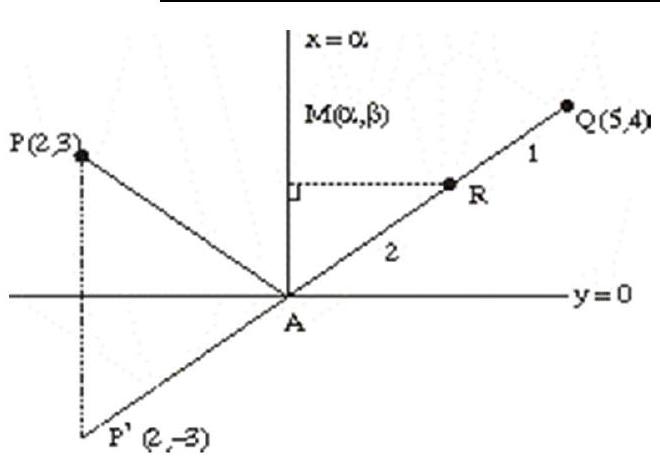
Question figure By observation we see that A(α,0). And β=y-cordinate of R (1)=2×4+1×02+1=83 Now P′ is image of P in y=0 which will be P′(2,−3) ∴ Equation of P′Q is (y+3)=4+35−2(x−2) i.e. 3y+9=7x−14 A≡(237,0) by solving with y=0 (2)∴α=237 By (1), (2) 7α+3β=23+8=31
Question 34 / Numerical
Question 34
Let the image of the point P(1,2,3) in the line L:x−63=y−12=z−23 be Q . let R(α,β,γ) be a point that divides internally the line segment PQ in the ratio 1:3. Then the value of 22(α+β+γ) is equal to
Numerical answer: ____________________
Enter the requested value (an integer; 0 decimal places). Use the units and scaling stated in the question.
Correct answer: 125

Source solution
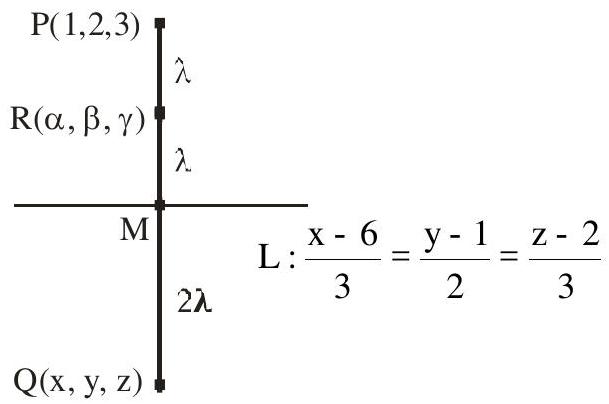
Question figure Let M be the mid-point of PQ ∴M=(3λ+6,2λ+1,3λ+2) Now, PM→=(3λ+5)i^+(2λ−1)j^+(3λ−1)k^ ∵PM→⊥(3i^+2j^+3k^) ∴3(3λ+5)+2(2λ−1)+3(3λ−1)=0 λ=−511 ∴M(5111,111,711) Since R is mid-point of PM 22(α+β+γ)=125
Question 35 / Numerical
Question 35
Let a conic C pass through the point (4,−2) and P(x,y),x≥3, be any point on C . Let the slope of the line touching the conic C only at a single point P be half the slope of the line joining the points P and (3, -5). If the focal distance of the point (7, 1) on C is d , then 12 d equals .
Numerical answer: ____________________
Enter the requested value (an integer; 0 decimal places). Use the units and scaling stated in the question.
Correct answer: 75

Source solution
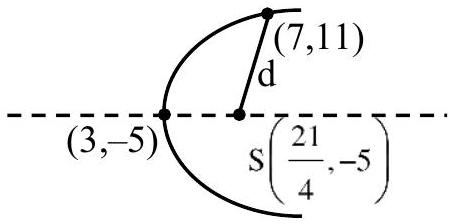
P(x,y)&x≥3 Slope of line at P(x,y) will be dydx=12(y+5x−3) ⇒2dy(y+5)=1(x−3)dx ⇒2ℓn(y+5)=ℓn(x−3)+C Passes through (4,−2) ⇒2ℓn(3)=ℓn(1)+C ⇒C=2ℓn(3) ⇒2ℓn(y+5)=ℓn(x−3)+2ℓn(3) ⇒2(ln⁡(y+53))=ln⁡(x−3) ⇒(y+53)2=(x−3) ⇒(y+5)2=9(x−3) ↓ Parabola 4a=9 a=94 Question figure d=(74)2+62 d=6254 d=254 12 d=75
Question 36 / Numerical
Question 36
A line passes through A(4,−6,−2) and B(16,−2,4). The point P(a,b,c) where a,b,c are non-negative integers, on the line AB lies at a distance of 21 units, from the point A . The distance between the points P(a,b,c) and Q(4,−12,3) is equal to .
Numerical answer: ____________________
Enter the requested value (an integer; 0 decimal places). Use the units and scaling stated in the question.
Correct answer: 22

Source solution

- x−412=x+64=z+26x−467=y+627=z+237=21(21×67+4,27×21−6,37×21−2)=(22,0,7)=(a,b,c)∴324+144+16=22
Question 37 / Numerical
Question 37
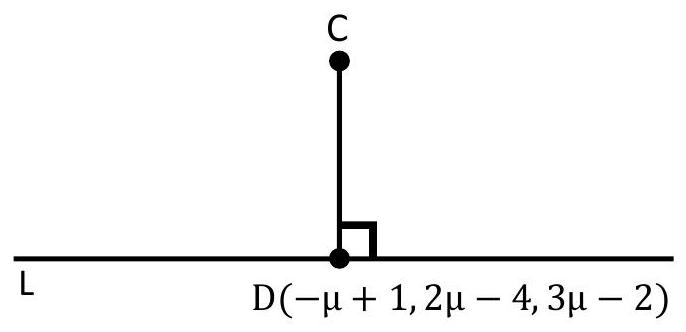
The point of intersection C of the plane 8x+y+2z=0 and the line joining the point A(−3,−61) and B(2,−4,−3) divides the line segment AB internally in the ratio k :. If a,b,c(|a|,|b|,|c|) are coprime are the direction ratios of the perpendicular form the point C on the line 1−x1=y+42=z+23, then ∣a+b+ c|is equal to
Numerical answer: ____________________
Enter the requested value (an integer; 0 decimal places). Use the units and scaling stated in the question.
Correct answer: 10

Source solution

10 Plane : 8x+y+2z=0 Given line AB:x−25=y−410=z+3−4=λ Any point on line (5λ+2,10λ+4,−4λ−3) Point of intersection of line and plane 8(5λ+2)+10λ+4−8λ−6=0 λ=−13 C (13,23,−53) L:x−1−1=y+42=z+23=μ Question figure CD―=(−μ+23)i^+(2μ−143)j^+(3μ−13)k^ (−μ+23)(−1)+(2μ−143)2+(3μ−13)3=0 μ=1114 CD→=−542,−13042,8542 Direction ratio →(−1,−26,17) |a+b+c|=10
Question 38 / Numerical
Question 38
Let a→=i^+2j^+λk^,b→=3i^−5j^−λk^,a→⋅c→=7,2b→⋅c→+43=0,a→×c→=b→×c→. Then |a→⋅b→| is equal to
Numerical answer: ____________________
Enter the requested value (an integer; 0 decimal places). Use the units and scaling stated in the question.
Correct answer: 8

Source solution

8 a¯=(1,2,λ)b¯=(3,−5,−λ) a¯⋅c¯=7,b¯⋅c¯=−432(a¯−b¯)×c¯=0c=x[−2,7,2λ]=(−2x,7x,2λx) now ,a¯⋅c¯=−2x+14x+2λ2x=72λ2x+12x=7b¯⋅c¯=−6x−35x−2λ2x=−432(1)−41x−2λ2x=−432 by adding (1) + (2) −29x=−292⇒x=12∴λ2+6=7⇒λ2=1|a¯⋅b¯|=|3−10−λ2|=|−8|
Question 39 / MCQ
Question 39
Let Tr be the rth  term of an A.P. If for some m, Tm=125, T25=120 and 20∑r=125 Tr=13, then 5 m∑r=m2 m Tr is equal to :
A.
112
B.
126
C.
98
D.
142
Correct answer: B

Source solution

Sol. Tm=125, T25=120,20∑r=125 Tr=13 (1)Tm=a+(m−1)d=125 T25=a+24 d=120 20⋅252[a+120]=13⇒a=1500 also, 20 S25=20⋅252[2a+24 d]=13⇒ d=1500 from (1) 1500+m−1500=125⇒ m=20 Now, 5 m∑r=m2 m Tr=100∑r=2040 Tr=126
Question 40 / MCQ
Question 40
Let a1,a2,a3…. be a G.P. of increasing positive terms. If a1a5=28 and a2+a4=29, the a6 is equal to
A.
628
B.
526
C.
784
D.
812
Correct answer: C

Source solution

Sol. a1⋅a5=28⇒a⋅ar4=28⇒a2r4=28 (1)a2+a4=29⇒ar+a3=29 ⇒ar(1+r2)=29 (2)⇒a2r2(1+r2)2=(29)2 By Eq. (1) & (2) r2(1+r2)2=2829×29 ⇒r1+r2=2829⇒r=28 ∵a2r4=28⇒a2×(28)2=28 ⇒a=128 ∴a6=ar5=128×(28)228=784
Question 41 / MCQ
Question 41
If the first term of an A.P. is 3 and the sum of its first four terms is equal to one-fifth of the sum of the next four terms, then the sum of the first 20 terms is equal to
A.
-1200
B.
-1080
C.
-1020
D.
-120
Correct answer: B

Source solution

\textbf{Given:} The first term of an A.P. is a=3. Also, the sum of the first four terms is one-fifth of the sum of the next four terms. We have to find the sum of the first 20 terms. \hrulefill \textbf{Step 1: Find the sum of the first four terms} The first four terms are 3,3+d,3+2d,3+3d. Hence S1=3+(3+d)+(3+2d)+(3+3d)=12+6d. \hrulefill \textbf{Step 2: Find the sum of the next four terms} The next four terms are 3+4d,3+5d,3+6d,3+7d. Their sum is S2=(3+4d)+(3+5d)+(3+6d)+(3+7d)=12+22d. Given that S1=15S2. Therefore, 12+6d=15(12+22d). Multiplying by 5, 60+30d=12+22d. 8d=−48. d=−6. \hrulefill \textbf{Step 3: Find the sum of the first 20 terms} Using Sn=n2[2a+(n−1)d], with a=3,d=−6,n=20, we get S20=202[2(3)+19(−6)]. =10(6−114). =10(−108). =−1080. \hrulefill S20=−1080 Hence, the correct option is (2)−1080.
Question 42 / MCQ
Question 42
Consider an A.P. of positive integers, whose sum of the first three terms is 54 and the sum of the first twenty terms lies between 1600 and 1800. Then its 11th  term is :
A.
84
B.
122
C.
90
D.
108
Correct answer: C

Source solution

Sol. S3=3a+3 d=54 ⇒a+d=18 S20=10(2a+19 d) ⇒10(36+17 d) ⇒1600<10(36+17 d)<1800 ⇒160<36+17 d<180 ⇒124<17 d<144 ⇒7517<d<8817 Common difference will be natural number ⇒d=8⇒a=10 ⇒a11=10+10×8=90
Question 43 / MCQ
Question 43
In an increasing geometric progression ol positive terms, the sum of the second and sixth terms is 703 and the product of the third and fifth terms is 49. Then the sum of the 4th ,6th  and 8th  terms is :-
A.
96
B.
78
C.
91
D.
84
Correct answer: C

Source solution

Sol. T2+T6=703 ar+ar5=703 T3⋅ T5=49 ar2.ar4=49 a2r6=49 ar3=+7,a=7r3 ar(1+r4)=703 7r2(1+r4)=703,r2=t 1t(1+t2)=103 3t2−10t+3=0 t=3,13 Increasing G.P. r2=3,r=3 T4+T6+T8 =ar3+ar5+ar7 =ar3(1+r2+r4) =7(1+3+9)=91
Question 44 / MCQ
Question 44
If the sum of the second, fourth and sixth terms of a G.P. of positive terms is 21 and the sum of its eighth, tenth and twelfth terms is 15309, then the sum of its first nine terms is :
A.
760
B.
755
C.
750
D.
757
Correct answer: D

Source solution

Sol. ar+ar3+ar5=21,ar7+ar9+ar11=15309 ⇒ar(1+r2+r4)=21,ar7(1+r2+r4)=15309 (1) (2) Eqn(2)÷eqn(1) ⇒a.r7ar=1530921⇒r6=729 ⇒a⋅(r9−1)r−1=791(19683−1)2=7×1968291×2 =984113=757
Question 45 / MCQ
Question 45
Let a1,a2,……,a21 be an AP such that ∑n=1201anan+1=49. If the sum of this AP is 189, then a6a16 is equal to :
A.
57
B.
72
C.
48
D.
36
Correct answer: B

Source solution

∑n=1201anan+1=∑n=1201an(an+d)=1d∑n=120(1an−1an+d)⇒1d(1a1−1a21)=49 (Given) ⇒1d(a21−a1a1a21)=49⇒1d(a1+20d−d1a1a2)=49⇒a1a2=45 Now sum of first 21 terms =212(2a1+20 d)=189 ⇒a1+10 d=9 For equation (1) & (2) we get a1=3& d=35 OR a1=15& d=−35 So, a6.a16=(a1+5 d)(a1+15 d) ⇒a6a16=72
Choose another chapter