Learne2i
Learne2i Priority Practice solutions
JEE Main 2026 / Session 1
All chapters

Physics

Laws of Motion

Question 31 / Numerical
Question 31
A body of mass ' m ' is launched up on a rough inclined plane making an angle of 30° with the horizontal. The coefficient of friction between the body and plane is x5 if the time of ascent is half of the time of descent. The value of x is ____.
Numerical answer: ____________________
Enter the requested integer (0 decimal places).
Correct answer: 3

Source solution

ta=12td 2saa=122sadaa=gsin⁡θ+μgcos⁡θ=g2+32μgad=gsin⁡θ−μgcos⁡θ =g2−32μ g using the above values of aa and ad and putting in equation (i) we will gate μ=35
Question 32 / Numerical
Question 32
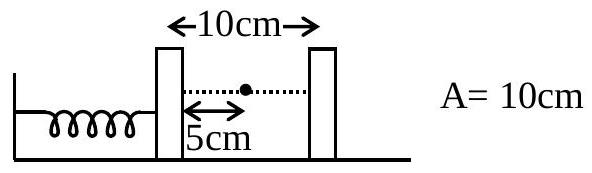
A block is fastened to a horizontal spring. The block is pulled to a distance x=10 cm from its equilibrium position (at x=0 ) on a frictionless surface from rest. The energy of the block at x=5 cm is 0.25 J . The spring constant of the spring is Nm−1
Numerical answer: ____________________
Enter the requested value (an integer; 0 decimal places). Use the units and scaling stated in the question.
Correct answer: 50

Source solution

(50) Given Question figure At any instant total energy for free oscillation remains constant =12kA2 ⇒12kA2=0.25 J ⇒12kA2=0.25 J⇒ K=0.25×2 A2 ⇒k=0.50(10 cm)2=0.50(10×10−2)=0.50×104100 k=0.50×100=50 N/m
Question 33 / MCQ
Question 33
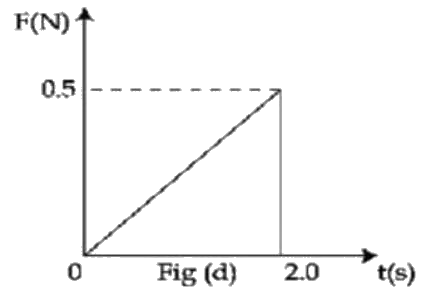
Figures (a), (b), (c) and (d) show variation of force with time.The impulse is highest in figure.Question figure
A.
Fig (c)
B.
Fig (b)
C.
Fig (d)
D.
Fig (a)
Correct answer: B

Source solution

Sol. (2) As we know that impulse is given by I=ΔP=F⋅Δt or I=Area of f-t graph For fig (a): I=12⋅base⋅height=12⋅0.5⋅1=0.25N⋅s For fig (b): I=length⋅width=2⋅0.5=1N⋅s For fig (c): I=12⋅base⋅height=12⋅1⋅0.75=0.375N⋅s For fig (d): I=12⋅base⋅height=12⋅2⋅0.5=0.5N⋅s Impulse is highest for that figure whose area under F-t is maximum, i.e., figure (b). Option (2) is correct.
Question 34 / MCQ
Question 34
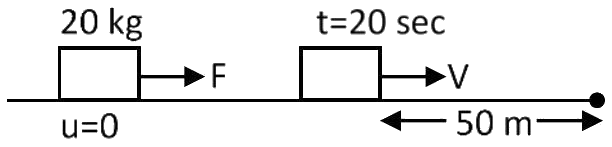
A force acts for 20 s on a body of mass 20 kg , starting from rest, after which the force ceases and then body describes 50 m in the next 10 s . The value of force will be:
A.
40 N
B.
5 N
C.
20 N
D.
10 N
Correct answer: B

Source solution

Sol. (2) 50=V×10V=5m/sV=0+a×205=a×20a=14m/s2F=ma=20×14=5NQuestion figure
Question 35 / MCQ
Question 35
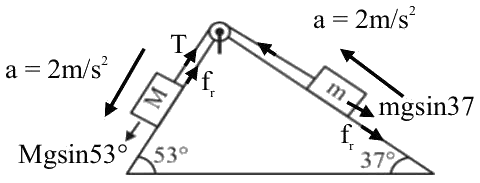
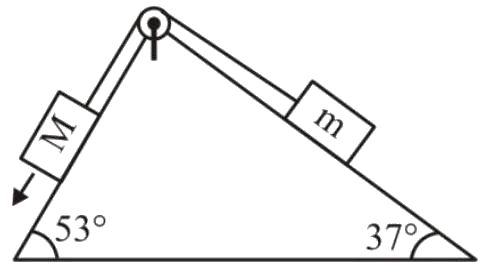
In the given arrangement of a doubly inclined plane two blocks of masses M and m are placed. The blocks are connected by a light string passing over an ideal pulley as shown. The coefficient of friction between the surface of the plane and the blocks is 0.25 . The value of m , for which M=10 kg will move down with an acceleration of 2 m/s2, is : (take g=10 m/s2 and tan⁡37∘=3/4 )Question figure
A.
9 kg
B.
4.5 kg
C.
6.5 kg
D.
2.25 kg
Correct answer: B

Source solution

For M block: 10g⋅sin⁡53∘−μ(10g)⋅cos⁡53∘−T=10⋅2 T=80−15−20 T=45N For m block: T−mg⋅sin⁡37∘−μmg⋅cos⁡37∘=m⋅2 45=10m m=4.5kgQuestion figure
Question 36 / Numerical
Question 36
A uniform rod AB of mass 2 kg and Length 30 cm at rest on a smooth horizontal surface. An impulse of force 0.2 Ns is applied to end B . The time taken by the rod to turn through at right angles will be πxs, where x= .
Numerical answer: ____________________
Enter the requested value (an integer; 0 decimal places). Use the units and scaling stated in the question.
Correct answer: 4

Source solution
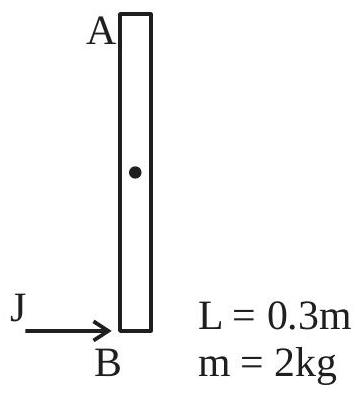
Question figure Impulse J=0.2 N−S J=∫Fdt=0.2 N−s Angular impuls ( M→ ) M→c=∫τdt =∫FL2dt =L2∫Fdt=L2×J =0.32×0.2 =0.03 Icm=ML212=2×(0.3)212=0.096 M=Icm(ωf−ωi) 0.03=0.096(ωf) ωf=2rad/s θ=ωt t=θω=π2×2=π4sec. X=4
Question 37 / Numerical
Question 37
A steel rod has a radius of 20 mm and a length of 2.0 m . A force of 62.8 kN stretches it along its length. Young's modulus of steel is 2.0×10¹¹ N/m2. The longitudinal strain produced in the wire is ×10−5
Numerical answer: ____________________
Enter the requested value (an integer; 0 decimal places). Use the units and scaling stated in the question.
Correct answer: 25

Source solution

Strain = stress Y=62.8×103π×(0.02)22×1011 =62.8×1033.14×4×10−4×2×1011 =2.5×10−4 =25×10−5
Question 38 / MCQ
Question 38
A bullet of mass 0.1 kg moving horizontally with speed 400 ms−1 hits a wooden block of mass 3.9 kg kept on a horizontal rough surface. The bullet gets embedded into the block and moves 20 m before coming to rest. The coefficient of friction between the block and the surface is ......... .(Given g=10 ms2 )
A.
0.50
B.
0.90
C.
0.65
D.
0.25
Correct answer: D

Source solution

Using conservation of momentum during collision: Pi=Pf (0.1)(400)=(0.1+3.9)v 40=4v v=10m/s After collision, the system moves with retardation due to friction: a=μmgm=μg Using equation of motion: v2=u2+2as Final velocity becomes zero after distance s=20m: 0=(10)2−2μg⋅20 100=40μg Taking g=10m/s2: 100=40μ⋅10 100=400μ μ=14
Question 39 / Numerical
Question 39
A mass of 10 kg is suspended vertically by a rope of length 5 m from the roof. A force of 30 N is applied at the middle point of rope in horizontal direction. The angle made by upper half of the rope with vertical is θ=tan−1⁡(x×10−1). The value of x is . (Given g=10 m/s2 )
Numerical answer: ____________________
Enter the requested value (an integer; 0 decimal places). Use the units and scaling stated in the question.
Correct answer: 3

Source solution
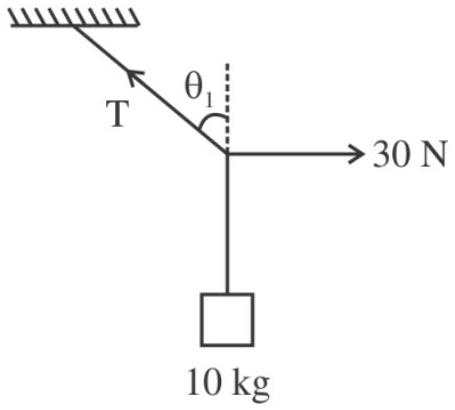
Question figure Tsin⁡θ=30 Tcos⁡θ=100 ⇒tan⁡θ=0.3
Question 40 / MCQ
Question 40
A body of mass 500 g moves along x -axis such that it's velocity varies with displacement x according to the relation v=10xm/s the force acting on the body is:-
A.
166 N
B.
25 N
C.
125 N
D.
5 N
Correct answer: B

Source solution

Sol. v=10x⇒v2=100x 2vdvdx=100⇒a=50m/s2 F=25N
Question 41 / MCQ
Question 41
An object of mass 5 kg is thrown vertically upwards from the ground. The air resistance produces a constant retarding force of 10 N throughout the motion. The ratio of time of ascent to the time of descent will be equal to : [Use g=10 ms−2 ]
A.
1:1
B.
2:3
C.
3:2
D.
2:3
Correct answer: B

Source solution

Let the mass of the object be m=5 kg, the acceleration due to gravity be g=10 m/s2, and the constant air resistance force be F=10 N. The retardation caused by air resistance is: ar=Fm=105=2 m/s2 During the ascent (moving upwards): Both gravity (g) and air resistance (ar) act in the downward direction, opposing the motion. The total downward acceleration is: a1=g+ar=10+2=12 m/s2 Let h be the maximum height reached. Using the equations of motion for the upward journey: h=12a1t12⟹t1=2ha1 where t1 is the time of ascent. During the descent (moving downwards): Gravity (g) acts downwards, while air resistance (ar) acts upwards to oppose the falling motion. The net downward acceleration is: a2=g−ar=10−2=8 m/s2 Using the equations of motion for the downward journey from the maximum height h: h=12a2t22⟹t2=2ha2 where t2 is the time of descent. Taking the ratio of the time of ascent to the time of descent: t1t2=2ha12ha2=a2a1 Substituting the values of a1 and a2: t1t2=812=23 t1t2=23
Question 42 / Numerical
Question 42
A rectangular block of mass 5 kg attached to a horizontal spiral spring executes simple harmonic motion of amplitude 1 m and time period 3.14 s . The maximum force exerted by spring on block is N.
Numerical answer: ____________________
Enter the requested value (an integer; 0 decimal places). Use the units and scaling stated in the question.
Correct answer: 20

Source solution

∴T=3.14=π T=π=2πω⇒ω=2 Fmax=mamax=m( Aω2)=mA(2)2=5×1×4=20 N
Question 43 / Numerical
Question 43
A force on an object of mass 100 g is (10i^+5j^)N. The position of that object at t= 2 s is (ai+bj^)m after starting from rest. The value of ab will be
Numerical answer: ____________________
Enter the requested value (an integer; 0 decimal places). Use the units and scaling stated in the question.
Correct answer: 2

Source solution

F→=10i^+5j^ m=100 g=0.1 kg a→=F→m=100i^+50j^ S→=u→t+12a→t2=12a→t2( as u→=0) =12(100i^+50j^)22 =200i^+100j^ =ai^+bj^ a=200, b=100 ∴ab=2
Question 44 / MCQ
Question 44
A block of mass 10 kg starts sliding on a surface with an initial velocity of 9.8 ms−1. The coefficient of friction between the surface and bock is 0.5 . The distance covered by the block before coming to rest is : [use g=9.8 ms−2 ]
A.
4.9 m
B.
9.8 m
C.
12.5 m
D.
19.6 m
Correct answer: B

Source solution

The acceleration due to friction is a=−μg=−0.5×9.8=−4.9m s−2 Using the equation of motion, v2=u2+2as At the stopping point, final velocity v=0. Hence, 0=(9.8)2+2(−4.9)d (9.8)2=9.8d d=9.8m
Question 45 / Numerical
Question 45
Mercury is filled in a tube of radius 2 cm up to a height of 30 cm . The force exerted by mercury on the bottom of the tube is N. (Given, atmospheric pressure =105Nm−2, density of mercury =1.36×10⁴ kg m−3, g=10 ms−2, π=227 )
Numerical answer: ____________________
Enter the requested value (an integer; 0 decimal places). Use the units and scaling stated in the question.
Correct answer: 177

Source solution

F=P0A+ρmghA =105×227×(2×10−2)2 +1.36×104×10×(30×10−2)(227×(2×10−2)2) F=51.29+125.71=177 N
Choose another chapter