
Learne2i
Learne2i Priority Practice solutions
JEE Main 2026 / Session 1
All chapters

Physics

Thermodynamics

Question 98 / MCQ
Question 98
The amount of heat needed to raise the temperature of 4 moles of a rigid diatomic gas from 0°C to 50°C when no work is done is ____. (R is the universal gas constant)
A.
250 R
B.
750 R
C.
175 R
D.
500 R
Correct answer: D

Source solution

ΔQ=ΔU+ΔW Here ΔW=0ΔQ=ΔU=nCVΔTΔQ=4×5R2(50)=500R Hence option (4)
Question 99 / MCQ
Question 99
1 g of a liquid is converted to vapour at 3×10⁵ Pa pressure. If 10% of the heat supplied is used for increasing the volume by 1600 cm3 during this phase change, then the increase in internal energy in the process will be:
A.
432000 J
B.
4320 J
C.
4800 J
D.
4.32×10⁸ J
Correct answer: B

Source solution

10% of ΔQ=PΔV (W/D by gas) ΔQ10=3×10⁵(1600×10−6) ΔQ=4800J Using the first law of thermodynamics: ΔQ=Δu+W ΔQ=Δu+ΔQ10⇒Δu=910ΔQ Δu=910×4800⇒Δu=4320J
Question 100 / MCQ
Question 100
Heat is given to an ideal gas in an isothermal process.A. Internal energy of the gas will decrease.B. Internal energy of the gas will increase.C. Internal energy of the gas will not change.D. The gas will do positive work.E. The gas will do negative work.Choose the correct answer from the options given below :
A.
C and D only
B.
C and E only
C.
A and E only
D.
B and D only
Correct answer: A

Source solution

Sol. (1) In an isothermal process So ΔT=0ΔU=0ΔQ=W+ΔUΔQ=W So heat will be used to do positive work.
Question 101 / MCQ
Question 101
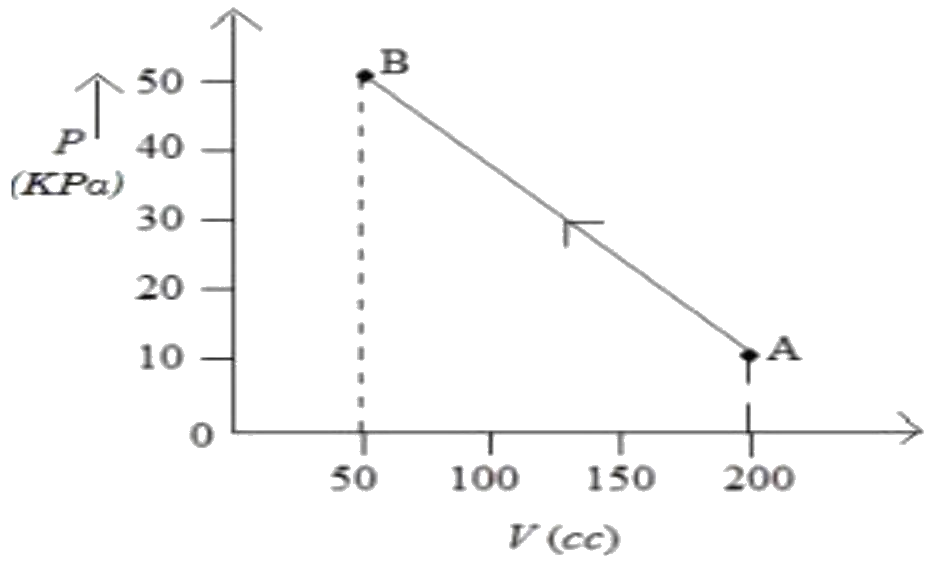
The pressure of a gas changes linearly with volume from A to B as shown in figure. If no heat is supplied to or extracted from the gas then change in the internal energy of the gas will beQuestion figure
A.
-4.5 J
B.
zero
C.
4.5 J
D.
6 J
Correct answer: C

Source solution

W=Area of PV Graph=−12×[50+10]×103×150×10−6 W=−4.5J Q=ΔU+W 0=ΔU−4.5 ΔU=4.5J
Question 102 / MCQ
Question 102
1 kg of water at 100∘C is converted into steam at 100∘C by boiling at atmospheric pressure. The volume of water changes from 1.00×10⁻³ m3 as a liquid to 1.671 m3 as steam. The change in internal energy of the system during the process will be (Given latent heat of vaporisaiton =2257 kJ/kg. Atmospheric pressure =1×10⁵ Pa )
A.
+2090 kJ
B.
-2090 kJ
C.
- 2426 kJ
D.
+2476 kJ
Correct answer: A

Source solution

ΔQ=ΔU+ΔW Hence, ΔU=ΔQ−ΔW. The heat supplied is ΔQ=mLv, and the work done against atmospheric pressure is ΔW=PΔV. Therefore, ΔU=mLv−PΔV. Substituting the given values, ΔU=(1kg)(2257×103J kg−1)−(1×10⁵Pa)(1.671m3−10−3m3). ΔU=2257×103−(105)(1.670). ΔU=2257×103−167×103. ΔU=2090×103J. Hence, ΔU=2090kJ.
Question 103 / MCQ
Question 103
Match List-I with List-II. List-IList-II(a) Isothermal(i) Pressure constant(b) Isochoric(ii) Temperature constant(c) Adiabatic(iii) Volume constant(d) Isobaric(iv) Heat content is constant Choose the correct answer from the options given below:
A.
(a) - (ii), (b) - (iv), (c) - (iii), (d) - (i)
B.
(a) - (ii), (b) - (iii), (c) - (iv), (d) - (i)
C.
(a) - (i), (b) - (iii), (c) - (ii), (d) - (iv)
D.
(a) - (iii), (b) - (ii), (c) - (i), (d) - (iv)
Correct answer: B

Source solution

The meanings of the thermodynamic processes are: Isothermal⇒Temperature remains constant,Isochoric⇒Volume remains constant,Adiabatic⇒No heat is exchanged with the surroundings,Isobaric⇒Pressure remains constant. Therefore, the correct matching is (a) Isothermal⟶(ii) Temperature constant,(b) Isochoric⟶(iii) Volume constant,(c) Adiabatic⟶(iv) No heat exchange,(d) Isobaric⟶(i) Pressure constant. Hence, (a)→(ii),(b)→(iii),(c)→(iv),(d)→(i)
Question 104 / MCQ
Question 104
Match List-I with List-II. List-IList-II(A) Pressure varies inversely with volume of an ideal gas(III) Isothermal process(B) Heat absorbed goes partly to increase internal energy and partly to do work(IV) Isobaric process(C) Heat is neither absorbed nor released by a system(I) Adiabatic process(D) No work is done on or by a gas(II) Isochoric process Choose the correct answer from the options given below:
A.
A-I, B-IV, C-II, D-III
B.
A-III, B-I, C-IV, D-II
C.
A-I, B-III, C-II, D-IV
D.
A-III, B-IV, C-I, D-II
Correct answer: D

Source solution

\textbf{(A) Pressure varies inversely with volume of an ideal gas} For an ideal gas undergoing an isothermal process, PV=constant. Hence, P∝1V. Therefore, (A)→(III). \textbf{(B) Heat absorbed goes partly to increase internal energy and partly to do work} In an isobaric process, ΔQ=ΔU+PΔV. Thus, the heat supplied is used partly to increase internal energy and partly to perform work. (B)→(IV). \textbf{(C) Heat is neither absorbed nor released by a system} For an adiabatic process, ΔQ=0. Hence, (C)→(I). \textbf{(D) No work is done on or by a gas} For an isochoric process, ΔV=0. Therefore, W=∫PdV=0. Hence, (D)→(II). Thus, the correct matching is A→III,B→IV,C→I,D→II
Question 105 / MCQ
Question 105
Match List-I with List-II. List-IList-II(A) Isothermal(IV) ΔU=0(B) Adiabatic(II) ΔQ=0(C) Isobaric(III) ΔU≠0(D) Isochoric(I) ΔW=0 Choose the correct answer from the options given below:
A.
(A)-(III), (B)-(II), (C)-(I), (D)-(IV)
B.
(A)-(IV), (B)-(I), (C)-(III), (D)-(II)
C.
(A)-(IV), (B)-(II), (C)-(III), (D)-(I)
D.
(A)-(II), (B)-(IV), (C)-(I), (D)-(III)
Correct answer: C

Source solution

\textbf{(A) Isothermal Process} For an ideal gas undergoing an isothermal process, ΔT=0. Since internal energy depends only on temperature, ΔU=0. Hence, (A)→(IV). \textbf{(B) Adiabatic Process} For an adiabatic process, ΔQ=0. Hence, (B)→(II). \textbf{(C) Isobaric Process} For an isobaric process, P=constant. In general, the temperature changes, therefore ΔU=nCVΔT≠0. Hence, (C)→(III). \textbf{(D) Isochoric Process} For an isochoric process, ΔV=0. Therefore, ΔW=∫PdV=0. Hence, (D)→(I). Thus, the correct matching is A→IV,B→II,C→III,D→I
Choose another chapter