Learne2i
Learne2i Priority Practice solutions
JEE Main 2026 / Session 1
All chapters

Physics

Ray Optics and Optical Instruments

Question 242 / Numerical
Question 242
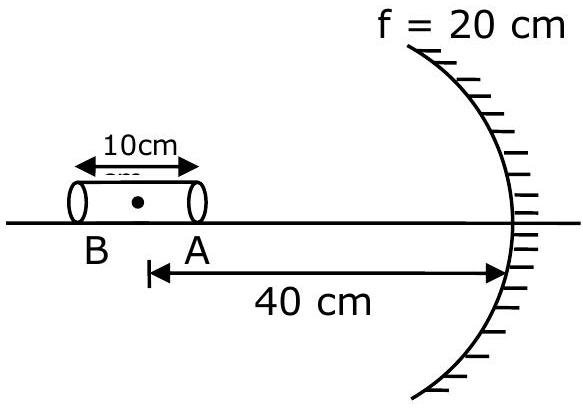
A thin cylindrical rod of length 10 cm is placed horizontally on the principle axis of a concave mirror of focal length 20 cm . The rod is placed in a such a way that mid point of the rod is at 40 cm from the pole of mirror. The length of the image formed by the mirror will be x3 cm. The value of x is .
Numerical answer: ____________________
Enter the requested value (an integer; 0 decimal places). Use the units and scaling stated in the question.
Correct answer: 32

Source solution

32 Question figure Image of end A: u=−35 cm f=−20 cm v= ? v=ufu−f =−35×−20−35+20 =−35×−20−15 v=−1403 Image of end B : u=−45 cm v= ? f=−20 cm v=ufu−f =−45×−20−45+20 =−45×−20−25 v=−36 ∴ length of image =|−36+1403| =|−108+1403|=323 ∴ The value of x=32
Question 243 / MCQ
Question 243
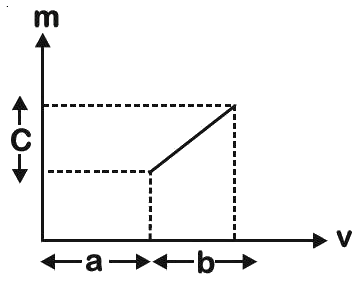
The graph shows how the magnification m produced by a thin lens varies with image distance v. What is the focal length of the lens used?Question figure
A.
b2ac
B.
b2ca
C.
ac
D.
bc
Correct answer: D

Source solution

m=vu Given m−v graph is a straight line, m=k1v+k2 vu=k1v+k2 1u=k1+k2v k2v−1u=−k1 Comparing with lens formula, 1v−1u=1f k2=1,k1=1f ∴f=1slope=bc f=bc
Question 244 / MCQ
Question 244
Consider a light ray travelling in air is incident into a medium of refractive index 2n. The incident angle is twice that of refracting angle. Then, the angle of incidence will be :
A.
sin−1⁡(n)
B.
cos−1⁡(n2)
C.
sin−1⁡(2n)
D.
2cos−1⁡(n2)
Correct answer: D

Source solution

Sol. i=2rsin⁡i⋅n1=sin⁡r⋅n2 sin⁡i⋅1=sin⁡i2⋅2n sin⁡isin⁡i2=2n 2sin⁡i2cos⁡i2sin⁡i2=2n cos⁡i2=n2 i2=cos−1⁡(n2) i=2cos−1⁡(n2)
Question 245 / MCQ
Question 245
The speed of light in media ' A ' and ' B ' are 2.0× 1010 cm/s and 1.5×10¹⁰chm/s respectively. A ray of light enters from the medium B to A at an incident angle ' θ '. If the ray suffers total internal reflection, then
A.
θ=sin−1⁡(34)
B.
θ>sin−1⁡(23)
C.
θ<sin−1⁡(34)
D.
θ>sin−1⁡(34)
Correct answer: D

Source solution

sin⁡ic=nrnd Since n=cv nrnd=vdvr Given, vd=1.5×10⁸m/s vr=2×10⁸m/s sin⁡ic=1.5×1082×108=34 ic=sin−1⁡(34) For total internal reflection, θ>ic θ>sin−1⁡(34)
Question 246 / MCQ
Question 246
A plano convex lens of refractive index μ1 and focal length f1 is kept in contact with another plano concave lens of refractive index μ2 and focal length f2. If the radius of curvature of their spherical faces is R each and f1=2f2, then μ1 and μ2 are related as :
A.
μ1+μ2=3
B.
2μ1−μ2=1
C.
2μ2−μ1=1
D.
3μ2−2μ1=1
Correct answer: B

Source solution

Sol. 12f2=1f1=(μ1−1)(1∞−1−R) 1f2=(μ2−1)(1−R−1∞) (μ1−1)R=(μ2−1)2R 2μ2−μ1=1
Question 247 / Numerical
Question 247
A plano-convex lens of radius of curvature 30 cm and refractive index 1.5 is kept in air. Find its focal length (in cm ).
Numerical answer: ____________________
Enter the requested value (an integer; 0 decimal places). Use the units and scaling stated in the question.
Correct answer: 60

Source solution

( 60 cm ) Applying Lens makers' formula, 1f=(μ−1)(1R1−1R2)R1=∞R2=−30 cm1f=(1.5−1)(1∞−1−30) 1f=0.530f=60 cm
Question 248 / MCQ
Question 248
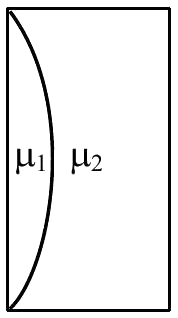
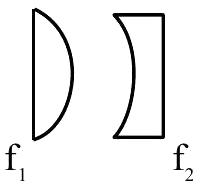
Curved surfaces of a plano-convex lens of refractive index μ1 and a plano-concave lens of refractive index μ2 have equal radius of curvature as shown in figure. Find the ratio of radius of curvature to the focal length of the combined lenses.Question figure
A.
1μ2−μ1
B.
μ1−μ2
C.
1μ1−μ2
D.
μ2−μ1
Correct answer: B

Source solution

Sol. 1f1=(μ1−1)(1R) 1f2=(μ2−1)(−1R) 1f1+1f2=1feq=(μ1−1)−(μ2−1)R 1feq=(μ1−μ2)R Rfeq=(μ1−μ2)Question figure
Question 249 / MCQ
Question 249
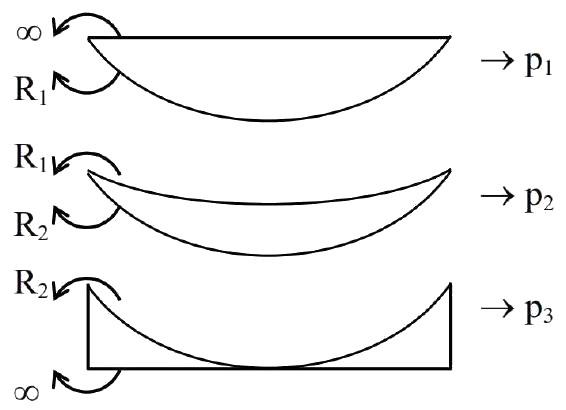
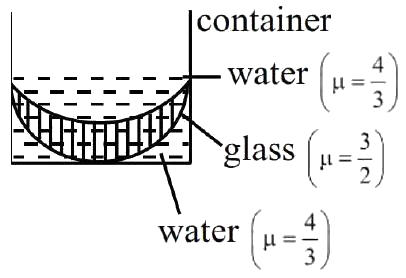
In the diagram given below, there are three lenses formed. Considering negligible thickness of each of them as compared to [R1] and [R2], i.e., the radii of curvature for upper and lower surfaces of the glass lens, the power of the combination isQuestion figure
A.
−16(1|R1|+1|R2|)
B.
−16(1|R1|−1|R2|)
C.
16(1|R1|+1|R2|)
D.
16(1|R1|−1|R2|)
Correct answer: B

Source solution

⇒peq=p1+p2+p3 ⇒p1=(43−1)(1∞−1−|R1|) ⇒p1=13|R1| ⇒p2=(12)(1−|R1|−1−|R2|) ⇒p2=12(1|R2|−1|R1|) ⇒p3=(13)(1−|R2|−1∞)=−13|R2| ⇒peq=13(1|R1|−1|R2|)−12(1|R1|−1|R2|)=−16(1|R1|−1|R2|)Question figure
Question 250 / MCQ
Question 250
A concave-convex lens of refractive index 1.5 and the radii of curvature of its surfaces are 30 cm and 20 cm , respectively. The concave surface is upwards and is filled with a liquid of refractive index 1.3. The focal length of the liquid-glass combination will be
A.
50011 cm
B.
80011 cm
C.
70011 cm
D.
60011 cm
Correct answer: D

Source solution

Sol. 1f=(1.3−11)(1∞−1−30)=(1.5−11)(1−30−1−30)=0.330+0.560=1100+1120=6+5600=11600f=60011cm
Question 251 / MCQ
Question 251
The radii of curvature for a thin convex lens are 10 cm and 15 cm respectively. The focal length of the lens is 12 cm . The refractive index of the lens material is
A.
1.2
B.
1.4
C.
1.5
D.
1.8
Correct answer: C

Source solution

Sol. 1f=(μ−1)(1R1−1R2) 112=(μ−1)(110−1−15) 112=(μ−1)(3+230) μ=32
Question 252 / MCQ
Question 252
A plano-convex lens (focal length f2, refractive index μ2, radius of curvature R ) fits exactly into a plano-concave lens (focal length f1, refractive index μ1, radius of curvature R ). Their plane surfaces are parallel to each other. Then, the focal length of the combination will be :
A.
f1−f2
B.
f1+f2
C.
Rμ2−μ1
D.
2f1f2f1+f2
Correct answer: C

Source solution

1F=1f1+1f2 =1−μ1R+μ2−1R =1−μ1+μ2−1R =μ2−μ1R ∴F=Rμ2−μ1 1F=μ2−μ1R
Question 253 / MCQ
Question 253
A plano-convex lens having radius of curvature of first surface 2 cm exhibits focal length of f1 in air. Another plano-convex lens with first surface radius of curvature 3 cm has focal length of f2 when it is immersed in a liquid of refractive index 1.2. If both the lenses are made of same glass of refractive index 1.5, the ratio of f1 and f2 will be :-
A.
3:5
B.
1:3
C.
1:2
D.
2:3
Correct answer: B

Source solution

1f1=(μ−1)(1R1−1R2) =(1.5−1)(12−0) 1f1=0.25 f1=4cm For the lens in medium, 1f2=(μlμm−1)(13−0) =(1.51.2−1)13 =0.31.2⋅13 =112 f2=12cm f1:f2=4:12=1:3
Question 254 / MCQ
Question 254
For the thin convex lens, the radii of curvature are at 15 cm and 30 cm respectively. The focal length the lens is 20 cm . The refractive index of the material is :
A.
1.2
B.
1.4
C.
1.5
D.
1.8
Correct answer: C

Source solution

Sol. 1f=(μlensμair−1)(1R1−1R2) ⇒1+20=(μ1−1)(1+15−1−30) ⇒120=(μ−1)(330) ⇒μ−1=12 ⇒μ=1+12=32=1⋅5
Question 255 / MCQ
Question 255
A thin plano convex lens made of glass of refractive index 1.5 is immersed in a liquid of refractive index 1.2. When the plane side of the lens is silver coated for complete reflection, the lens immersed in the liquid behaves like a concave mirror of focal length 0.2 m . The radius of curvature of the curved surface of the lens is :-
A.
0.15 m
B.
0.10 m
C.
0.20 m
D.
0.25 m
Correct answer: B

Source solution

μ2v=μ2−μ1R 1.5v=1.5−1.2R=0.3R v=1.5R0.3=5R For the second surface, μ1f−μ2v=μ1−μ2−R 1.2f−1.55R=1.2−1.5−R=0.3R 1.2f=0.3R+0.3R=0.6R f=1.2R0.6=2R Given, f=20cm R=f2=10cm=0.1m R=0.1m
Question 256 / MCQ
Question 256
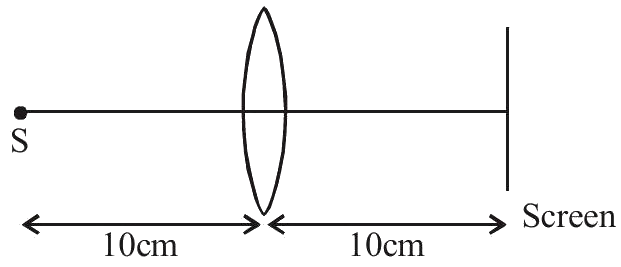
A convex lens is put 10 cm from a light source and it makes a sharp image on a screen, kept 10 cm from the lens. Now a glass block (refractive index 1.5) of 1.5 cm thickness is placed in contact with the light source. To get the sharp image again, the screen is shifted by a distance d . Then d is :
A.
0.55 cm away from the lens
B.
1.1 cm away from the lens
C.
0.55 cm towards the lens
D.
0
Correct answer: A

Source solution

Sol. 1v−1u=1f⇒110−1−10=1f⇒f=5cm Shift due to slab =t(1−1μ) in the direction of incident ray =1.5(1−23)=0.5 Again, 1v−1−9.5=15⇒1u=15−219=995⇒v=959=10.55cmQuestion figure
Choose another chapter