Learne2i
Learne2i Priority Practice solutions
JEE Main 2026 / Session 1
All chapters

Physics

Dual Nature of Radiation and Matter

Question 281 / Numerical
Question 281
A light beam of wavelength 500 nm is incident on a metal having work function of 1.25 eV, placed in a magnetic field of intensity B. The electrons emitted perpendicular to the magnetic field B, with maximum kinetic energy are bent into circular arc of radius 30 cm. The value of B is ____ ×10−7 T
Numerical answer: ____________________
Enter the requested integer (0 decimal places).
Correct answer: 125

Source solution

By photoelectric equation hcλ−ϕ=kmaxkmax=1240500−1.25≈1.25r=2mkeB B=2mker=125×10−7 T
Question 282 / MCQ
Question 282
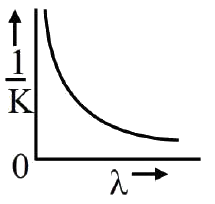
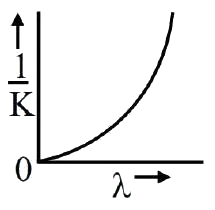
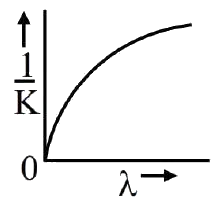
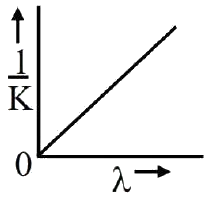
If λ and K are de Broglie Wavelength and kinetic energy, respectively, of a particle with constant mass. The correct graphical representation for the particle will be :-
A.
Question figure
B.
Question figure
C.
Question figure
D.
Question figure
Correct answer: B

Source solution

λ=hmv=h2mK λ2=h22m⋅1K Let y=λ2,x=1K y=h22mx This is of the form y=cx Hence, a straight line passing through the origin.
Question 283 / MCQ
Question 283
A metal plate of area 1×10⁻⁴ m2 is illuminated by a radiation of intensity 16 mW/m2. The work function of the metal is 5 eV . The energy of the incident photons is 10 eV and only 10% of it produces photo electrons. The number of emitted photo electrons per second and their maximum energy, respectively, will be : [1eV=1.6×10⁻¹⁹ J]
A.
1010 and 5 eV
B.
1014 and 10 eV
C.
1012 and 5 eV
D.
1011 and 5 eV
Correct answer: D

Source solution

I=nEAt 16×10−3=(nt)10×1.6×10−1910−4 (nt)=16×10−3×10−410×1.6×10−19 =16×10−716×10−18 =1011 s−1 (nt)=1011 photons s−1
Question 284 / Numerical
Question 284
Two stream of photons, possessing energies equal to twice and ten times the work function of metal are incident on the metal surface successively. The value of ratio of maximum velocities of the photoelectrons emitted in the two respective cases is x:y. The value of x is .
Numerical answer: ____________________
Enter the requested value (an integer; 0 decimal places). Use the units and scaling stated in the question.
Correct answer: 1

Source solution

Forphotoelectric effectk. Emax=E−ϕ E1=2ϕ,k1=ϕ E2=10ϕ,k2=9ϕ ∴V∝k(k=12mv2) v1v2=19⇒13=xy x=1
Question 285 / MCQ
Question 285
An α particle and a carbon 12 atom has same kinetic energy K . The ratio of their de-Broglie wavelength (λa:λC12) is :
A.
1:3
B.
3:1
C.
3:1
D.
2:3
Correct answer: B

Source solution

K=p22m⇒p∝m λ=hp⇒λ∝1p⇒λ∝1m λαλC12=mC12mα=124=3 λαλC12=3
Question 286 / MCQ
Question 286
Kinetic energy of the particle is E and it's De-Broglie wavelength is λ. On increasing it's K.E by ΔE, it's new De-Broglie wavelength becomes λ2. Then ΔE is
A.
3 E
B.
E
C.
2E
D.
4 E
Correct answer: A

Source solution

λ=hmv=h2m(KE) ⇒λ∝1KE Given that the wavelength becomes half, λiλf=λλ/2=2 =KEfKEi Squaring both sides, KEfKEi=4 ⇒KEf=4KEi Therefore, the increase in kinetic energy is ΔE=KEf−KEi =4KEi−KEi =3KEi If the initial kinetic energy is E, ΔE=3E
Question 287 / MCQ
Question 287
The de Broglie wavelength of an electron having kinetic energy E is λ. If the kinetic energy of electron becomes E4, then its de-Broglie wavelength will be :
A.
λ2
B.
λ2
C.
2λ
D.
2λ
Correct answer: C

Source solution

λ=h2mE If the kinetic energy becomes E′=E4, then λ′=h2m(E4) =2h2mE λ′=2λ
Question 288 / MCQ
Question 288
Consider an electron in a hydrogen atom, revolving in its second excited state (having radius 4.65\AA ). The de-Broglie wavelength of this electron is :
A.
3.5\AA
B.
12.9\AA
C.
9.7\AA
D.
6.6\AA
Correct answer: C

Source solution

For n=3, 2πr=nλ ⇒λ=2πr3 =2π×4.653\AA ≈9.7\AA λ≈9.7\AA
Question 289 / MCQ
Question 289
The de Brogue wavelengths for an electron and a photon are λe and λp respectively. For the same kinetic energy of electron and photon. which of the following presents the correct relation between the de Brogue wavelengths of two ?
A.
λp∝λe2
B.
λp ∝λe 
C.
λp ∝λe 
D.
λp∝1λe
Correct answer: A

Source solution

λe=h2mK For a photon, K=hcλp Substituting, λe=h2m(hcλp) =hλp2mhc λe∝λp λp∝λe2
Question 290 / MCQ
Question 290
The kinetic energy of an electron, α-particle and a proton are given as 4 K,2 K and K respectively. The de-Broglie wavelength associated with electron ( λ e) α-particle ( λα ) and the proton ( λ p) are as follows :
A.
λα=λp<λe
B.
λα>λp>λe
C.
λα<λp<λe
D.
λα=λp>λe
Correct answer: C

Source solution

Sol. Masses: Electron: me,Proton: mp,Alpha particle: mα=4mp Charges: Electron: e,Proton: e,Alpha particle: 2e Kinetic energies: Electron: 4K,Proton: K,Alpha particle: 2K Using de Broglie relation, λ=h2mK Thus, λe=h2me(4K),λp=h2mp(K),λα=h2mα(2K) Hence, λα<λp<λe
Question 291 / MCQ
Question 291
In photoelectric effect an em-wave is incident on a metal surface and electrons are ejected from the surface. If the work function of the metal is 2.14 eV and stopping potential is 2 V , what is the wavelength of the em-wave?(Given hc =1242eVnm where h is the Planck's constant and c is the speed of light in vaccum.)
A.
400 nm
B.
600 nm
C.
200 nm
D.
300 nm
Correct answer: D

Source solution

eVs=E−ϕ 2eV=E−2.14eV E=4.14eV E=hcλ λ=12424.14=300nm
Question 292 / MCQ
Question 292
A photo-emissive substance is illuminated with a radiation of wavelength λi so that it releases electrons with de-Broglie wavelength λe. The longest wavelength of radiation that can emit photoelectron is λ0. Expression for de-Broglie wavelength is given by :( m : mass of the electron, h : Planck's constant and c : speed of light)
A.
λe=h2mc(1λi−1λ0)
B.
λe=hλ02mc
C.
λe=h2mc(1λi−1λ0)
D.
λe=hλi2mc
Correct answer: A

Source solution

K.E=E−W λe=h2m⋅K.E,E=h⋅cλi,W=h⋅cλ0 h22m⋅λe2=h⋅cλi−h⋅cλ0 λe=h2m⋅c(1λi−1λ0)
Choose another chapter