
Learne2i
Learne2i Priority Practice solutions
JEE Main 2026 / Session 2
All chapters

Mathematics

Sequences and Series

Question 42 / MCQ
Question 42
If the domain of the function log5⁡(18x−x2−77) is (α,β) and the domain of the function log(x−1)⁡(2x2+3x−2x2−3x−4) is (γ,δ), then α2+β2+γ2 is equal to :
A.
195
B.
174
C.
186
D.
179
Correct answer: C

Source solution

log5⁡(18x−x2−77) has domain (α,β), and log(x−1)⁡(2x2+3x−2x2−3x−4) has domain (γ,δ). We need to find α2+β2+γ2. \hrulefill \textbf{Step 1: Domain of } log5⁡(18x−x2−77) For a logarithm, 18x−x2−77>0. −x2+18x−77>0 x2−18x+77<0. Factorizing, x2−18x+77=(x−7)(x−11). Hence, (x−7)(x−11)<0. Therefore, 7<x<11. Thus, (α,β)=(7,11). So, α=7,β=11. \hrulefill \textbf{Step 2: Domain of } log(x−1)⁡(2x2+3x−2x2−3x−4) For a logarithm: x−1>0,x−1≠1 which gives x>1,x≠2. Also, 2x2+3x−2x2−3x−4>0. Factorize: 2x2+3x−2=(2x−1)(x+2), x2−3x−4=(x−4)(x+1). Hence, (2x−1)(x+2)(x−4)(x+1)>0. Critical points: −2,−1,12,4. Using sign analysis: (2x−1)(x+2)(x−4)(x+1)>0 for (−∞,−2)∪(−1,12)∪(4,∞). Now intersect with x>1. Therefore, x∈(4,∞). Thus the domain is (γ,δ)=(4,∞). Hence, γ=4. \hrulefill \textbf{Step 3: Required value} α2+β2+γ2=72+112+42 =49+121+16 =186. 186 Hence, the correct option is (3) 186.
Question 43 / MCQ
Question 43
Let f be a function such that 3f(x)+2f(m19x)=5x, x≠0, where m=∑i=19(i)2. Then f(5)−f(2) is equal to
A.
-9
B.
36
C.
18
D.
9
Correct answer: C

Source solution

m=9×10×196=15×19 3f(x)+2f(15x)=5x Replace x by 15x 3f(15x)+2f(x)=75x 9f(x)−4f(x)=15x−150x5f(x)=15x−150xf(x)=3x−30xf(5)=15−305=9f(2)=6−15=−9f(5)−f(2)=18
Question 44 / Numerical
Question 44
Points P(−3,2),Q(9,10) and (a,4) lie on a circle C with PR as its diameter, The tangents to C at the points Q and R intersect at the point S. If S lies on the line 2x−ky=1, then k is equal to
Numerical answer: ____________________
Enter the requested value (an integer; 0 decimal places). Use the units and scaling stated in the question.
Correct answer: 3

Source solution

Equation of circle is (x+3)(x−α)+(y−2)(y−4)=0 Question figure Q lies on it 12(9−α)+8×6=0 α=13 x2+y2−10x−6y−31=0 Equation of Tangent at Q x.9+y.10−5(x+9)−3(y+10)−31=0 (1)4x+7y=106 Equation of Tangent at R x.13+y.4−5(x+13)−3(y+4)−31=0 (2)8x+y=108 Solution (1) and (2) s=(252,8) which lies on 2x−ky=1
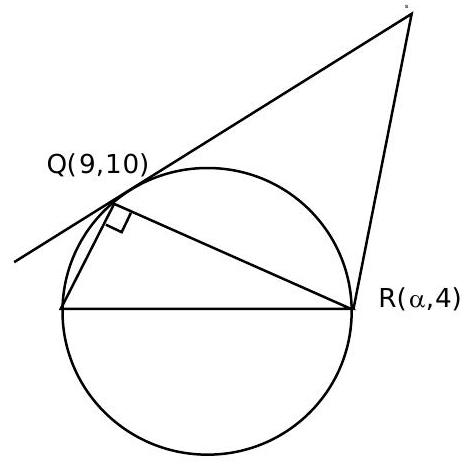
k=3
Question 45 / MCQ
Question 45
Let f:N→R be a function such that f(x+y)=2f(x)f(y) for natural numbers x and y. If f(1)=2, then the value of α for which ∑k=110f(α+k)=5123(220−1) holds, is
A.
2
B.
3
C.
4
D.
6
Correct answer: C

Source solution

f:N→R,f(x+y)=2f(x)f(y) f(1)=2, ∑k=110f(α+k)=2f(α)∑k=110f(k)(2)=2f(α)(f(1)+f(2)+…..+f(10)) From (1) f(2)=2f2(1)=23 f(3)=2f(2)f(1)=25 ⋮⋮ f(10)=29f10(1)=219 f(α)=22α−1;α∈N from (2) ∑k=110f(α+k)=2(22α−1)(2+23+25+….+219)5123(220−1)=22α(2(220−1)3) Hence α=4
Question 46 / Numerical
Question 46
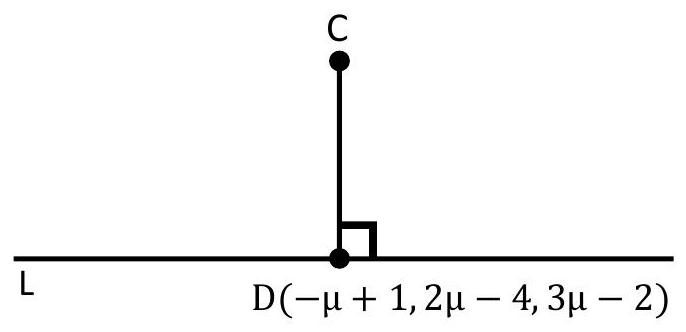
The point of intersection C of the plane 8x+y+2z=0 and the line joining the point A(−3,−61) and B(2,−4,−3) divides the line segment AB internally in the ratio k :. If a,b,c(|a|,|b|,|c|) are coprime are the direction ratios of the perpendicular form the point C on the line 1−x1=y+42=z+23, then ∣a+b+ c|is equal to
Numerical answer: ____________________
Enter the requested value (an integer; 0 decimal places). Use the units and scaling stated in the question.
Correct answer: 10

Source solution

10 Plane : 8x+y+2z=0 Given line AB:x−25=y−410=z+3−4=λ Any point on line (5λ+2,10λ+4,−4λ−3) Point of intersection of line and plane 8(5λ+2)+10λ+4−8λ−6=0 λ=−13 C (13,23,−53) L:x−1−1=y+42=z+23=μ Question figure CD―=(−μ+23)i^+(2μ−143)j^+(3μ−13)k^ (−μ+23)(−1)+(2μ−143)2+(3μ−13)3=0 μ=1114 CD→=−542,−13042,8542 Direction ratio →(−1,−26,17) |a+b+c|=10
Question 47 / Numerical
Question 47
A line passes through A(4,−6,−2) and B(16,−2,4). The point P(a,b,c) where a,b,c are non-negative integers, on the line AB lies at a distance of 21 units, from the point A . The distance between the points P(a,b,c) and Q(4,−12,3) is equal to .
Numerical answer: ____________________
Enter the requested value (an integer; 0 decimal places). Use the units and scaling stated in the question.
Correct answer: 22

Source solution

- x−412=x+64=z+26x−467=y+627=z+237=21(21×67+4,27×21−6,37×21−2)=(22,0,7)=(a,b,c)∴324+144+16=22
Question 48 / Numerical
Question 48
Let the image of the point P(1,2,3) in the line L:x−63=y−12=z−23 be Q . let R(α,β,γ) be a point that divides internally the line segment PQ in the ratio 1:3. Then the value of 22(α+β+γ) is equal to
Numerical answer: ____________________
Enter the requested value (an integer; 0 decimal places). Use the units and scaling stated in the question.
Correct answer: 125

Source solution
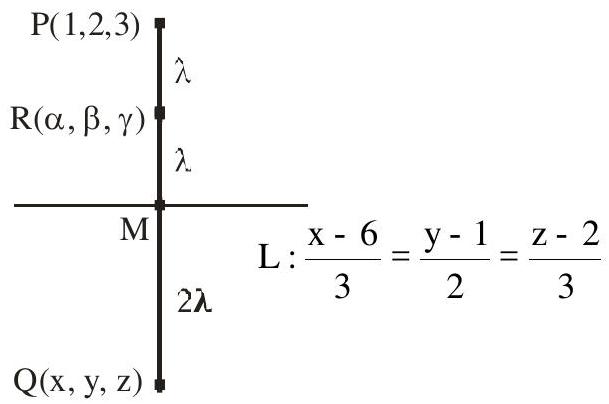
Question figure Let M be the mid-point of PQ ∴M=(3λ+6,2λ+1,3λ+2) Now, PM→=(3λ+5)i^+(2λ−1)j^+(3λ−1)k^ ∵PM→⊥(3i^+2j^+3k^) ∴3(3λ+5)+2(2λ−1)+3(3λ−1)=0 λ=−511 ∴M(5111,111,711) Since R is mid-point of PM 22(α+β+γ)=125
Question 49 / Numerical
Question 49
A ray of light passing through the point P(2,3) reflects on the x -axis at point A and the reflected ray passes through the point Q(5,4). Let R be the point that divides the line segment AQ internally into the ratio 2:1. Let the co-ordinates of the foot of the perpendicular M from R on the bisector of the angle PAQ be (α,β). Then, the value of 7α+3β is equal to .
Numerical answer: ____________________
Enter the requested value (an integer; 0 decimal places). Use the units and scaling stated in the question.
Correct answer: 31

Source solution
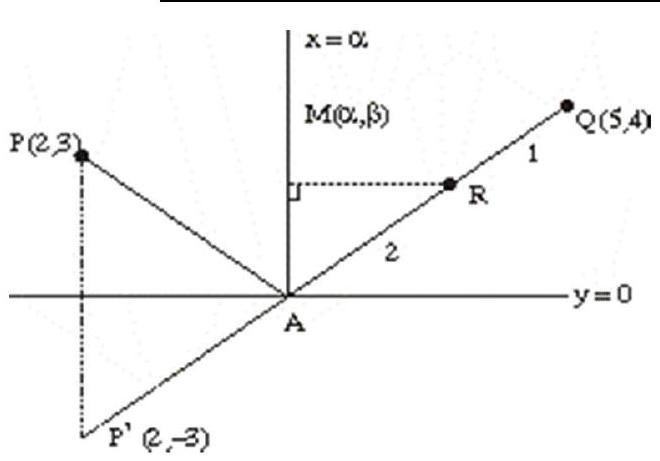
Question figure By observation we see that A(α,0). And β=y-cordinate of R (1)=2×4+1×02+1=83 Now P′ is image of P in y=0 which will be P′(2,−3) ∴ Equation of P′Q is (y+3)=4+35−2(x−2) i.e. 3y+9=7x−14 A≡(237,0) by solving with y=0 (2)∴α=237 By (1), (2) 7α+3β=23+8=31
Question 50 / MCQ
Question 50
The common difference of the A.P.: a1,a2,….,am is 13 more than the common difference of the A.P.: b1, b2,…, bn. If b31=−277, b43=−385 and a78= 327, then a1 is equal to
A.
21
B.
24
C.
19
D.
16
Correct answer: C

Source solution

Let common difference of A.P.'s are d1& d2 ∴d1=13+d2 b1+30 d2=−277 b1+42 d2=−385 By (2) - (1) 12 d2=−108 d2=−9 ∴d1=4 Now a78=327 ⇒a1+77d1=327⇒a1+308=327a1=19
Question 51 / MCQ
Question 51
Let a1,a22,a322,…,a1029 be a G.P. of common ratio 12. If a1+a2+…+a10=62, then a1 is equal to :
A.
2(2−1)
B.
2−2
C.
2−1
D.
2(2−2)
Correct answer: A

Source solution

a22a1=a32a2=a42a3=….=a102a9=12 ∴a1,a2,a3,.,a10 are in G.P. with common ratio 2. ∑i=110ai=a1((2)10−1)2−1=62⇒a1=2(2−1)
Question 52 / MCQ
Question 52
Let a1,a2,a3,…. be a G.P. of increasing positive terms such that a2.a3.a4=64 and a1+a3+a5=8137. Then a3+a5+a7 is equal to :
A.
3256
B.
3252
C.
3244
D.
3248
Correct answer: B

Source solution

ar.ar2.ar3=64 a3r6=64⇒ar2=4a+ar2+ar4=8137r2=28ar2+ar4+ar6=?ar2(1+r2+r4)=4(1+28+784)=3252
Question 53 / MCQ
Question 53
Let α1,α2,α3,α4 be an A.P. of four terms such that each term of the A. P. and its common difference l are integers. If α1+α2+α3+α4=48 and α1,α2,α3,α4+l4=361 then the largest term of the A.P. is equal to
A.
27
B.
24
C.
21
D.
23
Correct answer: A

Source solution

a1,a2,a3,a4 as a−3 d,a−d,a+d,a+3 d where d=ℓ2 ∵a1+a2+a3+a4=48⇒4a=48⇒a=12 &a1a2a3a4+ℓ4=361⇒(a2−9d2)(a2−d2)+16d4 =361⇒(144−9 d2)(144−d2)+16 d4=361⇒25 d4−1440 d2+(144)2=361 (5 d2−144)2=192∴5 d2−144=19 or −19 d2=1635 or d2=1255=25 d=1635 or d=5∴ℓ=21635 or ℓ=10 (rejected) ∵ common difference is an integer ∴ largest term =12+15=27
Question 54 / MCQ
Question 54
Consider an A.P. of positive integers, whose sum of the first three terms is 54 and the sum of the first twenty terms lies between 1600 and 1800. Then its 11th  term is :
A.
84
B.
122
C.
90
D.
108
Correct answer: C

Source solution

Sol. S3=3a+3 d=54 ⇒a+d=18 S20=10(2a+19 d) ⇒10(36+17 d) ⇒1600<10(36+17 d)<1800 ⇒160<36+17 d<180 ⇒124<17 d<144 ⇒7517<d<8817 Common difference will be natural number ⇒d=8⇒a=10 ⇒a11=10+10×8=90
Question 55 / MCQ
Question 55
Let a1,a2,a3…. be a G.P. of increasing positive terms. If a1a5=28 and a2+a4=29, the a6 is equal to
A.
628
B.
526
C.
784
D.
812
Correct answer: C

Source solution

Sol. a1⋅a5=28⇒a⋅ar4=28⇒a2r4=28 (1)a2+a4=29⇒ar+a3=29 ⇒ar(1+r2)=29 (2)⇒a2r2(1+r2)2=(29)2 By Eq. (1) & (2) r2(1+r2)2=2829×29 ⇒r1+r2=2829⇒r=28 ∵a2r4=28⇒a2×(28)2=28 ⇒a=128 ∴a6=ar5=128×(28)228=784
Question 56 / Numerical
Question 56
Let Sn be the sum to n-terms of an arithmetic progression 3, 7, 11, ...... . If 40<(6n(n+1)∑k=1nSk)<42, then n equals .
Numerical answer: ____________________
Enter the requested value (an integer; 0 decimal places). Use the units and scaling stated in the question.
Correct answer: 9

Source solution

Sn=3+7+11+…….n terms =n2(6+(n−1)4)=3n+2n2−2n=2n2+n∑k=1nSk=2∑k=1nK2+∑k=1nK=2⋅n(n+1)(2n+1)6+n(n+1)2=n(n+1)[2n+13+12]=n(n+1)(4n+5)6 ⇒40<6n(n+1)∑k=1nSk<42 40<4n+5<42 35<4n<37 n=9
Choose another chapter