
Learne2i
Learne2i Priority Practice solutions
JEE Main 2026 / Session 2
All chapters

Mathematics

Vector Algebra

Question 174 / MCQ
Question 174
If the equation of the plane containing the line x+2y+3z−4=0=2x+y−z+5 and perpendicular to the plane r→=(i^−j^)+λ(i^+j^+k^)+μ(i^−2j^+3k) is ax+by+cz=4, then (a−b+c) is equal to
A.
20
B.
24
C.
22
D.
18
Correct answer: C

Source solution

The given line is the intersection of the planes x+2y+3z−4=0 and 2x+y−z+5=0. The normals to these planes are n→1=(1,2,3),n→2=(2,1,−1). Hence the direction vector of the line is d→=n→1×n→2=|i^j^k^12321−1|=(−5,7,−3). --- The given plane is r→=(i^−j^)+λ(i^+j^+k^)+μ(i^−2j^+3k^). Its two direction vectors are a→=(1,1,1),b→=(1,−2,3). Therefore, its normal vector is n→p=a→×b→=|i^j^k^1111−23|=(5,−2,−3). --- Let the required plane have normal vector N→=(a,b,c). Since the required plane contains the given line, N→⋅d→=0. Thus, −5a+7b−3c=0. Also, the required plane is perpendicular to the plane whose normal is (5,−2,−3), so N→⋅(5,−2,−3)=0, i.e., 5a−2b−3c=0. Solving −5a+7b−3c=0 and 5a−2b−3c=0, adding, 5b−6c=0 b=6c5. Substituting into 5a−2b−3c=0, 5a−12c5−3c=0 25a=27c. Taking c=25, a=27,b=30. Hence, N→=(27,30,25). Therefore the required plane is 27x+30y+25z=4. So, a−b+c=27−30+25=22. 22 Hence, the correct option is (3)22.
Question 175 / MCQ
Question 175
Let the plane P:r→⋅a→=d contain the line of intersection of two planes r→⋅(i^+3j^−k^)=6 and r→⋅(−6i^+5j^−k^)=7. If the plane P passes through the point (2,3,12), then the value of |13a→|2 d2 is equal to
A.
90
B.
93
C.
95
D.
97
Correct answer: B

Source solution

Sol. Equation of plane passing through line of intersection of planes P1:r→((i^+3j^−k^)=6 and P2:r→⋅(−6i^+5j^−k^)=7 is P1+λP2=0 (r¯⋅(i^+3j^−k^)−6)+λ(r¯⋅(−6i^+5j^−k^)−7)=0 and it passes through point (2,3,12) ⇒(2+9−12−6)+λ(−12+15−12−7)=0 ⇒λ=1 Equation of plane is r¯⋅(−5i^+8j^−2k^)=13 |a→|2=25+64+4=93;d=13 Value of |13a―|2 d2=93
Question 176 / MCQ
Question 176
Let a→=2i^+7j^−k^,b→=3i^+5k^ and c→=i^−j^+2k^ . Let d→ be a vector which is perpendicular to both a→ and b→, and c→⋅d→=12. Then (−i^+j^−k^)⋅(c→×d→) is equal to
A.
48
B.
42
C.
44
D.
24
Correct answer: C

Source solution

Sol. a→=2i^+7j^−k^ b→=3i^+5k^ c→=i^−j^+2k^ d→=λ(a→×b→)=λ|i^j^k^27−1305| d→=λ(35i^−13j^−21k^) λ(35+13−42)=12 λ=2 d→=2(35i^−13j^−21k^) (i^+j^−k^)(c→×d→) =|−11−11−1270−26−42|=44
Question 177 / Numerical
Question 177
Let the three sides of a triangle ABC be given by the vectors 2i^−j^+k^,i^−3j^−5k^ and 3i^−4j^−4k^. Let G be the centroid of the triangle ABC . Then 6(|AG→|2+|BG→|2+|CG→|2) is equal to
Numerical answer: ____________________
Enter the requested value (an integer; 0 decimal places). Use the units and scaling stated in the question.
Correct answer: 164

Source solution
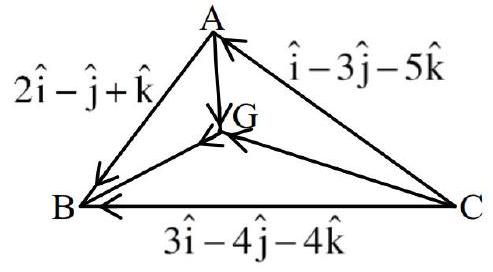
Question figure By given data AB→+AC→=CB→ Let pv of A→ are O→ then AB→=B→−A→ i.e. pv of B→−=2i^−j^+k^ CA→=A→−C→ i.e. pv of C→=−(i^−3j^−5k^) Now pv of centroid (G→)−=A→+B→+C→3=0→+(2,−1,1)+(−1,3,5)3 G→=13(i^+2j^+6k^) Now AG→=13(i^+2j^+6k^) ⇒|AG→|2=19×41 BG→=(13−2)i^+(23+1)j^+(2−1)k^ ⇒|BG→|2=599 CG→=(13+1)i^+(23−3)j^+(2−5)k^ ⇒|CG→|2=1469 Now 6[|AG→|2+|BG→|2+|CG→|2]=6×[419+599+1469] =6×2469=164
Question 178 / MCQ
Question 178
Let a→=2i^+3j^+4k^,b→=2i^−2j^−2k^ and c→=−i^+4j^+3k^. If d→ is a vector perpendicular to both b→ and c→ and a→⋅d→=18, Then |a→×d→|2 is equal to
A.
640
B.
760
C.
680
D.
720
Correct answer: D

Source solution

Sol. a=λ(b×c) b→×c→=|i^j^k^1−2−2−143|=2i^−j^+2k^ d→=λ(2i^−j^+2k^) a→⋅d→=18 λ=2 So d→=2(2i^−j^+2k^) d→×a→=|i^j^k^4−24234|=−20i^−8j^+16k^ |d→×a→|2=720
Question 179 / MCQ
Question 179
Let a→=i^−2j^+3k^,b→=2i^+j^−k^,c→=λi^+j^+k^ and v→=a→×b→. If v→.c→=11 and the length of the projection of b→ on c→ is p, then 9p2 is equal to :
A.
9
B.
6
C.
4
D.
12
Correct answer: D

Source solution

a→=i^−2j^+3k^,b→=2i^+j^−k^,c→=λi^+j^+k^, and v→=a→×b→. If v→.c→=11 v→=(a→×b→)=(−i^+7j^+5k^)v→⋅c→=11=(−i^+7j^+5k^)⋅(λi^+j^+k^)=11⇒−λ+7+5=11⇒λ=1 Length of projection of b→ on c→=b→.c^ ⇒|(2i^+j^−k^)⋅(i^+j^+k^)3|=2+1−13=P=23⇒9p2=9(43)=12
Question 180 / MCQ
Question 180
Let α→=3i^+j^ and β→=2i^−j^+3k^. If β→=β→1−β→2, where β→1 is parallel to α→ and β→2 is perpendicular to α→, then β→1×β→2 is equal to:
A.
12(3i^−9j^+5k^)
B.
12(−3i^+9j^+5k^)
C.
−3i^+9j^+5k^
D.
3i^−9j^−5k^
Correct answer: B

Source solution

Sol. β→=β1→−β2→ (i)∴β2→⋅α→=0 and Let β1→=λα→ α→⋅β→=α→⋅β1→−α→⋅β2→ ⇒5=λα2 ⇒5=λ×10 ⇒λ=12 ∴β1→=α→2 Cross product with β1→ in equation (i) ⇒β→×β1→=−β2→×β1→ ⇒β→×β1→=β1→×β2→=(β→×α→)2 ⇒β1→×β2→=12|i^j^k^2−13310| =12[−3i^−j^(−9)+k^(5)]=12[−3i^+9j^+5k^]
Question 181 / Numerical
Question 181
Let a→=i^+j^+k^,b→=3i^+2j^−k^,c→=λj^+μk^ and d^ be a unit vector such that a→×d^=b→×d^ and c→.d^=1, If c→ is perpendicular to a→, then |3λd^+μc→|2 is equal to .
Numerical answer: ____________________
Enter the requested value (an integer; 0 decimal places). Use the units and scaling stated in the question.
Correct answer: 5

Source solution

a→×d→−b→×d→=0 (a−b→)×d→=0 d→=t(a→−b→) d→=t(−2i^−j^+2k^) |d→|=1 |t|=13 c→⋅a→=0 λ+μ=0 μ=−λ c→=λ(j^−k^),|c→|2=2λ2 c→⋅d^=1 t(−2,−1,2)⋅λ(0,1,−1)=1 λt=−13⇒λ2=1 |3λ d^+μc→|2=9λ2| d^|2+μ2|c→|2+6λμ( d^⋅c→) =3λ2+2λ4 =5
Question 182 / MCQ
Question 182
Let a→=i^+2j^+3k^,b→=2i^+3j^−5k^ and c→=3i^−j^+λk^ be three vectors. Let r→ be a unit vector along b→+c→. If r→.a→=3, then 3λ is equal to :
A.
27
B.
25
C.
25
D.
21
Correct answer: B

Source solution

Sol. r→=k(b→+c→) r→⋅a→=3 r→.a→=k(b→.a→+c→.a→) 3=k(2+6−15+3−2+3λ) (1)3=k(−6+3λ) r→=k(5i^+2j^−(5−λ)k^) (2)|r→|=k25+4+25+λ2−10λ=1 k=3−6+3λ=1−2+λ put in (2) 4+λ2−4λ=54+λ2−10λ 6λ=50 3λ=25
Question 183 / MCQ
Question 183
Let a=i^+4j^+2k^,b=3i^−2j^+7k^ and c→=2i^−j^+4k^. If a vector d→ satisfies d→×b→=c→×b→ and d→.a→=24, then |d→|2 is equal to
A.
413
B.
423
C.
323
D.
313
Correct answer: A

Source solution

Sol.:} d→×b→=c→×b→ ⇒(d→−c→)×b→=0 ⇒d→=c→+λb→ Also d→.a→=24 ⇒(c→+λb→)⋅a→=24 λ=24−a→⋅c→b→⋅a→=24−69=2 ⇒d→=c→+2( b→) =8i^−5j^+18k^ ⇒|d→|2=64+25+324=413
Question 184 / MCQ
Question 184
Let a→=2i^−3j^+4k^ and b→=7i^+j^−6k^. If r→×a→=r→×b→,r→⋅(i^+2j^+k^)=−3, then r→⋅(2i^−3j^+k^) is equal to :
A.
12
B.
8
C.
13
D.
10
Correct answer: A

Source solution

Sol. r→×a→−r→×b→=0 ⇒r→×(a→−b→)=0 ⇒r→=λ(a→−b→) ⇒r→=λ(−5i^−4j^+10k^) Also r→⋅(i^+2j^+k^)=−3 ⇒λ(−5−8+10)=−3 λ=1 Now r→=−5i^−4j^+10k^ =r→⋅(2i^−3j^+k^) =−10+12+10=12
Question 185 / MCQ
Question 185
Let a→=−i^+j^+2k^,b→=i^−j^−3k^,c→=a→×b→ and d→=c→×a→. Then (a→−b→)⋅d→ is equal to :
A.
4
B.
-4
C.
-2
D.
2
Correct answer: C

Source solution

d→=(a→×b→)×a→d→=(a2)b→−(a→⋅b→)a→d→=6b→+8a→(a→−b→)⋅d→−=(a→−b→)⋅(6b→+8a→)=8a2−6b2−2a→⋅b→=48−66+16=−2
Choose another chapter