Learne2i
Learne2i Priority Practice solutions
JEE Main 2026 / Session 2
All chapters

Mathematics

Three Dimensional Geometry

Question 201 / MCQ
Question 201
Let the line passing through the points, P(2,−1,2) and Q(5,3,4) meet the plane x−y+z=4 at the point R . Then the distance of the point R from the plane x+2y+3z+2=0 measured parallel to the line x−72=y+32=z−21 is equal to
A.
31
B.
189
C.
61
D.
3
Correct answer: D

Source solution

Sol. Line : x−53=y−34=z−42=λ R(3λ+5,4λ+3,2λ+4) ∴3λ+5−4λ−3+2λ+4=4 λ+6=4∴λ=−2 ∴R≡(−1,−5,0) Line : x+12=y+52=z−01=μ Point T=(2μ−1,2μ−5,μ) It lies on plane 2μ−1+2(2μ−5)+3μ+2=0 μ=1 ∴T=(1,−3,1) ∴RT=3
Question 202 / MCQ
Question 202
Let the point, on the line passing through the points P(1,−2,3) and Q(5,−4,7), farther from the origin and at a distance of 9 units from the point P, be (α,β,γ). Then α2+β2+γ2 is equal to :
A.
155
B.
150
C.
160
D.
165
Correct answer: A

Source solution

Sol. The line PQ is given by the equations: x−14=y+2−2=z−34 We can express the points on the line in terms of a parameter t: (x,y,z)=(4t+1,−2t−2,4t+3) Next, we calculate the distance squared from the origin to the point on the line: d2=(4t+1)2+(−2t−2)2+(4t+3)2 Expanding each term: d2=(16t2+8t+1)+(4t2+8t+4)+(16t2+24t+9) Combining like terms: d2=16t2+4t2+16t2+8t+8t+24t+1+4+9 d2=36t2+40t+14 Setting d2=81: 36t2+40t+14=81 Rearranging gives: 36t2+40t−67=0 Using the quadratic formula: t=−b±b2−4ac2a=−40±402−4⋅36⋅(−67)2⋅36 Calculating the discriminant: b2−4ac=1600+9632=11232 Thus, t=−40±1123272 Calculating 11232: 11232=106 So, t=−40±10672 Calculating the two possible values for t: 1. t=6672=1112 2. t=−14672=−7336 Finding the corresponding points: For t=1112: (4⋅1112+1,−2⋅1112−2,4⋅1112+3)=(7,−5,9) For t=−7336: Calculating gives another point. Finally, we find: α2+β2+γ2=155 Thus, the answer is option (1).
Question 203 / Numerical
Question 203
A circle with centre (2,3) and radius 4 intersects the line x+y=3 at the points P and Q. If the tangents at P and Q intersect at the point S(α,β), then 4α−7β is equal to
Numerical answer: ____________________
Enter the requested value (an integer; 0 decimal places). Use the units and scaling stated in the question.
Correct answer: 11

Source solution

11 (x−2)2+(y−3)2=16 x2+y2−4x−6y−3=0 let the chord of contact w.r. to the point S(α,β) is T=0 αx+βy−2(x+α)−3(y+β)−3=0 x(α−2)+y(β−3)−2α−3β−3=0 Comparison with x+y=3 α−21=β−31=−2α−3β−3−3 α−2=β−3−3β+9=−2α−3β−3 α−β=−12α=−3−9 β=α+1α=−122 =−6+1=−5α=−6 4α−7β 4(−6)−7(−5) ⇒−24+35=11
Question 204 / MCQ
Question 204
Let the point, on the line passing through the points P(1,−2,3) and Q(5,−4,7), farther from the origin and at a distance of 9 units from the point P , be (α,β,γ). Then α2+β2+γ2 is equal to :
A.
155
B.
150
C.
160
D.
165
Correct answer: A

Source solution

Sol. PQ line x−14=y+2−2=z−34 pt (4t+1,−2t−2,4t+3) distance 2=16t2+4t2+16t2=81 t=±32 pt (7, -5, 9) α2+β2+γ2=155 option (1)
Question 205 / MCQ
Question 205
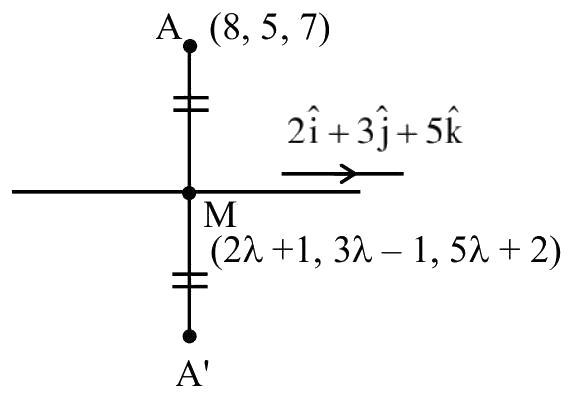
Let (α,β,γ) be the point (8,5,7) in the line x−12=y+13=z−25. Then α+β+γ is equal to
A.
16
B.
18
C.
14
D.
20
Correct answer: B

Source solution

Given: AM→⋅(2i^+3j^+5k^)=0 Let AM→=(2λ−7)i^+(3λ−6)j^+(5λ−5)k^ Setting up the dot product: (2λ−7)(2)+(3λ−6)(3)+(5λ−5)(5)=0 Expanding: 4λ−14+9λ−18+25λ−25=0 Combining like terms: (4λ+9λ+25λ)−57=0 38λ=57 λ=5738=32 Coordinates of M:M(4,72,192) Coordinates of A′:A′(0,2,12)Question figure
Question 206 / MCQ
Question 206
Let d be the distance of the point of intersection of the lines x+63=y2=z+11 and x−74=y−93=z−42 from the point (7,8,9). Then d2+6 is equal to :
A.
72
B.
69
C.
75
D.
78
Correct answer: C

Source solution

Line L1:x+63=y2=z+11=λ Hence, x=3λ−6,y=2λ,z=λ−1. Similarly, Line L2:x−74=y−93=z−42=μ gives x=4μ+7,y=3μ+9,z=2μ+4. Since the lines intersect, 3λ−6=4μ+7, 2λ=3μ+9, λ−1=2μ+4. From the third equation, λ=2μ+5. Substituting into the second equation, 2(2μ+5)=3μ+9 4μ+10=3μ+9 μ=−1. Therefore, λ=2(−1)+5=3. Hence, the point of intersection is P=(3⋅3−6,2⋅3,3−1)=(3,6,2). --- Given point Q=(7,8,9). Therefore, d=PQ. So, d2=(7−3)2+(8−6)2+(9−2)2. d2=42+22+72. d2=16+4+49=69. Hence, d2+6=69+6=75. 75 Hence, the correct option is (3)75.
Question 207 / MCQ
Question 207
For real numbers α and β≠0, if the point of intersection of the straight lines x−α1=y−12=z−13 and x−4β=y−63=z−73, lies on the plane x+2y−z=8, then α−β is equal to :
A.
5
B.
9
C.
3
D.
7
Correct answer: D

Source solution

\textbf{Given lines:} x−α1=y−12=z−13=λ and x−4β=y−63=z−73=μ. Since the lines intersect, let their point of intersection be P(x,y,z). From the first line, x=α+λ,y=1+2λ,z=1+3λ. From the second line, x=4+βμ,y=6+3μ,z=7+3μ. Equating the y-coordinates, (1)1+2λ=6+3μ. Equating the z-coordinates, (2)1+3λ=7+3μ. From (2), (3)λ−μ=2. Substituting λ=μ+2 into (1), 1+2(μ+2)=6+3μ, 5+2μ=6+3μ, μ=−1. Hence, λ=1. Therefore the point of intersection is P=(α+1,3,4). Since P lies on the plane x+2y−z=8, we have (α+1)+2(3)−4=8. α+3=8. α=5. Now equating the x-coordinates, α+λ=4+βμ. Substituting α=5, λ=1, μ=−1, 5+1=4−β. 6=4−β. β=−2. Hence, α−β=5−(−2)=7. α−β=7 Option (4)
Question 208 / Numerical
Question 208
Let P(α,β,γ) be the image of the point Q(1,6,4) in the line x1=y−12=z−23. Then 2α+β+γ is equal to .
Numerical answer: ____________________
Enter the requested value (an integer; 0 decimal places). Use the units and scaling stated in the question.
Correct answer: 11

Source solution

\(\frac{\)
Q(1,6,4)
A(1714,4814,7914)
x1=y−12=z−23
P(α,β,γ)b→=i^+2j^+3k^
\}\{4\} A(t,2t+1,3t+2) QA→=(t−1)i^+(2t−5)j^+(3t−2)k^ QA→⋅b→=0 (t−1)+2(2t−5)+3(3t−2)=0 14t=17 α=2014β=1214γ=10214 2α+β+γ=15414=11
Question 209 / MCQ
Question 209
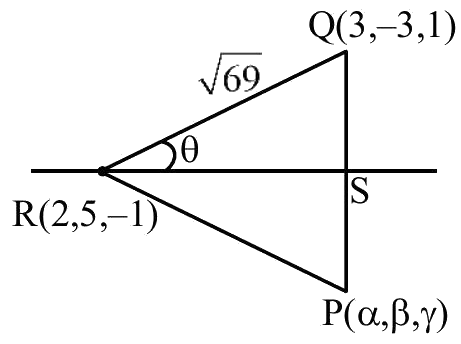
Let P(α,β,γ) be the image of the point Q(3,−3,1) in the line x−01=y−31=z−1−1 and R be the point (2,5,−1). If the area of the triangle PQR is λ and λ2=14 K, then K is equal to:
A.
36
B.
72
C.
18
D.
81
Correct answer: D

Source solution

Given: 1. Calculate RQ: RQ=1+64+4=69 2. Define vectors: RQ→=ℓ^−8j^+2k^ RS→=ℓ^+j^−k^ 3. Calculate cos⁡θ: cos⁡θ=RQ→⋅RS→|RQ→||RS→| =|1−8−2693|=9323 4. Simplify cos⁡θ: cos⁡θ=323=RSRQ=RS69 ⇒RS=33 5. Calculate sin⁡θ: sin⁡θ=1423=QS69 ⇒QS=42 6. Calculate the area: Area=12⋅2QS⋅RS=42⋅33 7. Calculate λ: λ=914 8. Calculate λ2: λ2=81.14=14k ⇒k=81Question figure
Question 210 / MCQ
Question 210
Let P(α,β,γ) be the image of the point Q(3,−3,1) in the line x−01=y−31=z−1−1 and R be the point ( 2,5,−1 ). If the area of the triangle PQR is λ and λ2=14 K, then K is equal to:
A.
36
B.
72
C.
18
D.
81
Correct answer: D

Source solution

Sol. RQ=1+64+4=69 RQ→=ℓ^−8j^+2k^ RS→=ℓ^+j^−k^ cos⁡θ=RQ→⋅RS→|RQ→||RS→|=|1−8−2693|=9323 cos⁡θ=323=RSRQ=RS69 RS =33 sin⁡θ=1423=QS69 QS=42 area =12⋅2QS⋅RS=42⋅33 λ=914 λ2=81.14=14k k=81Question figure
Question 211 / MCQ
Question 211
If the line 2−x3=3y−24λ+1=4−z makes a right angle with the line x+33μ=1−2y6=5−z7, then 4λ+9μ is equal to :
A.
13
B.
4
C.
5
D.
6
Correct answer: D

Source solution

Sol. We start with the equations: 2−x3=3y−24λ+1=4−z x−2−3=y−234λ+13=z−4−1 From the second set of equations, we have: x+33μ=1−2y6=5−z7 This can be rewritten as: x+33μ=y−12−3=z−5−7 Using the right angle condition, we set up the equation: (−3)(3μ)+(4λ+13)(−3)+(−1)(−7)=0 Simplifying this gives: −9μ−4λ−1+7=0 Thus, we arrive at: 4λ+9μ=6
Question 212 / MCQ
Question 212
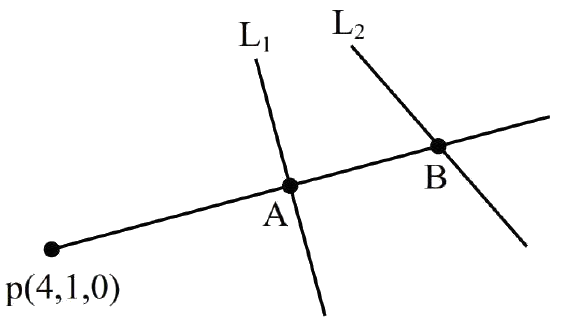
Let a line passing through the point (4,1,0) intersect the line L1;x−12=y−23=z−34 at the point A(α,β,γ) and the line L2:x−6=y=−z+4 at the point B(a,b,c). Then |101αβγabc| is equal to
A.
8
B.
16
C.
12
D.
6
Correct answer: A

Source solution

Sol.} L1=x−12=y−23=z−34=p L2=x−61=y1=z−4−1=q A(2p+1,3p+2,4p+3) B(q+6,q,4−q) D.R. of PA=2p−3,3P+1,4p+3 D.R. of PB=q+2,q−1,4−q 2p−3q+2=3p+1q−1=4p+34−q 2pq−2p−3q+3=3pq+6p+q+2 (1)pq+rp+4q−1=0 12p−3pq+4−q=4pq+3q−4p−3 (2)7pq−16p+4q−7=0 8p−2pq−12+3q=4pq+8p+3q+6 6pq=−18∴pq=−3 8p+4q=4⇒2p+q=1 −21−16p+4q−7⇒4p−q=−7 16p−4q=−28∴p=−1,q=3 A(−1,−1,−1)B(9,3,1) |101−1−1−1931|=|0−10−1−1−1931|=1(−1+9)=8 Option (1)Question figure
Question 213 / Numerical
Question 213
The lines x−22=y−2=z−716 and x+34=y+23=z+21 intersect at the point P. If the distance of P from the line x+12=y−13=z−11 is l, then 14l2 is equal to.
Numerical answer: ____________________
Enter the requested value (an integer; 0 decimal places). Use the units and scaling stated in the question.
Correct answer: 108

Source solution
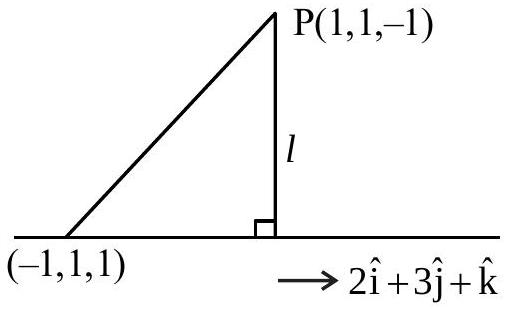
x−21=y−1=z−78=λ x+34=y+23=z+21=k ⇒λ+2=4k−3 −λ=3k−2 ⇒k=1,λ=−1 8λ+7=k−2 ∴P=(1,1,−1) Question figure Projection of 2i^−2k^ on 2i^+3j^+k^ is =4−24+9+1=214 ∴l2=8−414=10814 ⇒14l2=108
Question 214 / MCQ
Question 214
Let a line passing through the point (4,1,0) intersect the line L1:x−12=y−23=z−34 at the point (α,β,γ) and the line L2:x−6=y=−z+4 at the point (a,b,c). Then |101αβγabc| is equal to
A.
8
B.
16
C.
12
D.
6
Correct answer: A

Source solution

Let L1=x−12=y−23=z−34=p L2=x−61=y1=z−4−1=q A(2p+1,3p+2,4p+3) B(q+6,q,4−q) Direction Ratios of PA:(2p−3,3p+1,4p+3) Direction Ratios of PB:(q+2,q−1,4−q) 2p−3q+2=3p+1q−1=4p+34−q 2pq−2p−3q+3=3pq+6p+q+2 (1)pq+rp+4q−1=0 12p−3pq+4−q=4pq+3q−4p−3 (2)7pq−16p+4q−7=0 8p−2pq−12+3q=4pq+8p+3q+6 6pq=−18⇒pq=−3 8p+4q=4⇒2p+q=1 −21−16p+4q−7⇒4p−q=−7 16p−4q=−28⇒p=−1,q=3 A(−1,−1,−1)B(9,3,1) |101−1−1−1931|=|0−10−1−1−1931|=1(−1+9)=8 Option (1)Question figure
Question 215 / MCQ
Question 215
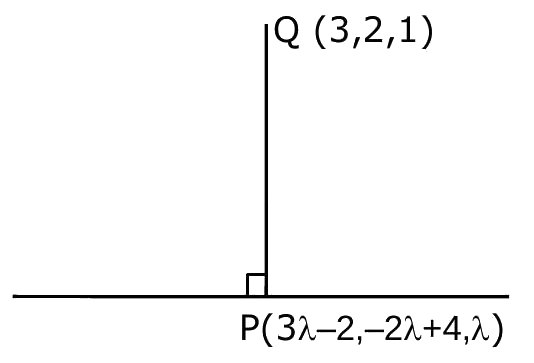
Let L be a line obtained from the intersection of two planes x+2y+z=6 and y+2z=4. If point P(α,β,γ) is the foot of perpendicular from (3,2,1) on L, then the value of 21(α+β+γ) equals :
A.
142
B.
68
C.
136
D.
102
Correct answer: D

Source solution

Sol. Dr's of line |i^j^k^121012|=3i^−2j^+k^ Dr/s :- (3,−2,1) Points on the line (−2,4,0) Equation of the line x+23=y−4−2=z1=λ Dr's of PQ ; 3λ−5,−2λ+2.λ−1 Dr's of y lines are (3,−2,1) Since PQ⊥ line 3(3λ−5)−2(−2λ+2)+1(λ−1)=0 λ=107 P(167,87,107) 21(α+β+γ)=21(347)=102Question figure
Choose another chapter