
Physics
Work, Energy and Power
Question 38 / MCQ
A body at rest is moved along a horizontal straight line by a machine delivering a constant power. The distance moved by the body in time '
Correct answer: A
Source solution
Question 39 / Numerical
The amplitude of a particle executing SHM is 3 cm . The displacement at which its kinetic energy will be
Numerical answer: ____________________
Enter the requested value (an integer; 0 decimal places). Use the units and scaling stated in the question.
Correct answer: 2
Source solution
Question 40 / Numerical
A spherical body of mass 2 kg starting from rest acquires a kinetic energy of 10000 J at the end of
Numerical answer: ____________________
Enter the requested value (an integer; 0 decimal places). Use the units and scaling stated in the question.
Correct answer: 40
Source solution
40 ImpulseQuestion 41 / MCQ
The bob of a pendulum was released from a horizontal position. The length of the pendulum is 10 m . If it dissipates
Correct answer: A
Source solution
Sol. Length of the pendulum,Question 42 / Numerical
A uniform chain of length 3 meter and mass 3 kg overhangs a smooth table with 2 meter laying on the table. If k is the kinetic energy of the chain in joule as it completely slips off the table, then the value of
Numerical answer: ____________________
Enter the requested value (an integer; 0 decimal places). Use the units and scaling stated in the question.
Correct answer: 40
Source solution
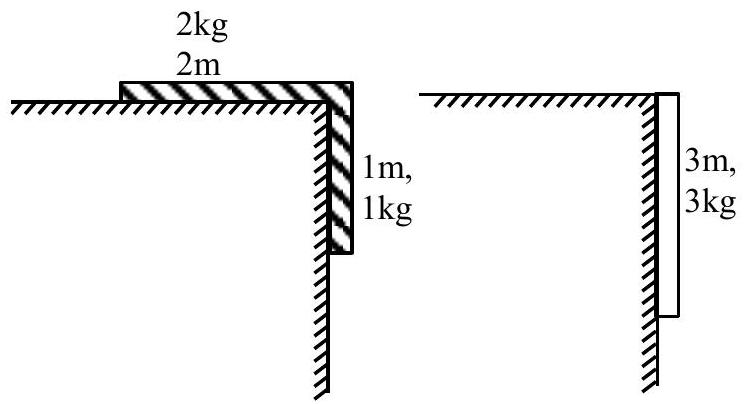 From energy conservation
Question 43 / Numerical
A block of mass ' 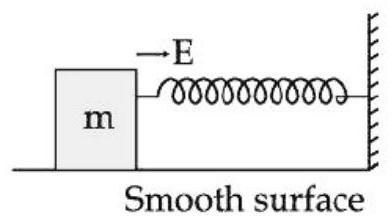
Numerical answer: ____________________
Enter the requested value (an integer; 0 decimal places). Use the units and scaling stated in the question.
Correct answer: 24
Source solution
Using work - energy theoremQuestion 44 / MCQ
A particle is placed at the point A of a frictionless track ABC as shown in figure. It is gently pushed toward right. The speed of the particle when it reaches the point B is : 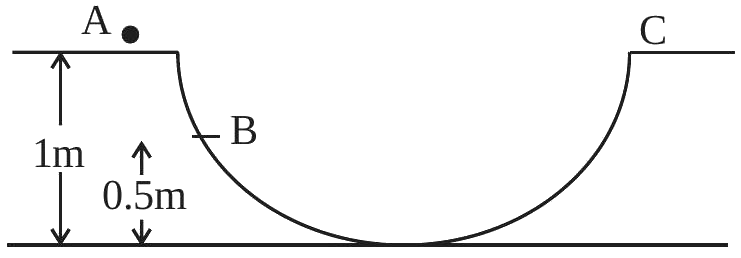
Correct answer: B
Source solution
Sol. By conservation of energy,Question 45 / MCQ
A block of mass 100 kg slides over a distance of 10 m on a horizontal surface. If the co-efficient of friction between the surfaces is 0.4 , then the work done against friction (in J ) is :
Correct answer: C
Source solution
Sol. Given,Question 46 / MCQ
A body of mass 'm' dropped from a height 'h' reaches the ground with a speed of
Correct answer: A
Source solution
Work done = Change in kinetic energyQuestion 47 / MCQ
A body of mass 0.5 kg travels on straight line path with velocity
Correct answer: B
Source solution
Sol. Given,Question 48 / Numerical
A body of mass 2 kg is driven by an engine delivering a constant power of
Numerical answer: ____________________
Enter the requested value (an integer; 0 decimal places). Use the units and scaling stated in the question.
Correct answer: 18
Source solution
18 P = Fv = mavQuestion 49 / Numerical
A block of mass 5 kg starting from rest pulled up on a smooth incline plane making an angle of
Numerical answer: ____________________
Enter the requested value or coefficient rounded to the nearest integer (0 decimal places).
Correct answer: 300
Source solution
Question 50 / Numerical
A body of mass 5 kg is moving with a momentum of
Numerical answer: ____________________
Enter the requested value (an integer; 0 decimal places). Use the units and scaling stated in the question.
Correct answer: 30
Source solution
GivenQuestion 51 / MCQ
A wooden block of mass 5 kg rests on soft horizontal floor. When an iron cylinder of mass 25 kg is placed on the top of the block, the floor yields and the block and the cylinder together go downwith an acceleration of
Correct answer: C
Source solution
Sol. TakingQuestion 52 / Numerical
The radius of curvature of each surface of a convex lens having refractive index 1.8 is 20 cm . The lens is now immersed in a liquid of refractive index 1.5. The ratio of power of lens in air to its power in the liquid will be
Numerical answer: ____________________
Enter the requested value (an integer; 0 decimal places). Use the units and scaling stated in the question.
Correct answer: 4