
Learne2i
Learne2i Priority Practice solutions
JEE Main 2026 / Session 2
All chapters

Physics

Wave Optics

Question 261 / MCQ
Question 261
In YDSE path difference at a point on the screen is 8λ. Find ratio of intensity at this point with maximum intensity.
A.
0.533
B.
0.853
C.
0.234
D.
0.123
Correct answer: B

Source solution

In YDSE, the intensity at a point on the screen varies with the phase difference between the interfering light waves as: I=I0cos2⁡(Δϕ2) Here, Δϕ= phase difference between the interfering waves and I0= maximum intensity on the screen. II0=cos2⁡[2πλ⋅Δx2]=cos2⁡(π8)II0=0.853
Question 262 / MCQ
Question 262
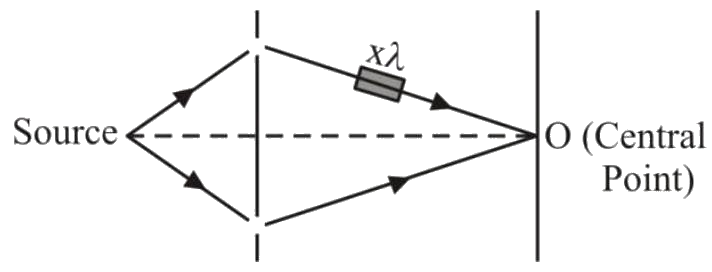
In young's double slit experiment performed using a monochromatic light of wavelength λ, when a glass plate (μ=1.5) of thickness xλ is introduced in the path of the one of the interfering beams, the intensity at the position where the central maximum occurred previously remains unchanged. The value of x will be:
A.
3
B.
2
C.
1.5
D.
0.5
Correct answer: B

Source solution

Sol. Path difference at O=(μ−1)t. If the intensity at O remains (maximum) unchanged, path difference must be nλ. (μ−1)t=nλ (1.5−1)⋅xλ=nλ ⇒x=2n For n=1, x=2Question figure
Question 263 / MCQ
Question 263
Two light beams of intensities in the ratio of 9:4 are allowed to interfere. The ratio of the intensity of maxima and minima will be :
A.
2:3
B.
16:81
C.
25:169
D.
25:1
Correct answer: D

Source solution

I1I2=94=32 Hence, I1I2=32. Using ImaxImin=(I1+I2I1−I2)2, we get ImaxImin=(3+23−2)2=(51)2=25. ImaxImin=25
Question 264 / MCQ
Question 264
The interference pattern is obtained with two coherent light sources of intensity ratio 4:1. And the ratio Imax +Imin Imax −Imin  is 5x. Then, the value of x will be equal to :
A.
3
B.
4
C.
2
D.
1
Correct answer: B

Source solution

Sol. I1I2=4 ImaxImin=[I1+I2I1−I2]2 ImaxImin=[2I2+I22I2−I2]2 ImaxImin=9 Imax+IminImax−Imin=108 5x=108 x=4
Question 265 / MCQ
Question 265
Using Young's double slit experiment, a monochromatic light of wavelength 5000\AA produces fringes of fringe width 0.5 mm . If another monochromatic light of wavelength 6000\AA is used and the separation between the slits is doubled, then the new fringe width will be :
A.
0.5 mm
B.
1.0 mm
C.
0.6 mm
D.
0.3 mm
Correct answer: D

Source solution

Fringe widthβ=Dλd For λ1=5000\AA, (I)β1=Dd(5000×10−10)=5×10⁻⁴m For λ2=6000\AA and slit separation 2d, (II)β2=D2d(6000×10−10)=x. Dividing Eq.~(II) by Eq.~(I), β2β1=D2d(6000×10−10)Dd(5000×10−10) =60002×5000=35. Hence, x5×10−4=35. x=35(5×10⁻⁴)=3×10⁻⁴m. x=0.3×10⁻³m=0.3mm. β2=3×10⁻⁴m=0.3mm
Question 266 / MCQ
Question 266
In a Young's double slit experiment, light of 500 nm is used to produce an interference pattern. When the distance between the slits is 0.05 mm , the angular width (in degree) of the fringes formed on the distance screen is close to :
A.
0.17∘
B.
0.07∘
C.
0.57∘
D.
1.7∘
Correct answer: C

Source solution

Sol. B=λDd θ=βD=(λd) θ=500×10−90.05×10−3 θ=5×10−25=5100×5 θ∘=5100⋅1805⋅π θ∘=0.57∘
Question 267 / Numerical
Question 267
A beam of light consisting of wavelengths 650 nm and 550 nm illuminates the Young's double slits with separation of 2 mm such that the interference fringes are formed on a screen, placed at a distance of 1.2 m from the slits. The least distance of a point from the central maximum, where the bright fringes due to both the wavelengths coincide, is________×10−5 m.
Numerical answer: ____________________
Enter an integer. Use the units and scaling requested in the question.
Correct answer: 429

Source solution

y=nλDd y1=y2 n1λ1Dd=n2λ2Dd n1n2=λ2λ1=550650=1113 y=11×λ1Dd=11×650×10−9×1.22×10−3 y=429×10−5
Question 268 / MCQ
Question 268
In a double slit experiment the distance between the slits is 0.1 cm and the screen is placed at 50 cm from the slits plane. When one slit is covered with a transparent sheet having thickness t and refractive index n(=1.5), the central fringe shifts by 0.2 cm. The value of t is ____ cm.
A.
8×10⁻⁴
B.
6.0×10⁻³
C.
5.6×10⁻⁴
D.
5.0×10⁻³
Correct answer: A

Source solution

The sheet introduces optical path difference (n−1)t. The fringe shift is s=D(n−1)t/d, so t=sd/[D(n−1)]=(0.2)(0.1)/[50(0.5)]=8×10−4 cm.
Question 269 / MCQ
Question 269
In Young's double slit arrangement, slits are separated by a gap of 0.5 mm , and the screen is placed at a distance of 0.5 m from them. The distance between the first and the third bright fringe formed when the slits are illuminated by a monochromatic light of 5890\AA is :-
A.
1178×10−9 m
B.
1178×10−6 m
C.
1178×10−12 m
D.
5890×10−7 m
Correct answer: B

Source solution

β=λDd=5890×10−10×0.50.5×10−3 =5890×10−7m=589×10−6m The distance between the first and third bright fringes is 2β=2×589×10−6m (2)=1178×10−6m=1.178×10⁻³m
Question 270 / Numerical
Question 270
In a Young's double slit experiment set up, the two slits are kept 0.4. mm apart and screen is placed at 1 m from slits. If a thin transparent sheet of thickness 20μ m is introduced in front of one of the slits then centre bring fringe shifts by 20 mm on the screen. The refractive index of transparent sheet is given by α10, where α is ________ .
Numerical answer: ____________________
Enter an integer. Use the units and scaling requested in the question.
Correct answer: 14

Source solution

yshift =(μ−1)t.Dd 20910−3=(μ−1)×20×10−6×10.4×10−3(μ−1)⇒0.4μ⇒1.4α10=1.4,α=14
Question 271 / MCQ
Question 271
The Young's double slit interference experiment is performed using light consisting of 480 nm and 600 nm wavelengths to form interference patterns. The least number of the bright fringes of 480 nm light that are required for the first coincidence with the bright fringes formed by 600 nm light is :-
A.
4
B.
8
C.
6
D.
5
Correct answer: D

Source solution

n1λ1Dd=n2λ2Dd n1λ1=n2λ2 Given, λ1=480nm,λ2=600nm. Therefore, 480n1=600n2 4n1=5n2. For the minimum values of n1 and n2, n1=5,n2=4. Hence, n1,min=5
Question 272 / MCQ
Question 272
In the Young's double slit experiment the intensity produced by each one of the individual slits is I0. The distance between two slits is 2 mm. The distance of screen from slits is 10 m. The wavelength of light is 6000\AA. The intensity of light on the screen in front of one of the slits is ________ .
A.
2I0
B.
I0
C.
I02
D.
4I0
Correct answer: B

Source solution

d=2 mm D=10mλ=6000\AAy=d2( in front of one slit )I=4I0cos2⁡(2πλ⋅yDd)⇒I=I0
Question 273 / MCQ
Question 273
In a Young's double slit experiment, the slits are placed 0.320 mm apart. Light of wavelength λ =500 nm is incident on the slits. The total number of bright fringes that are observed in the angular range −30∘≤θ≤30∘ is:
A.
320
B.
641
C.
321
D.
640
Correct answer: B

Source solution

dsin⁡θ=nλ where d is the slit separation, λ is the wavelength, and n is the order of the maxima. 0.32×10⁻³sin⁡30∘=n(500×10−9) 0.32×10−3×12=n(500×10−9) n=0.16×10−3500×10−9=320 Hence, the total number of maxima observed in the angular range −30∘≤θ≤30∘ is N=320+1+320=641.
Question 274 / MCQ
Question 274
Two coherent light sources having intensity in the ratio 2x produce an interference pattern. The ratio Imax −Imin Imax +Imin  will be :
A.
22xx+1
B.
2x2x+1
C.
22x2x+1
D.
2xx+1
Correct answer: C

Source solution

Sol. Let I1=2x, I2=1, Imax=(I1+I2)2 Imin=(I1−I2)2 Imax−IminImax+Imin=(2x+1)2−(2x−1)2(2x+1)2+(2x−1)2 =42x2+4x=22x1+2x
Question 275 / MCQ
Question 275
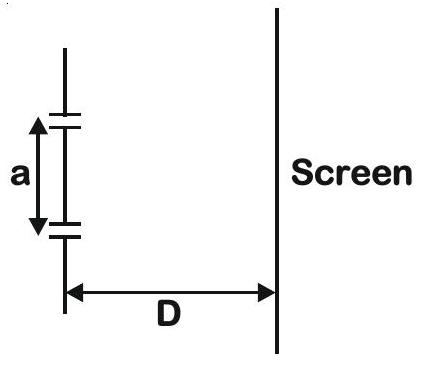
The figure shows a Young's double slit experimental setup. It is observed that when a thin transparent sheet of thickness t and refractive index μ is put in front of one of the slits, the central maximum gets shifted by a distance equal to n fringe widths. If the wavelength of light used is λ, t will be Question figure
A.
nλμ−1
B.
2Dλa(μ−1)
C.
nDλa(μ−1)
D.
Dλa(μ−1)
The original exam question had no correct option and was marked BONUS. For this corrected practice version, option 1 has been replaced with the correct value; the original statement and the other three options are retained.
Correct answer: A

Source solution

The inserted sheet adds optical path (μ−1)t. A shift of n fringe widths corresponds to path difference nλ. Thus t=nλ/(μ−1), independent of D and slit separation a.
Choose another chapter