
Physics
Ray Optics and Optical Instruments
Question 220 / Numerical
A thin cylindrical rod of length 10 cm is placed horizontally on the principle axis of a concave mirror of focal length 20 cm . The rod is placed in a such a way that mid point of the rod is at 40 cm from the pole of mirror. The length of the image formed by the mirror will be
Numerical answer: ____________________
Enter the requested value (an integer; 0 decimal places). Use the units and scaling stated in the question.
Correct answer: 32
Source solution
32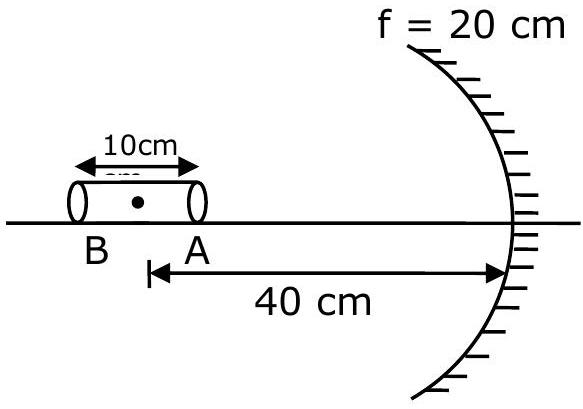 Image of end A:
Question 221 / Numerical
A plano-convex lens of radius of curvature 30 cm and refractive index 1.5 is kept in air. Find its focal length (in cm ).
Numerical answer: ____________________
Enter the requested value (an integer; 0 decimal places). Use the units and scaling stated in the question.
Correct answer: 60
Source solution
( 60 cm ) Applying Lens makers' formula,Question 222 / Numerical
A collimated beam of light of diameter 2 mm is propagating along x-axis. The beam is required to be expanded in a collimated beam of diameter 14 mm using a system of two convex lenses. If first lens has focal length 40 mm , then the focal length of second lens is ____ mm.
Numerical answer: ____________________
Enter an integer in the units and scaling requested in the question.
Correct answer: 280
Source solution
For an afocal two-convex-lens system, the beam-diameter ratio equals the focal-length ratio: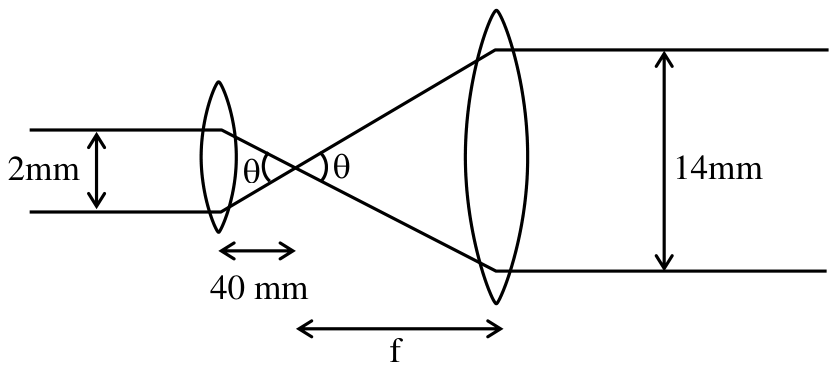
Question 223 / MCQ
A thin prism with angle 5° of refractive index 1.72
is combined with another prism of refractive index
1.9 to produce dispersion without deviation. The
angle of second prism is
________
.
Correct answer: C
Source solution
Question 224 / MCQ
Consider an equilateral prism (refractive index
Correct answer: A
Source solution
Equilateral prism.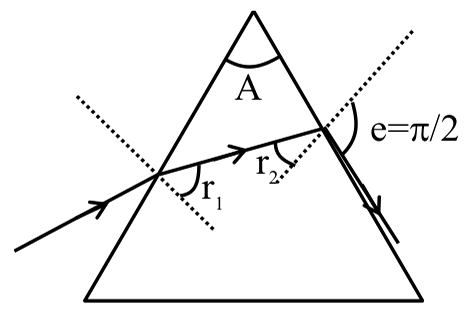
Question 225 / MCQ
A convex lens of focal length 30 cm is placed in contact with a concave lens of focal length 20 cm . An object is placed at 20 cm to the left of this lens system. The distance of the image from the lens in cm is .........
Correct answer: D
Source solution
Sol. Equivalent focal lengthQuestion 226 / Numerical
Light from a point source in air falls on a spherical glass surface (refractive index,
Numerical answer: ____________________
Enter the requested value (an integer; 0 decimal places). Use the units and scaling stated in the question.
Correct answer: 4
Source solution
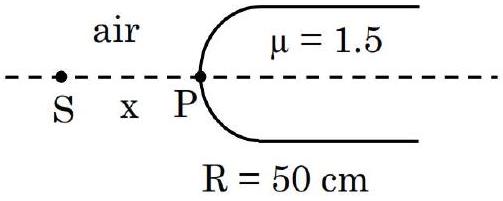
Question 227 / Numerical
A light ray is incident, at an incident angle 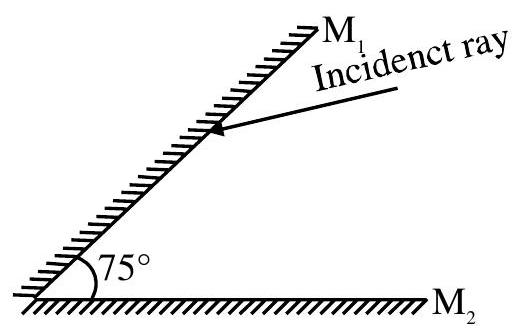
Numerical answer: ____________________
Enter the requested value (an integer; 0 decimal places). Use the units and scaling stated in the question.
Correct answer: 210
Source solution
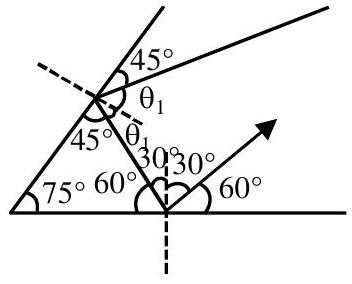
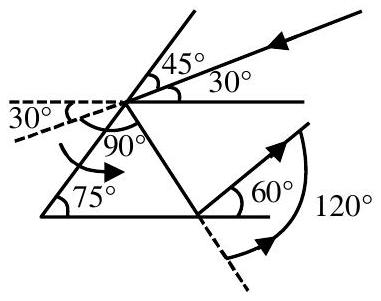
Question 228 / MCQ
Consider a light ray travelling in air is incident into a medium of refractive index
Correct answer: D
Source solution
Sol.Question 229 / MCQ
Curved surfaces of a plano-convex lens of refractive index 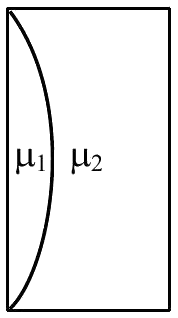
Correct answer: B
Source solution
Sol.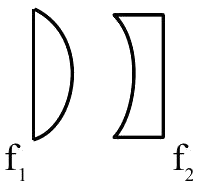
Question 230 / MCQ
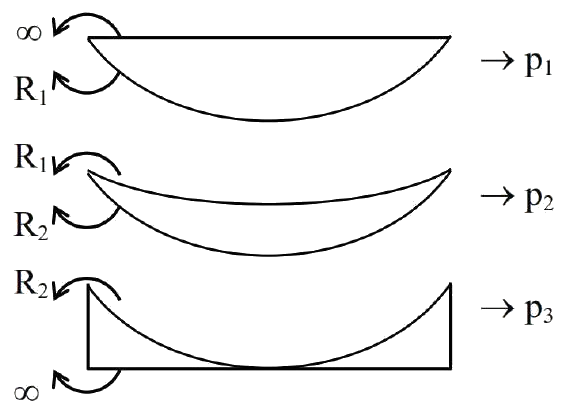
In the diagram given below, there are three lenses formed. Considering negligible thickness of each of them as compared to 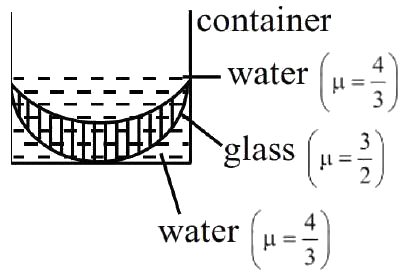
Correct answer: B
Source solution
Question 231 / MCQ
A concave-convex lens of refractive index 1.5 and the radii of curvature of its surfaces are 30 cm and 20 cm , respectively. The concave surface is upwards and is filled with a liquid of refractive index 1.3. The focal length of the liquid-glass combination will be
Correct answer: D
Source solution
Sol.Question 232 / Numerical
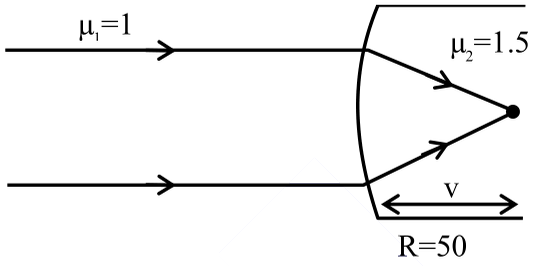
A parallel beam of light travelling in air (refractive
index 1.0) is incident on a convex spherical glass
surface of radius of curvature 50 cm. Refractive
index of glass is 1.5. The rays converge to a point
at a distance x cm from the centre of the curvature
of the spherical surface. The value of x is
________
cm.
Numerical answer: ____________________
Enter an integer. Use the units and scaling requested in the question.
Correct answer: 100
Source solution
Question 233 / MCQ
The refractive index of the material of a glass prism is
Correct answer: B
Source solution
Sol.Question 234 / Numerical
The refractive index of prism is
Numerical answer: ____________________
Enter the requested value (an integer; 0 decimal places). Use the units and scaling stated in the question.
Correct answer: 60
Source solution
For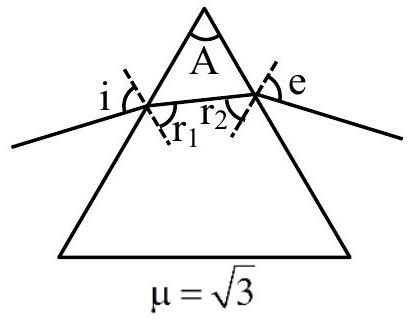 Snell's law