
Physics
Ray Optics and Optical Instruments
Question 235 / Numerical
A ray of light suffers minimum deviation when incident on a prism having angle of the prism equal to
Numerical answer: ____________________
Enter the requested value (an integer; 0 decimal places). Use the units and scaling stated in the question.
Correct answer: 45
Source solution
Question 236 / MCQ
Two objects A and B are placed at 15 cm and 25 cm from the pole in front of a concave mirror having radius of curvature 40 cm . The distance between images formed by the mirror is ......... .
Correct answer: C
Source solution
Sol. (3) Using the mirror formula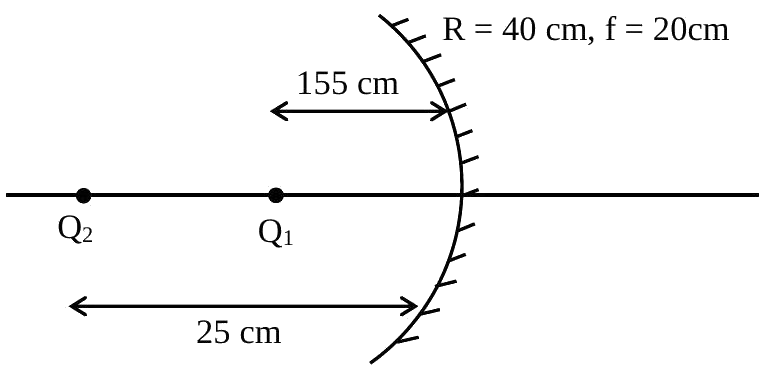
Question 237 / MCQ
The magnitudes of power of a biconvex lens (refractive index 1.5) and that of a plano-concave lens (refractive index
Correct answer: A
Source solution
Question 238 / MCQ
In a long glass tube, mixture of two liquids A and B with refractive indices 1.3 and 1.4 respectively, forms a convex refractive meniscus towards A . If an object placed at 13 cm from the vertex of the meniscus in A forms an image with a magnification of ' -2 ' then the radius of curvature of meniscus is :
Correct answer: C
Source solution
Sol.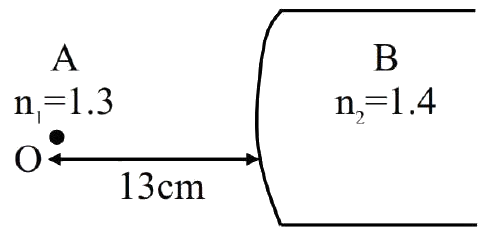
Question 239 / MCQ
As shown in the diagram, when the incident ray is
parallel to base of the prism, the emergent ray
grazes along the second surface.
If refractive index of the material of prism is 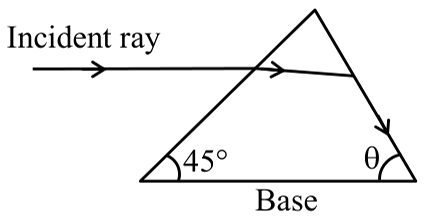
Correct answer: A
Source solution
For grazing emergence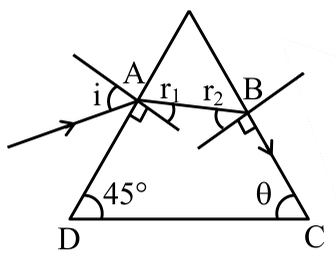
Question 240 / Numerical
As shown in the figure, a combination of a thin plano concave lens and a thin plano convex lens is used to image an object placed at infinity. The radius of curvature of both the lenses is 30 cm and refraction index of the material for both the lenses is 1.75 . Both the lenses are placed at distance of 40 cm from each other. Due to the combination, the image of the object is formed at distance 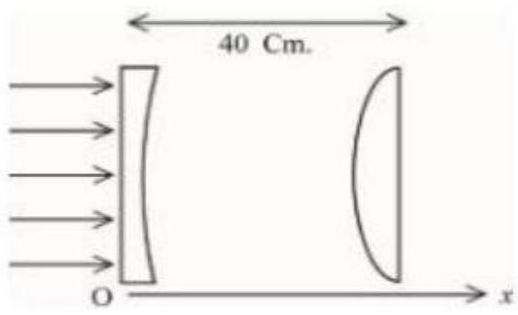
Numerical answer: ____________________
Enter the requested value (an integer; 0 decimal places). Use the units and scaling stated in the question.
Correct answer: 120
Source solution
120 Magnitude of focal length of both lens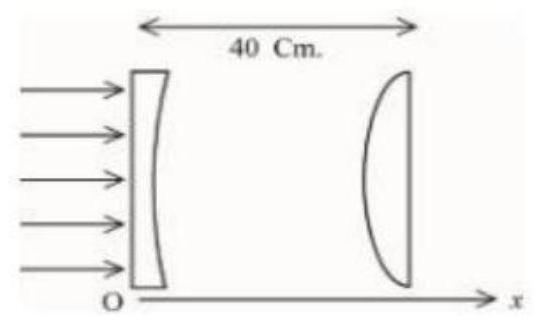
Question 241 / MCQ
For the thin convex lens, the radii of curvature are at 15 cm and 30 cm respectively. The focal length the lens is 20 cm . The refractive index of the material is :
Correct answer: C
Source solution
Sol.Question 242 / MCQ
A bi-convex lens has radius of curvature of both the surfaces same as
Correct answer: B
Source solution
Question 243 / MCQ
A plano-convex lens having radius of curvature of first surface 2 cm exhibits focal length of
Correct answer: B
Source solution
Question 244 / MCQ
The radii of curvature for a thin convex lens are 10 cm and 15 cm respectively. The focal length of the lens is 12 cm . The refractive index of the lens material is
Correct answer: C
Source solution
Sol.Question 245 / MCQ
One plano-convex and one plano-concave lens of same radius of curvature ' 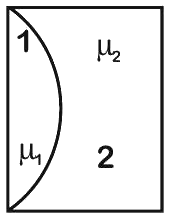
Correct answer: C
Source solution
Sol. Focal length of plano-convex lens:Question 246 / MCQ
A thin plano convex lens made of glass of refractive index 1.5 is immersed in a liquid of refractive index 1.2. When the plane side of the lens is silver coated for complete reflection, the lens immersed in the liquid behaves like a concave mirror of focal length 0.2 m . The radius of curvature of the curved surface of the lens is :-
Correct answer: B
Source solution
Question 247 / Numerical
Cross-section view of a prism is the equilateral triangle ABC in the figure. The minimum deviation is observed using this prism when the angle of incidence is equal to the prism angle. The time taken by light to travel from P (midpoint of BC ) to A is 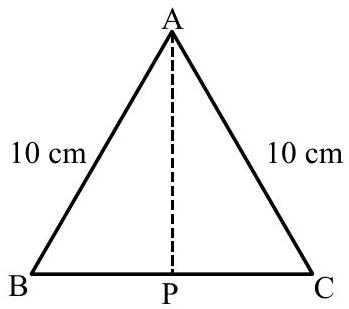
Numerical answer: ____________________
Enter the requested value (an integer; 0 decimal places). Use the units and scaling stated in the question.
Correct answer: 5
Source solution
Question 248 / MCQ
The eye can be regarded as a single refracting surface . The radius of curvature of this surface is equal to that of cornea ( 7.8 mm ). This surface separates two media of refractive indices 1 and 1.34. Calculate the distance from the refracting surface at which a parallel beam of light will come to focus.
Correct answer: C
Source solution
Question 249 / MCQ
Consider following statements for refraction of light through prism, when angle of deviation is minimum.(A) The refracted ray inside prism becomes parallel to the base.(B) Larger angle prisms provide smaller angle of minimum deviation.(C) Angle of incidence and angle of emergence becomes equal.(D) There are always two sets of angle of incidence for which deviation will be same except at minimum deviation setting.(E) Angle of refraction becomes double of prism angle.Choose the correct answer from the options given below.
Correct answer: A