Learne2i
Learne2i Guess Paper solutions
JEE Main 2026 / Session 2
All chapters

Physics

Ray Optics and Optical Instruments

Question 250 / MCQ
Question 250
Given is a thin convex lens of glass (refractive index μ ) and each side having radius of curvature R. One side is polished for complete reflection. At what distance from the lens, an object be placed on the optic axis so that the image gets formed on the object itself.
A.
R/μ
B.
R/(2μ−3)
C.
μR
D.
R/(2μ−1)
Correct answer: D

Source solution

Peq=2Pl+Pm 1feq=2fl−1fm =4(μ−1)R+2R =4μ−2R feq=R4μ−2 =R2(2μ−1) Since the equivalent system contains a mirror, Req=2feq =2(R2(2μ−1)) Req=R2μ−1
Question 251 / Numerical
Question 251
A convex lens of refractive index 1.5 and focal length 18 cm in air is immersed in water. The change in focal length of the lens will be cm (Given refractive index of water =43 )
Numerical answer: ____________________
Enter the requested value (an integer; 0 decimal places). Use the units and scaling stated in the question.
Correct answer: 54

Source solution

54 1f=(μ−1)(1R1−1R2) 118=(1.5−1)2R…. (1)1f=(1.543−1)2R…… Div eq. by eq. 2 f18=0.5×81 f=72 cm change =72−18 =54
Question 252 / Numerical
Question 252
A ray of light passing through a prism (μ=3) suffers minimum deviation. It is found that the angle of incidence is double the angle of refraction within the prism. Then, the angle of prism is ____ (in degrees)
Numerical answer: ____________________
Enter the requested integer (0 decimal places).
Correct answer: 60

Source solution

At minimum deviation r1=r2=A2 Also given i=2r1=A Now 1. sin⁡i=3sin⁡r1 1sin⁡ A=3sin⁡ A2⇒2sin⁡ A2cos⁡ A2=3sin⁡ A2⇒cos⁡ A2=32⇒ A2=30∘⇒A=60∘
Question 253 / MCQ
Question 253
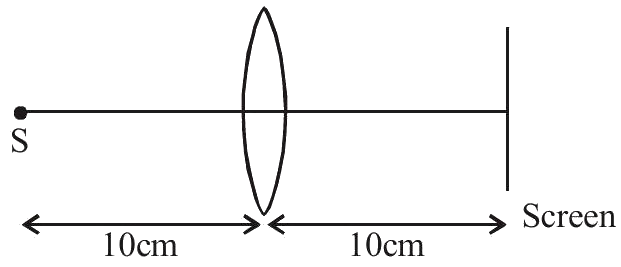
A convex lens is put 10 cm from a light source and it makes a sharp image on a screen, kept 10 cm from the lens. Now a glass block (refractive index 1.5) of 1.5 cm thickness is placed in contact with the light source. To get the sharp image again, the screen is shifted by a distance d . Then d is :
A.
0.55 cm away from the lens
B.
1.1 cm away from the lens
C.
0.55 cm towards the lens
D.
0
Correct answer: A

Source solution

Sol. 1v−1u=1f⇒110−1−10=1f⇒f=5cm Shift due to slab =t(1−1μ) in the direction of incident ray =1.5(1−23)=0.5 Again, 1v−1−9.5=15⇒1u=15−219=995⇒v=959=10.55cmQuestion figure
Question 254 / Numerical
Question 254
Light from a point source in air falls on a convex curved surface of radius 20 cm and refractive index 1.5. If the source is located at 100 cm from the convex surface, the image will be formed at cm from the object.
Numerical answer: ____________________
Enter the requested value (an integer; 0 decimal places). Use the units and scaling stated in the question.
Correct answer: 200

Source solution
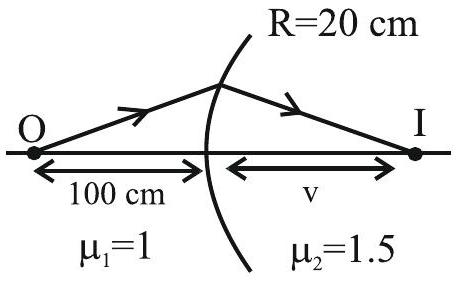
Question figure μ2v−μ1u=μ2−μ1R 1.5v−1−100=1.5−120 v=100 cm Distance from object =100+100 =200 cm
Question 255 / MCQ
Question 255
A convex lens of focal length 40 cm forms an image of an extended source of light on a photoelectric cell. A current I is produced. The lens is replaced by another convex lens having the same diameter but focal length 20 cm . The photoelectric current now is :
A.
I2
B.
4 I
C.
2 I
D.
I
Correct answer: D

Source solution

Photocurrent∝number of photoelectrons emitted per second Photocurrent depends on the total light energy falling on the photocell. Both lenses have the same diameter. ∴Both collect the same amount of light from the source. Changing the focal length only changes the size and intensity distribution of the image, not the total light reaching the photocell. ∴Number of emitted photoelectrons remains unchanged. I′=I
Question 256 / MCQ
Question 256
A thin prism, P1 with an angle 6th  and made of glass of refractive index 1.54 is combined with another prism P2 made from glass of refractive index 1.72 to produce dispersion without average deviation. The angle of prism P2 is
A.
1.3∘
B.
6∘
C.
4.5∘
D.
7.8∘
Correct answer: C

Source solution

δ1=δ2 For a thin prism, δ=(μ−1)A Hence, 6(1.54−1)=A(1.72−1) 6(0.54)=0.72A A=3.240.72 A=4.5∘
Question 257 / MCQ
Question 257
The power of a lens (biconvex) is 1.25 m−1 in particular medium. Refractive index of the lens is 1.5 and radii of curvature are 20 cm and 40 cm respectively. The refractive index of surrounding medium :
A.
1.0
B.
97
C.
32
D.
43
Correct answer: B

Source solution

P=(μlμm−1)(1R1−1R2) Given, P=1.25D,μl=1.5 R1=+20cm=0.2m R2=−40cm=−0.4m 1.25=(1.5μm−1)(10.2−1−0.4) 1.25=(1.5μm−1)(5+2.5) 1.25=7.5(1.5μm−1) 1.5μm−1=1.257.5=16 1.5μm=76 μm=1.5×67=97 μm=97≈1.286
Question 258 / Numerical
Question 258
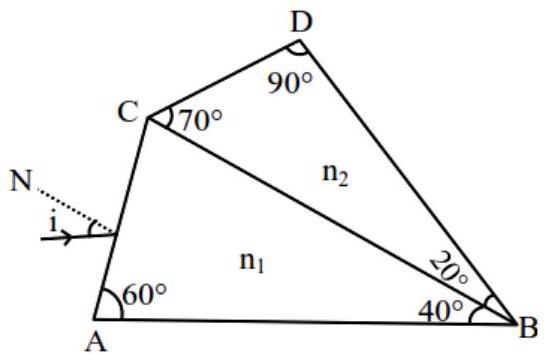
Two prisms of refractive indices n1 and n2 are joined as shown. For wavelength λ measured in metres, n1=1.2+10.8×10⁻¹⁴λ2,n2=1.45+1.8×10⁻¹⁴λ2. Find the wavelength in nm for which rays incident at any angle on interface BC pass through that interface without bending. Question figure
Numerical answer: ____________________
Corrected practice version: Rejoined the cross-page statement and restored lambda-squared notation and consistent powers of ten; source key 600 nm is independently verified. The original wording and worked answer are retained in the review package. Enter the requested integer (0 decimal places).
Correct answer: 600

Source solution

For no refraction at any incidence angle, n1=n2. Thus 9.0×10⁻¹⁴/λ2=0.25, giving λ2=3.6×10⁻¹³m2 and λ=6.0×10⁻⁷m=600nm.
Question 259 / MCQ
Question 259
A prism of refractive index μ and angle of prism A is placed in the position of minimum angle of deviation. If minimum angle of deviation is also A, then in terms of refractive index
A.
2cos−1⁡(μ2)
B.
sin−1⁡(μ2)
C.
sin−1⁡(μ−12)
D.
cos−1⁡(μ2)
Correct answer: A

Source solution

μ=sin⁡(A+δmin2)sin⁡(A2)μ=sin⁡(A+A2)sin⁡(A2) μ=sin⁡Asin⁡A2=2cos⁡A2A=2cos−1⁡(μ2)
Question 260 / MCQ
Question 260
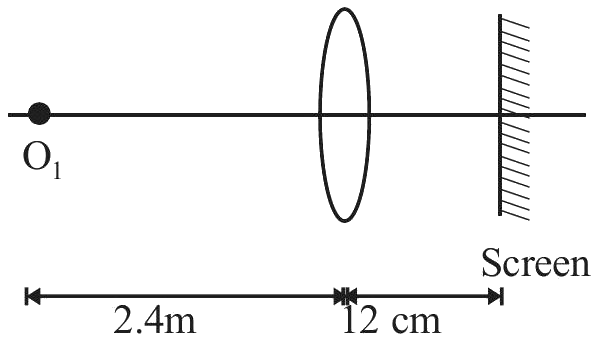
For an object placed at a distance 2.4 m from a lens, a sharp focused image is observed on a screen placed at a distance 12 cm from the lens. A glass plate of refractive index 1.5 and thickness 1 cm is introduced between lens and screen such that the glass plate plane faces parallel to the screen. By what distance should the object be shifted so that a sharp focused image is observed again on the screen?
A.
0.8 m
B.
3.2 m
C.
1.2 m
D.
5.6 m
Correct answer: B

Source solution

Sol. Applying lens formula 10.12+12.4=1f⇒1f=21024 Upon putting the glass slab, the shift of the image is Δx=t(1−1μ)=13cm Now v=12−13=353cm Again applying the lens formula 10.12+1u=1f=21024 Solving gives u=−5.6m Thus, the shift of the object is 5.6−2.4=3.2mQuestion figure
Choose another chapter