Learne2i
Learne2i Priority Practice solutions
JEE Main 2025 / Session 2
All chapters

Mathematics

Three Dimensional Geometry

Question 283 / Numerical
Question 283
If the line, 2x−y+3=0 is at a distance 15 and 25 from the lines 4x−2y+α=0 and 6x−3y+β=0, respectively, then the sum of all possible values of α and β is
Numerical answer: ____________________
Enter the requested value (an integer; 0 decimal places). Use the units and scaling stated in the question.
Correct answer: 30

Source solution

30 L1:2x−y+3=0  L2:4x−2y+α=0  L3:6x−3y+β=0 |α2−3|5=15⇒α2−3=1,−1⇒α=8,4 |β3−3|5=25⇒β3−3=2,−2⇒β=15,3
Question 284 / MCQ
Question 284
If the shortest distance between the lines x−12=y−23=z−3λ and x−21=y−44=z−55 is 13, then the sum of all possible values of λ is :
A.
16
B.
6
C.
12
D.
10
Correct answer: A

Source solution

S.D.=|5−2λ|(15−4λ)2+(λ−10)2+25=13 ⇒3(5−2λ)2=(15−4λ)2+(λ−10)2+25 ⇒λ2−4λ−12=0 (λ−6)(λ+2)=0 λ=6 or λ=−2 Sum of all possible values of λ=6+(−2)=4
Question 285 / MCQ
Question 285
The shortest distance between the lines x+21=y−2=z−52 and x−41=y−12=z+30 is
A.
6
B.
9
C.
7
D.
8
Correct answer: B

Source solution

Sol. Given lines x+21=y−2=z−52&x−41=y−12=z+30 Formula for shortest distance S.D. =|x2−x1y2−y1z2−z1a1 b1c1a2 b2c2||i^j^k^a1 b1c1a2 b2c2| =|61−81−22120||i^j^k^1−22120|=546=9
Question 286 / MCQ
Question 286
Let the line passing through the points (−1,2,1) and parallel to the line x−12=y+13=z4 intersect the line x+23=y−32=z−41 at the point P. Then the distance of P from the point Q(4,−5,1) is :
A.
5
B.
4
C.
(2) 10
D.
(3) 56
Correct answer: D

Source solution

Given line L1:x−12=y+13=z4. Its direction vector is d→1=(2,3,4). Therefore, the line passing through (−1,2,1) and parallel to L1 is x+12=y−23=z−14=λ. Hence, x=−1+2λ,y=2+3λ,z=1+4λ. --- The second line is x+23=y−32=z−41=μ. Thus, x=−2+3μ,y=3+2μ,z=4+μ. Since the two lines intersect at P, (1)−1+2λ=−2+3μ, (2)2+3λ=3+2μ, (3)1+4λ=4+μ. From (3), μ=4λ−3. Substituting into (1), −1+2λ=−2+3(4λ−3), −1+2λ=12λ−11, 10=10λ, λ=1. Hence, μ=4(1)−3=1. Therefore, P=(−1+2,2+3,1+4)=(1,5,5). --- Given Q=(4,−5,1). Hence, PQ=(4−1)2+(−5−5)2+(1−5)2. =32+(−10)2+(−4)2. =9+100+16. =125=55. 56 Therefore, the distance of P from Q is 56.
Question 287 / MCQ
Question 287
Let two vertices of triangle ABC be (2,4,6) and (0,−2,−5), and its centroid be (2,1,−1). If the image of third vertex in the plane x+2y+4z=11 is (α,β,γ), then αβ+βγ+γα is equal to
A.
72
B.
74
C.
76
D.
70
Correct answer: B

Source solution

Given points A(2,4,6), B(0,−2,−5), and G(2,1,−1), we need to find the coordinates of vertex C(x,y,z). 1. **Finding x**: 2+0+x3=2⇒2+0+x=6⇒x=4 2. **Finding y**: 4−2+y3=1⇒4−2+y=3⇒y=1 3. **Finding z**: 6−5+z3=−1⇒6−5+z=−3⇒z=−4 Thus, the coordinates of vertex C are C(4,1,−4). Next, we find the image of vertex C in the plane, denoted as (α,β,γ): α−41=β−12=γ+44=−2(4+2−16−11)21 Calculating the right-hand side: 4+2−16−11=−21⇒−2(−21)=42⇒4221=2 Now, we have: α−41=2⇒α=6 β−12=2⇒β−1=4⇒β=5 γ+44=2⇒γ+4=8⇒γ=4 Thus, the image coordinates are (α,β,γ)=(6,5,4). Finally, we calculate: αβ+βγ+γα=6⋅5+5⋅4+4⋅6=30+20+24=74 The final answer is: αβ+βγ+γα=74
Question 288 / MCQ
Question 288
If the square of the shortest distance between the lines x−21=y−12=z+3−3 and x+12=y+34=z+5−5 is mn, where m,n are coprime numbers, then m+n is equal to:
A.
6
B.
9
C.
21
D.
14
Correct answer: B

Source solution

Sol. Given vectors: a→=(2,1,−3),b→=(−1,−3,−5) Calculate the cross product p→×q→: p→×q→=|i^j^k^12−324−5| Calculating the determinant: =2i^−j^ Next, find b→−a→: b→−a→=(−1−2,−3−1,−5+3)=(−3,−4,−2)=−3i^−4j^−2k^ Now, calculate the scalar distance Sd: Sd=|(b→−a→)⋅(p→×q→)||p→×q→| First, compute the dot product: (b→−a→)⋅(p→×q→)=(−3,−4,−2)⋅(2,−1,0)=−6+4+0=−2 Next, find the magnitude of p→×q→: |p→×q→|=(2)2+(−1)2+(0)2=4+1=5 Substituting back into the equation for Sd: Sd=|−2|5=25 Now, square Sd: (Sd)2=(25)2=45 Let m=4 and n=5: m+n=9
Question 289 / MCQ
Question 289
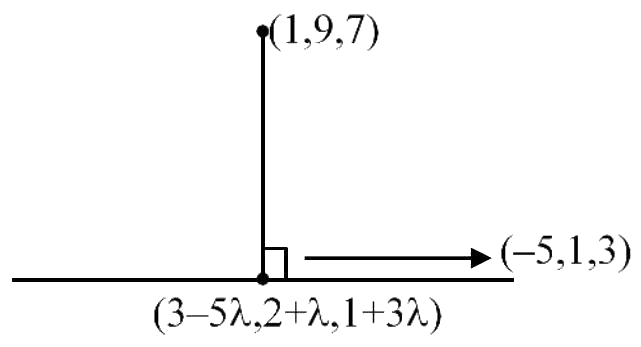
If the foot of the perpendicular drawn from (1,9,7) to the line passing through the point (3,2,1) and parallel to the planes x+2y+z=0 and 3y−z=3 is (α,β,γ), then α+β+γ is equal to
A.
3
B.
1
C.
-1
D.
5
Correct answer: D

Source solution

Sol. 4 n―1=(1,2,1)n―2=(0,3,−1) P―=|i^j^k^12103−1|=i^(−5)−j^(−1)+k^(3) =(−5,1,3) ∴ line :x−3−5=y−21=z−13=λ (2−5λ)⋅−5+(λ−7)⋅1+(3λ−6)⋅3=0 25λ−10+λ−7+9λ−18=0 35λ=35 λ=1 ∴ Point is (−2,3,4)α+β+γ=5Question figure
Question 290 / MCQ
Question 290
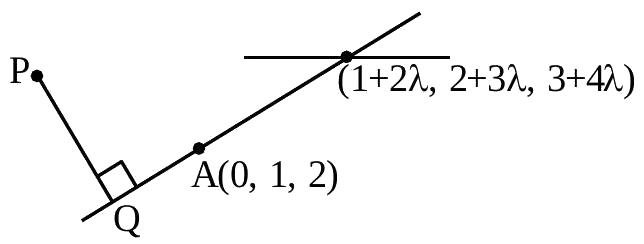
Let the line L pass through the point (0,1,2), intersect the line x−12=y−23=z−34 and be parallel to the plane 2x+y−3z=4. Then the distance of the point P(1,−9,2) from the line L is
A.
9
B.
54
C.
69
D.
74
Correct answer: D

Source solution

Let AB→⋅n→=0 AB→=(1+2λ)i^+(1+3λ)j^+(1+4λ)k^ n→=2i^+j^−3k^ Calculating the dot product: (1+2λ)⋅2+(1+3λ)⋅1+(1+4λ)⋅(−3)=0 Expanding this gives: 2+4λ+1+3λ−3−12λ=0 Combining like terms: 5λ=0⇒λ=0 Now, the line AB→ can be expressed as: r→=j^+2k^+μ(i^+j^+k^) The general form of point Q is: Q(μ,1+μ,2+μ) Since PQ→⋅AB→=0: (μ−1)+(10+μ)+μ=0 Simplifying this: 3μ−1+10=0⇒3μ=−9⇒μ=−3 Finally, the distance is calculated as: Distance=16+49+9=74Question figure
Question 291 / Numerical
Question 291
Consider a line L passing through the points P(1,2,1) and Q(2,1,−1). If the mirror image of the point A(2,2,2) in the line L is (α,β,γ), then α+β+6γ is equal to .....
Numerical answer: ____________________
Enter the requested value (an integer; 0 decimal places). Use the units and scaling stated in the question.
Correct answer: 6

Source solution
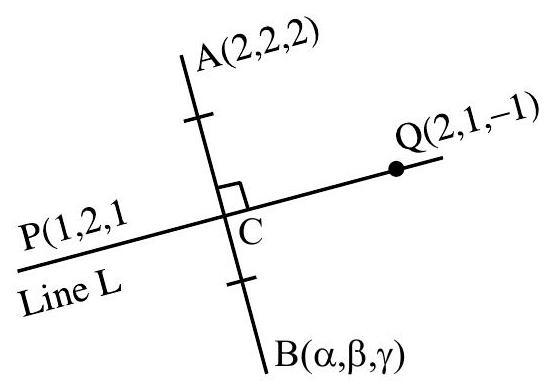
Question figure DR's of Line L≡−1:1:2 DR's of AB≡α−2:β−2:γ−2 AB⊥arL⇒2−α+β−2+2γ−4=0 (1)2γ+β−α=4 Let C is mid-point of AB C(α+22,β+22,γ+22) DR's of PC=α2:β−22:γ2 line L‖PC⇒−α2=β−22=γ4=K( let ) α=−2 K β=2 K+2 γ=4 K use in (1)⇒K=16 value of α+β+6γ=24 K+2=6
Question 292 / Numerical
Question 292
Let the line x−37=y−2−1=z−3−4 intersect the plane containing the lines x−41=y+1−2=z1 and 4ax−y+5z−7a=0=2x−5y−z−3,a∈R at the point P(α,β,γ). Then the value of α+β+γ equals .
Numerical answer: ____________________
Enter the requested value or coefficient rounded to the nearest integer (0 decimal places).
Correct answer: 12

Source solution

Use the plane family 4ax−y+5z−7a+λ(2x−5y−z−3)=0. Containing the point (4,-1,0) gives 9a+1+10λ=0; containing the direction (1,-2,1) gives 4a+7+11λ=0. Hence a=1, lambda=-1 and the plane is x+2y+3z−2=0. Substitution of (7t+3,2-t,3-4t) gives t=2, so P=(17,0,-5), whose coordinate sum is 12.
Question 293 / MCQ
Question 293
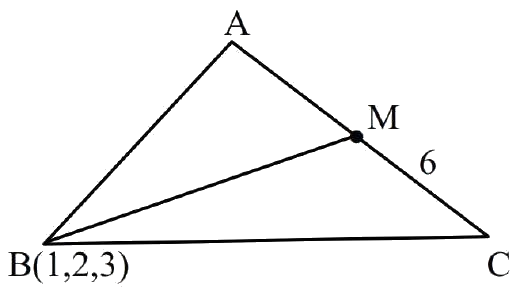
Let in a △ABC, the length of the side AC be 6, the vertex B be (1,2,3) and the vertices A,C lie on the line x−63=y−72=z−7−2. Then the area (in sq. units) of △ABC is
A.
42
B.
21
C.
56
D.
17
Correct answer: B

Source solution

Let M(3λ+6,2λ+7,−2λ+7). First, we find the vector BM→: BM→=(3λ+5)i^+(2λ+5)j^+(−2λ+4)k^ Next, we compute the dot product AC→⋅BM→=0: 0=3(3λ+5)+2(2λ+5)−2(−2λ+4) We also have: BM→=2i^+3j^+6k^ Now, we calculate the magnitude of BM→: |BM→|=7 Finally, we find the area: Area=12×6×7=21 Thus, the final answer is option (2).Question figure
Choose another chapter