Learne2i
Learne2i Priority Practice solutions
JEE Main 2025 / Session 2
All chapters

Mathematics

Three Dimensional Geometry

Question 268 / MCQ
Question 268
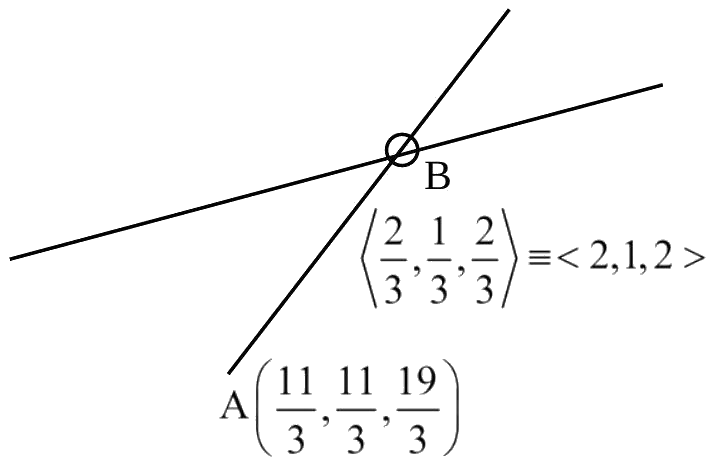
Consider the line L passing through the points (1,2,3) and (2,3,5). The distance of the point (113,113,193) from the line L along the line 3x−112=3y−111=3z−192 is equal to :
A.
3
B.
5
C.
4
D.
6
Correct answer: A

Source solution

Sol. x−12−1=y−23−2=z−35−3 ⇒x−11=y−21=z−32=λ B(1+λ,2+λ,3+2λ) D.R. of AB=<3λ−83,3λ−53,6λ−103> B (53,83,133)3λ−83λ−5=21⇒3λ−8=6λ−10 3λ=2 λ=23 AB=36+9+363=93=3Question figure
Question 269 / Numerical
Question 269
Let P be the point (10,−2,−1) and Q be the foot of the perpendicular drawn from the point R(1,7,6) on the line passing through the points (2,−5,11) and (−6,7,−5). Then the length of the line segment PQ is equal to .
Numerical answer: ____________________
Enter the requested value (an integer; 0 decimal places). Use the units and scaling stated in the question.
Correct answer: 13

Source solution
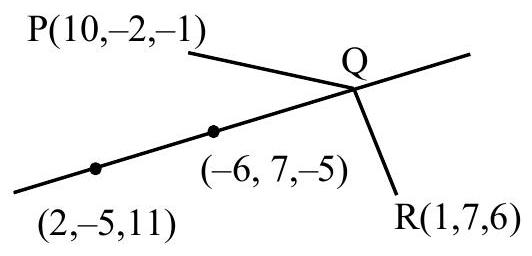
Question figure Line : x+6−8=y−712=z+5−16 x+62=y−7−3=z+54=λ Q(2λ−6,7−3λ,4λ−5) QR―(2λ−7,−3λ,4λ−11) QR―⋅dr 's of line =0 4λ−14+9λ+16λ−44=0 29λ=58⇒λ=2 Q(-2, 1, 3) PQ=144+9+16=169=13
Question 270 / MCQ
Question 270
Let in a △ABC, the length of the side AC be 6 , the vertex B be (1,2,3) and the vertices A,C lie on the line x−63=y−72=z−7−2. Then the area (in sq. units) of △ABC is
A.
42
B.
21
C.
56
D.
17
Correct answer: B

Source solution

Sol. Let M(3λ+6,2λ+7,−2λ+7) BM→=(3λ+5)i^+(2λ+5)j^+(−2λ+4)k^ AC→⋅BM→=0=3(3λ+5)+2(2λ+5)−2(−2λ+4) BM→=2i^+3j^+6k^ |BM→|=7 Area =12×6×7=21 Option (2) is the correct answer.
Question 271 / MCQ
Question 271
If the shortest distance between the lines x−12=y−23=z−3λ and x−21=y−44=z−55 is 13, then the sum of all possible values of λ is :
A.
16
B.
(1) is correct option.
C.
(2) 6
D.
(3) 12
Correct answer: A

Source solution

L1:x−12=y−23=z−3λ and L2:x−21=y−44=z−55. For L1, A=(1,2,3),d→1=(2,3,λ). For L2, B=(2,4,5),d→2=(1,4,5). Also, AB→=(1,2,2). --- The shortest distance between two lines is D=|AB→⋅(d→1×d→2)||d→1×d→2|. Given D=13. First, d→1×d→2=|i^j^k^23λ145|=(15−4λ, λ−10, 5). Therefore, AB→⋅(d→1×d→2)=(1,2,2)⋅(15−4λ,λ−10,5). =15−4λ+2λ−20+10=5−2λ. Also, |d→1×d→2|2=(15−4λ)2+(λ−10)2+25. =17λ2−140λ+350. Hence, |5−2λ|17λ2−140λ+350=13. Squaring, 3(5−2λ)2=17λ2−140λ+350. 75−60λ+12λ2=17λ2−140λ+350. 5λ2−80λ+275=0. λ2−16λ+55=0. (λ−5)(λ−11)=0. Thus, λ=5orλ=11. Therefore, the sum of all possible values of λ is 5+11=16. 16 Hence, the correct option is (1)16.
Question 272 / MCQ
Question 272
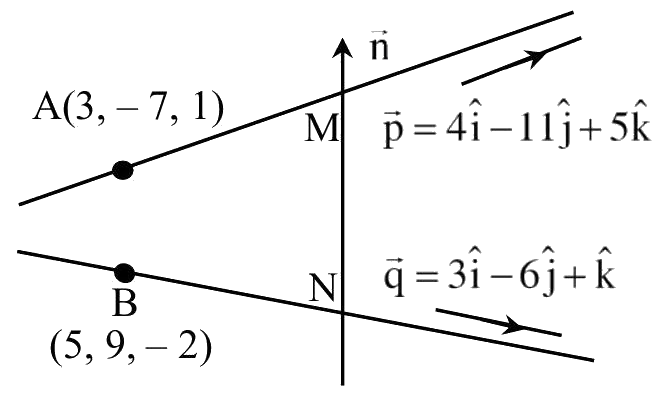
The shortest distance between the line x−34=y+7−11=z−15 and x−53=y−9−6=z+21 is :
A.
187563
B.
178563
C.
185563
D.
179563
Correct answer: A

Source solution

n→=p→×q→ Calculating the cross product: n→=|i^j^k^4−1153−61|=19i^+11j^+9k^ Next, we find the shortest distance (S.d.) as the projection of AB→ on n→: S.d.=|AB→⋅n→|n→|| Calculating the dot product: AB→=2i^+16j^−3k^ AB→⋅n→=(2i^+16j^−3k^)⋅(19i^+11j^+9k^)=38+176−27=187 Calculating the magnitude of n→: |n→|=361+121+81=563 Thus, the shortest distance is: S.d.=|187563| Final answer: S.d.=187563Question figure
Question 273 / Numerical
Question 273
Let λ be an integer. If the shortest distance between the lines x−λ=2y−1=−2z and x=y+2λ=z−λ is 722, then the value of |λ| is
Numerical answer: ____________________
Enter the requested value (an integer; 0 decimal places). Use the units and scaling stated in the question.
Correct answer: 1

Source solution

x−λ1=y−1212=z−12 (1)x−λ2=y−121=2−1 Point on line =(λ,12,0) (2)x1=y+2λ1=z−λ1 Point on line =(0,−2λ,λ) Distance between skew lines =[a→2−a→1b→1b→2]|b→1×b→2| |λ12+2λ−λ21−1111||i^j^k^21−1111| =|−5λ−32|14=722 (given) =|10λ+3|=7⇒λ=−1 ⇒|λ|=1
Question 274 / MCQ
Question 274
Let P the point of intersection of the lines x−21=y−45=z−21 and x−32=y−23=z−32. Then, the shortest distance of P from the line 4x=2y=z is
A.
5147
B.
147
C.
3147
D.
6147
Correct answer: C

Source solution

Line L1:x−21=y−45=z−21=λ Hence, x=2+λ,y=4+5λ,z=2+λ. Similarly, Line L2:x−32=y−23=z−32=μ gives x=3+2μ,y=2+3μ,z=3+2μ. Since the two lines intersect at P, 2+λ=3+2μ, 4+5λ=2+3μ. From the first equation, λ−2μ=1. From the second, 5λ−3μ=−2. Substituting λ=1+2μ, 5(1+2μ)−3μ=−2 5+7μ=−2 μ=−1. Therefore, λ=1+2(−1)=−1. Hence, P=(2−1,4−5,2−1)=(1,−1,1). --- The line 4x=2y=z can be written as x1=y2=z4=t. Thus it passes through the origin and has direction vector d→=(1,2,4). Let r→=(1,−1,1) be the position vector of P. The shortest distance from a point to a line through the origin is D=|r→×d→||d→|. Now, r→×d→=|i^j^k^1−11124|=(−6,−3,3). Therefore, |r→×d→|=(−6)2+(−3)2+32=54=36. Also, |d→|=12+22+42=21. Hence, D=3621=327=3147. 3147 Hence, the correct option is (3) 3147.
Question 275 / MCQ
Question 275
Let a line pass through two distinct points P(−2,−1,3) and Q, and be parallel to the vector 3i^+2j^+2k^. If the distance of the point Q from the point R(1,3,3) is 5, then the square of the area of △PQR is equal to:
A.
136
B.
140
C.
144
D.
148
Correct answer: A

Source solution

Sol. 1. Let PQ→ be parallel to 3i^+2j^+2k^ and point R(1,3,3). 2. Define point Q as Q(3λ−2,2λ−1,2λ+3), where λ∈R−{0}. 3. The distance |QR→| is given by: |QR→|=5=(3λ−3)2+(2λ−4)2+(2λ)2 4. Squaring both sides, we have: 25=(3λ−3)2+(2λ−4)2+(2λ)2 5. Expanding and simplifying: 17λ2−34λ+25=25⇒17λ2−34λ=0 6. Factoring out λ: λ(17λ−34)=0⇒λ=2(since λ≠0) 7. Substitute λ back to find Q: Q(4,3,7),P(−2,−1,3),R(1,3,3) 8. The area of triangle △PQR is given by: [PQR]=12|PQ→×PR→| 9. Calculate the cross product: PQ→=Q−P=(4+2,3+1,7−3)=(6,4,4) PR→=R−P=(1+2,3+1,3−3)=(3,4,0) 10. The cross product is: PQ→×PR→=|i^j^k^644340| 11. Evaluating the determinant: =i^(4⋅0−4⋅4)−j^(6⋅0−4⋅3)+k^(6⋅4−4⋅3) =−16i^+12j^+6k^ 12. The magnitude is: ‖−16i^+12j^+6k^‖=(−16)2+122+62=256+144+36=436 13. Therefore, the area is: [PQR]=12436=109 14. Finally, the squared area is: [PQR]2=136
Question 276 / MCQ
Question 276
The shortest distance between the lines x−44=y+25=z+33 and x−13=y−34=z−42 is
A.
36
B.
63
C.
62
D.
26
Correct answer: A

Source solution

Line L1:x−44=y+25=z+33=t Hence, (x,y,z)=(4,−2,−3)+t(4,5,3). So, A=(4,−2,−3),d→1=(4,5,3). Similarly, Line L2:x−13=y−34=z−42=s gives (x,y,z)=(1,3,4)+s(3,4,2). Thus, B=(1,3,4),d→2=(3,4,2). --- The shortest distance between two skew lines is D=|(AB→)⋅(d→1×d→2)||d→1×d→2|. First, AB→=(1−4,3−(−2),4−(−3))=(−3,5,7). Now, d→1×d→2=|i^j^k^453342|. =i^(10−12)−j^(8−9)+k^(16−15) =(−2,1,1). Therefore, |d→1×d→2|=(−2)2+12+12=6. Also, (AB→)⋅(d→1×d→2)=(−3,5,7)⋅(−2,1,1) =6+5+7=18. Hence, D=186=36. 36 Hence, the correct option is (1)36.
Question 277 / MCQ
Question 277
The shortest distance between the lines x+7−6=y−67=z and 7−x2=y−2=z−6 is
A.
229
B.
1
C.
3729
D.
292
Correct answer: A

Source solution

L1:x+7−6=y−67=z=t. Hence, x=−6t−7,y=7t+6,z=t. So a point on L1 is A=(−7,6,0), and its direction vector is d→1=(−6,7,1). --- The second line is 7−x2=y−2=z−6=s. Thus, x=7−2s,y=s+2,z=s+6. Hence a point on L2 is B=(7,2,6), and its direction vector is d→2=(−2,1,1). --- The shortest distance between two skew lines is D=|AB→⋅(d→1×d→2)||d→1×d→2|. First, AB→=B−A=(14,−4,6). Now, d→1×d→2=|i^j^k^−671−211|. =i^(7⋅1−1⋅1)−j^(−6⋅1−1(−2))+k^(−6⋅1−7(−2)). =6i^+4j^+8k^. =2(3,2,4). Therefore, |d→1×d→2|=62+42+82=116=229. --- Now, AB→⋅(d→1×d→2)=(14,−4,6)⋅(6,4,8). =84−16+48=116. Hence, D=116229=5829=229. D=229 Therefore, the correct option is (1)229.
Question 278 / MCQ
Question 278
The shortest distance between the lines x−32=y+15−7=z−95 and x+12=y−11=z−9−3 is
A.
63
B.
43
C.
53
D.
83
Correct answer: B

Source solution

Sol. x−32=y+15−7=z−95&x+12=y−11=z−9−3 S.D =|(a¯2⋅a¯1)⋅(b¯1⋅b¯2)||b¯1×b¯2| a1=3,−15,9 b1=2,−7,5 a2=−1,1,9 b2=2,1,−3 a2−a1=−4,16,0 b―1×b―2=|i^j^k^2−7521−3|=i^(16)−j^(−16)+k^(16) 16(i^+j^+k^) |b―1×b―2|=163 ∴(a―2−a―1)⋅(b―1−b―2)=16[−4+16]=(16)(12) S.D. =(16)(12)163=43
Question 279 / MCQ
Question 279
Let the image of the point P(1,2,6) in the plane passing through the points A(1,2,0),B(1,4,1) and C(0,5,1) be Q(α,β,γ). Then (α2+β2+γ2) is equal to :
A.
65
B.
70
C.
76
D.
62
Correct answer: A

Source solution

Sol. Equation of plane A(x−1)+B(y−2)+C(z−0)=0 Put (1,4,1)⇒2 B+C=0 Put (0,5,1)⇒−A+3 B+C=0 Sub : B−A=0⇒ A=B,C=−2 B 1(x−1)+1(y−2)−2(z−0)=0 x+y−2z−3=0 Image is (α,β,γ)pt≡(1,2,6) α−11=β−21=γ−6−2=−2(1+2−12−3)6 α−11=β−21=γ−6−2=4 α=5,β=6,γ=−2⇒α2+β2+γ2 =25+36+4=65
Question 280 / MCQ
Question 280
Let the line x1=6−y2=z+85 intersect the lines x−54=y−73=z+21 and x+36=3−y3=z−61 at the points A and B respectively. Then the distance of the mid-point of the line segment AB from the plane 2x−2y+z=14 is
A.
4
B.
103
C.
3
D.
113
Correct answer: A

Source solution

Sol. x1=y−6−2=z+85=λ (1)x−54=y−73=z+21=μ (2)x+34=y−3−3=z−61=γ Intersection of (1) & (2) "A" (λ,−2λ+6,5λ−8)&(4μ+5,3μ+7,μ−2) λ=1,μ=−1 A(1,4,−3) Intersection of (1) & (3) "B" (λ,−2λ+6,5λ−8)&(6γ−3,−3γ+3,γ+6) λ=3 γ=1 B(3, 0, 7) Mid point of A&B⇒(2,2,2) Perpendicular distance from the plane 2x−2y+z=14 ⇒|2(2)−2(2)+2−144+4+1|=4
Question 281 / MCQ
Question 281
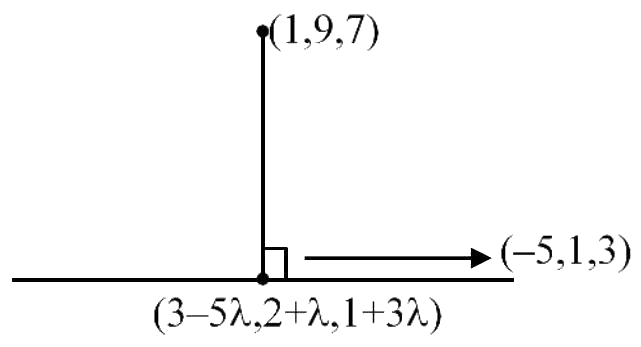
If the foot of the perpendicular drawn from (1,9,7) to the line passing through the point (3,2,1) and parallel to the planes x+2y+z=0 and 3y−z=3 is (α,β,γ), then α+β+γ is equal to
A.
3
B.
1
C.
-1
D.
5
Correct answer: D

Source solution

Sol. Given vectors: n―1=(1,2,1),n―2=(0,3,−1) Calculate the cross product P―=n―1×n―2: P―=|i^j^k^12103−1|=i^(−5)−j^(−1)+k^(3)=(−5,1,3) The equation of the line is: x−3−5=y−21=z−13=λ Substituting into the equation: (2−5λ)(−5)+(λ−7)(1)+(3λ−6)(3)=0 Expanding and simplifying: 25λ−10+λ−7+9λ−18=0 35λ−35=0 λ=1 Substituting λ back to find the point: (−2,3,4)whereα+β+γ=5Question figure
Question 282 / Numerical
Question 282
If the shortest distance between the lines x−λ3=y−2−1=z−11 and x+2−3=y+52=z−44 is 4430, then the largest possible value of |λ| is equal to .
Numerical answer: ____________________
Enter the requested value (an integer; 0 decimal places). Use the units and scaling stated in the question.
Correct answer: 43

Source solution

a¯1=λi^+2j^+k^ a¯2=−2i^−5j^+4k^ p→−=3i^−j^+k^ q→−=−3i^+2j^+4k^ (λ+2)i^+7j^−3k^=a¯1−a¯2 p→×q→−=−6i^−15j^+3k^ 4430=|−6λ−12−105−9|(−6)2+(−15)2+32 4430=|6λ+126|330 132=|6λ+126| λ=1,λ=−43 |λ|=43
Choose another chapter