Learne2i
Learne2i Priority Practice solutions
JEE Main 2025 / Session 2
All chapters

Mathematics

Three Dimensional Geometry

Question 253 / Numerical
Question 253
If the shortest distance between the lines x+62=y−63=z−64 and x−λ3=y−264=z+265 is 6 , then the square of sum of all possible values of λ is
Numerical answer: ____________________
Enter the requested value (an integer; 0 decimal places). Use the units and scaling stated in the question.
Correct answer: 384

Source solution

384 P(−6,6,6)Q(λ,26,−26) n―1=(2,3,4)n―2=(3,4,5) n¯1×n¯2⇒|i^j^k^234345|=i^(−1)−j^(−2)+k^(−1) =(−1,2,−1) ∴Sd|PQ―⋅(−1,2,−1)6|=(λ+6,6,−36)⋅(−1,2,−1)6 =|−λ−6+26+366|=6 ⇒|−λ+46|=66 (+) −λ+46=66 (-) λ−46=66 λ=−26 λ=106 ∴(86)2=384
Question 254 / MCQ
Question 254
The distance of the line x−22=y−63=z−34 from the point (1,4,0) along the line x1=y−22=z+33 is :
A.
17
B.
14
C.
15
D.
13
Correct answer: B

Source solution

Sol. Let the parallel line is x−11=y−42=z−03 so their point of intersection is (λ+1,2λ+43λ)=(2t+2,3t+6,4t+3) λ=2t+1 2λ+4=3t+6⇒t=0 so POI is (2,6,3) so distance =(2−1)2+(6−4)2+(3−0)2=14
Question 255 / Numerical
Question 255
If d1 is the shortest distance between the lines x+1=2y=−12z,x=y+2=6z−6 and d2 is the shortest distance between the lines x−12=y+8−7=z−45,x−12=y−21=z−6−3, then the value of 323 d1 d2 is :
Numerical answer: ____________________
Enter the requested value (an integer; 0 decimal places). Use the units and scaling stated in the question.
Correct answer: 16

Source solution

L1:x+11=y1/2=z−1/12, L2:x1=y+21=z−116 d1= shortest distance between L1& L2 =|(a→2−a→1)⋅(b→1×b→2)|(b→1×b→2)|| d1=2 L3:x−12=y+8−7=z−45, L4:x−12=y−21=z−6−3 d2= shortest distance between L3& L4 d2=123 Hence =323 d1 d2=323×2123=16
Question 256 / MCQ
Question 256
The shortest distance between the lines x+1=2y=−12z and x=y+2=6z−6 is
A.
32
B.
2
C.
52
D.
3
Correct answer: B

Source solution

Sol. We start with the equations: x+11=y12=z−112,x1=y+21=z−116 Let a→=(−1,0,0) and b→=(0,−2,1). Define the vectors: p→=(1,12,−112),q→=(1,1,16) Calculate b→−a→: b→−a→=i^−2j^+k^ Next, compute the cross product p→×q→: p→×q→=|i^j^k^112−1121116| Calculating the determinant: =i^(112+112)−j^(16+112)+k^(1−12) This simplifies to: =i^6−j^4+k^2 Now, find the magnitude of p→×q→: |p→×q→|=136+116+14=712 Now, calculate the distance d: d=|(b→−a→)⋅(p→×q→)|p→×q→|| Substituting the values: d=|(i^−2j^+k^)⋅(i^6−j^4+k^2)712| Calculating the dot product: =|16+1+12712|=|76712|=2 Thus, the final answer is: 2
Question 257 / MCQ
Question 257
The shortest distance between the lines x+1=2y=−12z and x=y+2=6z−6 is
A.
32
B.
2
C.
52
D.
3
Correct answer: B

Source solution

Given lines x+11=y12=z−112,x1=y+21=z−116. Let the lines be L1: r→=a→+λp→,L2: r→=b→+μq→. From the given equations, a→=(−1,0,0),p→=(1,12,−112), and b→=(0,−2,1),q→=(1,1,16). --- The shortest distance between two skew lines is d=|(b→−a→)⋅(p→×q→)|p→×q→||. First, b→−a→=(0,−2,1)−(−1,0,0)=(1,−2,1). Hence, b→−a→=i^−2j^+k^. --- Now compute p→×q→: p→×q→=|i^j^k^112−1121116|. p→×q→=i^(12⋅16−(−112)⋅1)−j^(1⋅16−(−112)⋅1)+k^(1⋅1−12⋅1). =i^(112+112)−j^(16+112)+k^(1−12). =i^6−j^4+k^2. --- Its magnitude is |p→×q→|=(16)2+(−14)2+(12)2. =136+116+14. =4+9+36144=49144=712. --- Next, (b→−a→)⋅(p→×q→)=(i^−2j^+k^)⋅(i^6−j^4+k^2). =16+12+12. =76. --- Therefore, d=|76712|. =76⋅127. =2. Hence, the shortest distance between the two lines is 2.
Question 258 / Numerical
Question 258
If the shortest distance between the lines r1→=αi^+2j^+2k^+λ(i^−2j^+2k^),λ∈R,α>0 and r2→=−4i^−k^+μ(3i^−2j^−2k^),μ∈R is 9 , then α is equal to ____。
Numerical answer: ____________________
Enter the requested integer (0 decimal places).
Correct answer: 6

Source solution

If r→=a→+λb→ and r→=c→+λd→ then shortest distance between two lines is L=(a→−c→)⋅(b→×d→)|b×d| ∴a→−c→=((α+4)i^+2j^+3k^)b→×d→| b×d|=(2i^+2j^+k^)3∴((α+4)i^+2j^+3k^)⋅(2i^+2j^+k^)3=9 or α=6
Question 259 / MCQ
Question 259
Let the line passing through the points (−1,2,1) and parallel to the line x−12=y+13=z4 intersect the line x+23=y−32=z−41 at the point P. Then the distance of P from the point Q(4,−5,1) is :
A.
5
B.
10
C.
56
D.
55
Correct answer: D

Source solution

Let the line through (−1,2,1) parallel to x−12=y+13=z4: x+12=y−23=z−14=λ ⇒x=2λ−1,y=3λ+2,z=4λ+1 Let x+23=y−32=z−41=μ ⇒x=3μ−2,y=2μ+3,z=μ+4 For intersection: 2λ−1=3μ−2, 3λ+2=2μ+3, 4λ+1=μ+4 λ=1,μ=1 P(1,5,5),Q(4,−5,1) PQ=9+100+16=125=55
Question 260 / MCQ
Question 260
If the shortest distance between the lines x−λ2=y−43=z−34 and x−24=y−46=z−78 is 1329, then a value of λ is :
A.
−1325
B.
1325
C.
1
D.
-1
Correct answer: C

Source solution

Let r¯1=(λi^+4j^+3k^)+α(2i^+3j^+4k^) r¯2=(2i^+4j^+7k^)+β(2i^+3j^+4k^) b¯=2i^+3j^+4k^ a¯1=λi^+4j^+3k^ a¯2=2i^+4j^+7k^ The shortest distance is given by: Shortest distance=|b¯×(a¯2−a¯1)||b¯| Calculating a¯2−a¯1: a¯2−a¯1=(2−λ)i^+(4−4)j^+(7−3)k^=(2−λ)i^+0j^+4k^ Now, compute the cross product: b¯×(a¯2−a¯1)=(2i^+3j^+4k^)×((2−λ)i^+4k^) Calculating the cross product: =|i^j^k^2342−λ04| =i^(3⋅4−0⋅4)−j^(2⋅4−(2−λ)⋅4)+k^(2⋅0−3(2−λ)) =12i^−(8−4(2−λ))j^−3(2−λ)k^ =12i^−(8−8+4λ)j^−(6−3λ)k^ =12i^−4λj^+(3λ−6)k^ Now, find the magnitude: |12i^−4λj^+(3λ−6)k^|=13 Calculating the magnitude: 122+(−4λ)2+(3λ−6)2=13 Squaring both sides: 144+16λ2+(3λ−6)2=169 Expanding: (3λ−6)2=9λ2−36λ+36 Thus: 144+16λ2+9λ2−36λ+36=169 Combining terms: 25λ2−36λ+180=169 Simplifying: 25λ2−36λ+11=0 Using the quadratic formula: λ=−(−36)±(−36)2−4⋅25⋅112⋅25 Calculating the discriminant: =36±1296−110050=36±19650=36±1450 Thus: λ=5050=1orλ=2250=1125 Final answer: λ=1
Question 261 / MCQ
Question 261
If the square of the shortest distance between the lines x−21=y−12=z+3−3 and x+12=y+34=z+5−5 is mn, where m,n are coprime numbers, then m+n is equal to:
A.
6
B.
9
C.
21
D.
14
Correct answer: B

Source solution

Sol. a→=(2,1,−3) b→=(−1,−3,−5) p→×q→=|i^j^k^12−324−5| =2i^−j^ b→−a→=−3i^−4j^−2k^ Sd=|(b→−a→)⋅(p→×q→)||p→×q→|− =25 (Sd)2=45 m=4,n=5⇒ m+n=9
Question 262 / MCQ
Question 262
Let PQR be a triangle with R(−1,4,2). Suppose M(2,1,2) is the mid point of PQ . The distance of the centroid of △PQR from the point of intersection of the line x−20=y2=z+3−1 and x−11=y+3−3=z+11 is
A.
69
B.
9
C.
69
D.
99
Correct answer: C

Source solution

Sol. Centroid G divides MR in 1:2 G(1,2,2) Point of intersection A of given lines is ( 2,−6,0 ) AG=69
Question 263 / MCQ
Question 263
Let a line pass through two distinct points P(−2,−1,3) and Q , and be parallel to the vector 3i^+2j^+2k. If the distance of the point Q from the point R(1,3,3) is 5 , then the square of the area of △PQR is equal to:
A.
136
B.
140
C.
144
D.
148
Correct answer: A

Source solution

Sol. PQ→ parallel to 3i^+2j^+2k^,R(1,3,3) ⇒Q(3λ−2,2λ−1,2λ+3),λ∈R−{0} |QR→|=5=(3λ−3)2+(2λ−4)2+(2λ)2 ∴17λ2−34λ+25=25⇒λ=2(∵λ≠0) ∴Q(4,3,7),P(−2,−1,3),R(1,3,3) Area of △PQR=[PQR]=12|PQ→×PR→| [PQR]=12‖i^j^k^644340‖=‖i^j^k^322340‖ [PQR]=|−8i^+6j^+6k^|=136 ∴[PQR]2=136
Question 264 / MCQ
Question 264
Let P be the plane passing through the line x−11=y−2−3=z+57 and the point (2,4,−3). If the image of the point (−1,3,4) in the plane P is ( α,β,γ ), then α+β+γ is equal to
A.
12
B.
11
C.
9
D.
10
Correct answer: D

Source solution

The plane P passes through the line x−11=y−2−3=z+57 and the point A=(2,4,−3). A point on the line is B=(1,2,−5), and its direction vector is d→=(1,−3,7). Also, BA→=(2−1,4−2,−3+5)=(1,2,2). Hence a normal vector to the plane is n→=d→×BA→=|i^j^k^1−37122|. =i^(−6−14)−j^(2−7)+k^(2+3) =(−20,5,5)=(−4,1,1). Therefore, the equation of the plane is −4(x−1)+(y−2)+(z+5)=0, i.e., 4x−y−z−7=0. --- Let P0=(−1,3,4) and let its image in the plane be P0′=(α,β,γ). For the plane ax+by+cz+d=0, the reflection of (x1,y1,z1) is (x1−2aDa2+b2+c2,y1−2bDa2+b2+c2,z1−2cDa2+b2+c2), where D=ax1+by1+cz1+d. Here, a=4,b=−1,c=−1,d=−7. Thus, D=4(−1)−3−4−7=−18. Also, a2+b2+c2=16+1+1=18. Hence, α=−1−2(4)(−18)18=−1+8=7, β=3−2(−1)(−18)18=3−2=1, γ=4−2(−1)(−18)18=4−2=2. Therefore, (α,β,γ)=(7,1,2). So, α+β+γ=7+1+2=10. 10 Hence, the correct option is (4)10.
Question 265 / MCQ
Question 265
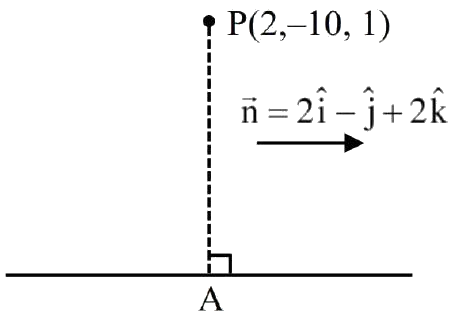
The perpendicular distance, of the line x−12=y+2−1=z+32 from the point P(2,−10,1), is:
A.
6
B.
52
C.
35
D.
43
Correct answer: C

Source solution

Let x−12=y+2−1=z+32=λ ⇒(x,y,z)=(2λ+1,−λ−2,2λ−3) Since PA→⋅n→=0 ⇒(2λ−1)⋅2+(−λ+8)(−1)+(2λ−4)⋅2=0 ⇒4λ−2+λ−8+4λ−8=0 ⇒9λ−18=0⇒λ=2 ∴A(5,−4,1) ∴AP=32+62+02=45=35Question figure
Question 266 / MCQ
Question 266
Let L1:x−12=y−23=z−34 and L2:x−23=y−44=z−55 be two lines. Then which of the following points lies on the line of the shortest distance between L1 and L2 ?
A.
(−53,−7,1)
B.
(2,3,13)
C.
(83,−1,13)
D.
(143,−3,223)
Correct answer: D

Source solution

Sol. P(2λ+1,3λ+2,4λ+3) on L1 Q(3μ+2,4μ+4,5μ+5) on L2 Dr's of PQ=3μ−2λ+1,4μ−3λ+2,5μ−4λ+2 PQ⊥L1 ⇒(3μ−2λ+1)2+(4μ−3λ+2)3+(5μ−4λ―+ 2) 4=0 (1)38μ−29λ+16=0 PQ⊥L2 ⇒(3μ−2λ+1)3+(4μ−3λ+2)4+(5μ−4λ―+ 2) 5=0 (2)50μ−38λ+21=0 By (1) & (2) λ=13;μ=−16 ∴P(53,3,133)&Q(32,103,256) Line PQ x−5316y−3−13z−13316 x−531=y−3−2=z−1331 Point (143,−3,223) lies on the line PQ
Question 267 / Numerical
Question 267
Let a line having direction ratio 1,−4,2 intersect the lines x−73=y−1−1=z+21 and x2=y−73=z1 at the point A and B . Then (AB)2 is equal to .
Numerical answer: ____________________
Enter the requested value or coefficient rounded to the nearest integer (0 decimal places).
Correct answer: 84

Source solution

Write A=(7+3t,1-t,-2+t), B=(2s,7+3s,s). Requiring B-A to have direction ratios (1,-4,2) gives t=-5,s=-3. Thus A=(-8,6,-7), B=(-6,-2,-3), and AB2=22+(−8)2+42=84. The printed source coordinate +7 for the last component of A is a sign typo.
Choose another chapter