Learne2i
Learne2i Priority Practice solutions
JEE Main 2025 / Session 2
All chapters

Mathematics

Three Dimensional Geometry

Question 238 / MCQ
Question 238
Let L1:x−11=y−2−1=z−12 and L2:x+1−1=y−22=z1 be two lines. Let L3 be a line passing through the point ( α,β,γ ) and be perpendicular to both L1 and L2. If L3 intersects L1, then |5α−11β−8γ| equals :
A.
18
B.
16
C.
25
D.
20
Correct answer: C

Source solution

Sol. DR's of L3=m→×n→=|i^j^k^1−12−121| =−5i^−3j^+k^ L3:x−α−5=y−β−3=z−γ1=λ A(α−5λ,β−3λ,γ+λ) L1:x−11=y−2−1=z−12=k B(k+1,−k+2,2k+1) Now α−5λ=k+1⇒α=5λ+k+1 β−3λ=−k+2⇒β=3λ−k+2 γ+λ=2k+1⇒γ=−λ+2k+1 |5α−11β−8γ|=|−25| =25
Question 239 / MCQ
Question 239
The line l1 passes through the point (2,6,2) and is perpendicular to the plane 2x+y−2z=10. Then the shortest distance between the line l1 and the line x+12=y+4−3=z2 is :
A.
133
B.
193
C.
7
D.
9
Correct answer: A

Source solution

Sol. 9} equation of l1 is x−22=y−61=z−2−2 Let l2 is x+12=y+4−3=z2 Point on l1 is a =(2,6,2), direction p→=⟨2,1,−2⟩ Point on l2 is b=(−1,−4,0) direction q→=⟨2,−3,2⟩ Shortest distance between l1 and l2=|(a→−b→)⋅(p→×q→)|p→×q→|| ∵p→×q→=|i^j^k21−22−32|=i^(−4)−j^(8)+k(−8)=|⟨3,10,2⟩⋅⟨−4,−8,−8⟩16+64+64|=|−12−80−16144|=10812=9 Shortest distance between the lines is 9 .
Question 240 / MCQ
Question 240
Let for a triangle ABC, AB→=−2i^+j^+3k^ CB→=αi^+βj^+γk^ CA→=4i^+3j^+δk^ If δ>0 and the area of the triangle ABC is 56, then CB→⋅CA→ is equal to
A.
60
B.
120
C.
108
D.
54 Official Answer. By NTA (1)
Correct answer: A

Source solution

AB―+BC―+CA―=0→ Given: α=2, β=4, γ−δ=3 Using the area of the triangle: 12|AB―×AC―|=56 Solving the equation: (δ−9)2+(2δ+12)2+100=600 This simplifies to: δ=5,γ=8 Finally, we find: CB―⋅CA―=60
Question 241 / MCQ
Question 241
Let the shortest distance between the lines L:x−5−2=y−λ0=z+λ1,λ≥0 and L1:x+1=y−1=4−z be 26. If ( α,β,γ ) lies on L , then which of the following is NOT possible?
A.
α−2γ=19
B.
2α+γ=7
C.
2α−γ=9
D.
α+2γ=24
Correct answer: D

Source solution

Letb→1=⟨−2,0,1⟩,a→1=(5,λ,−λ),b→2=⟨1,1,−1⟩,a→2=(−1,1,4). A vector perpendicular to both lines is b→1×b→2. b→1×b→2=|i^j^k^−20111−1|=i^(0⋅(−1)−1⋅1)−j^((−2)(−1)−1⋅1)+k^((−2)(1)−0⋅1)=−i^−j^−2k^. Hence, b→1×b→2=⟨−1,−1,−2⟩. Also, a→1−a→2=⟨6,λ−1,−λ−4⟩. Using the formula for the shortest distance between two skew lines, d=|(a→1−a→2)⋅(b→1×b→2)|b→1×b→2||. Given d=26, 26=|⟨6,λ−1,−λ−4⟩⋅⟨−1,−1,−2⟩1+1+4|. Since |b→1×b→2|=6, we get 26=|−6−(λ−1)+2λ+86|. 12=|−6−λ+1+2λ+8|. 12=|λ+3|. Therefore, λ+3=±12. λ=9orλ=−15. Since λ≥0, λ=9. Now, since (α,β,γ) lies on line L, α−5−2=β−90=γ+91=k. Hence, α=5−2k,β=9,γ=−9+k. Therefore, α+2γ=(5−2k)+2(−9+k). α+2γ=5−2k−18+2k. α+2γ=−13. Hence, α+2γ=24 is not possible.
Question 242 / MCQ
Question 242
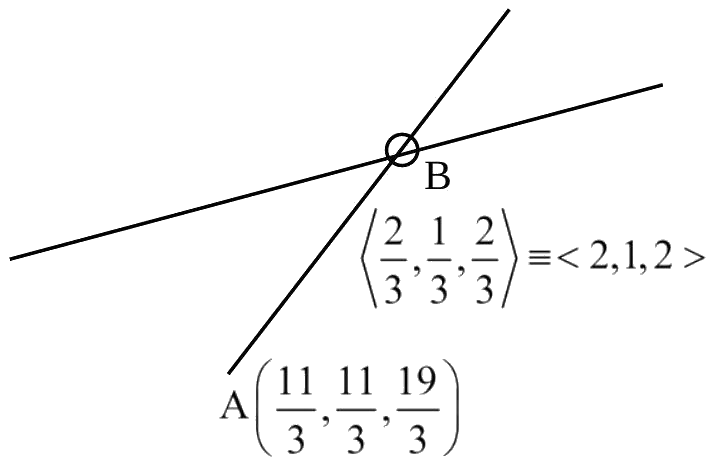
Consider the line L passing through the points (1,2,3) and (2,3,5). The distance of the point (113,113,193) from the line L along the line 3x−112=3y−111=3z−192 is equal to :
A.
3
B.
5
C.
4
D.
6
Correct answer: A

Source solution

Sol. Given the equations: x−12−1=y−23−2=z−35−3 This simplifies to: x−11=y−21=z−32=λ From this, we can express x, y, and z in terms of λ: x=1+λ,y=2+λ,z=3+2λ The point B can be represented as: B(1+λ,2+λ,3+2λ) The direction ratios (D.R.) of line segment AB are given by: ⟨3λ−83,3λ−53,6λ−103⟩ Substituting B into the equation: B(53,83,133) Setting the ratios equal: 3λ−83λ−5=21 Cross-multiplying gives: 3λ−8=6λ−10 Rearranging the equation: 3λ=2⇒λ=23 Now, we calculate the length of AB: AB=36+9+363=93=3Question figure
Question 243 / MCQ
Question 243
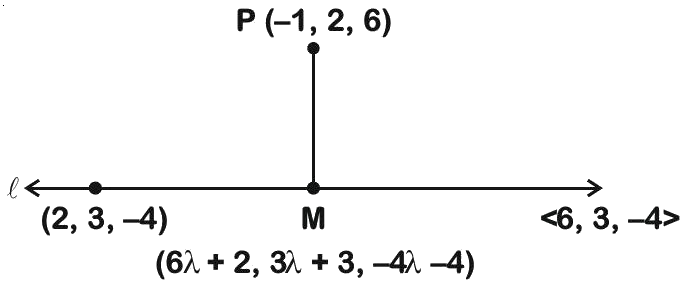
The distance of the point having position vector −i^+2j^+6k^ from the straight line passing through the point (2,3,−4) and parallel to the vector 6i^+3j^−4k^ is :
A.
7
B.
43
C.
6
D.
213
Correct answer: A

Source solution

Sol. The equation of line I is given by x−26=y−33=z+4−4 Let the point M be represented as M(6λ+2,3λ+3,−4λ−4) The direction ratios of the vector PM are ⟨6λ+3,3λ+1,−4λ−10⟩ Setting up the equation for the dot product with the direction ratios of line I: (6λ+3)(6)+(3λ+1)(3)+(−4λ−10)(−4)=0 Expanding this gives: 36λ+18+9λ+3+16λ+40=0 Combining like terms results in: 61λ+61=0 Solving for λ: λ=−1 Substituting λ back into the coordinates of M: M≡(−4,0,0) Finally, calculating the distance PM: PM=(0−(−4))2+(0−0)2+(0−0)2=9+0+36=7 Thus, the final answer is PM=7Question figure
Question 244 / MCQ
Question 244
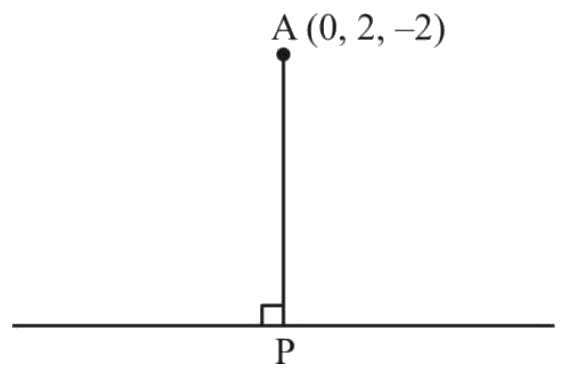
The distance of the point Q(0,2,−2) form the line passing through the point P(5,−4,3) and perpendicular to the lines r→=(−3i^+2k^)+ λ(2i^+3j^+5k^),λ∈R and r→=(i^−2j^+k^)+ μ(−i^+3j^+2k^),μ∈R is
A.
86
B.
20
C.
54
D.
74
Correct answer: D

Source solution

Sol. A vector in the direction of the required line can be obtained by cross product of |i^j^k^235−132| =−9i^−9j^+9k^ Required line, r→=(5i^−4j^+3k^)+λ′(−9i^−9j^+9k^) r→=(5i^−4j^+3k^)+λ(i^+j^−k^) Now distance of (0, 2, -2) P.V. of P≡(5+λ)i^+(λ−4)j^+(3−λ)k^ AP→=(5+λ)i^+(λ−6)j^+(5−λ)k^ AP→⋅(i^+j^−k^)=0 5+λ+λ−6−5+λ=0 λ=2 |AP→|=49+16+9 |AP→|=74Question figure
Question 245 / MCQ
Question 245
If the shortest distance between the lines x−λ2=y−43=z−34 and x−24=y−46=z−78 is 1329, then a value of λ is :
A.
−1325
B.
1325
C.
1
D.
-1
Correct answer: C

Source solution

Sol. r¯1=(λi^+4j^+3k^)+α(2i^+3j^+4k^)r¯2=(2i^+4j^+7k^)+β(2i^+3j^+4k^)}b¯=2i^+3j^+4k^a¯1+λi^+4j^+3k^ r―2=(2i^+4j^+7k^)+β(2i^+3j^+4k^)∫a2=2i^+4j^+7k^ Shortest dist. =|b―×(a―2−a―1)||b|=1329 |(2i^+3j^+4k^)×((2−λ)i^+4k^)|29=1329 |−8j^−3(2−λ)k^+12i^+4(2−λ)j^|=13 |12i^−4λj^+(3λ−6)k^|=13 144+16λ2+(3λ−6)2=169 16λ2+(3λ−6)2=25=λ⇒=1
Question 246 / Numerical
Question 246
Let the point (−1,α,β) lie on the line of the shortest distance between the lines x+2−3=y−24=z−52 and x+2−1=y+62=z−10. Then (α−β)2 is equal to .
Numerical answer: ____________________
Enter the requested value (an integer; 0 decimal places). Use the units and scaling stated in the question.
Correct answer: 25

Source solution
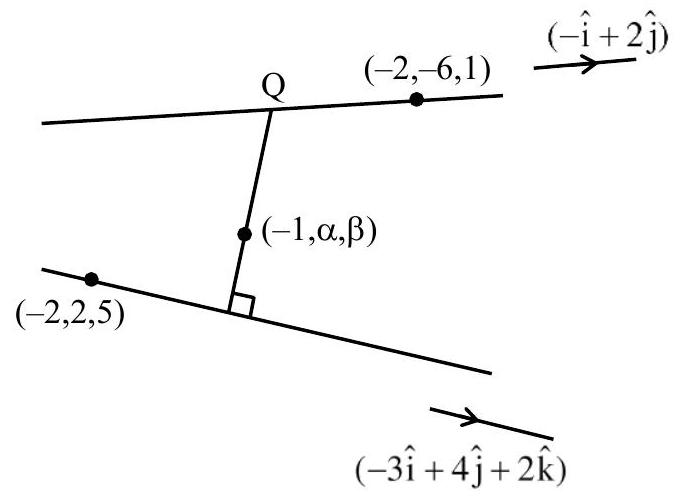
Question figure P(−3λ−2,4λ+2,2λ+5) Q(−μ−2,2μ−6,1) DRS of PQ =(3λ−μ,2μ−4λ−8,−2λ−4) DRS of PQ=|i^j^k^−120−342| =(4i^+2j^+2k^) OR (2, 1, 1) 3λ−μ2=2μ−4λ−81=−2λ−41 ⇒μ=λ+2&7λ=μ−8 λ=−1μ=1 Q:(−3,−4,1) LPQ=x+32=y+41=z−11 (−1,α,β)⇒1=α+41=β−11 ⇒α=−3,β=2 (α−β)2=25
Question 247 / MCQ
Question 247
Let L1:x−12=y−23=z−34 and L2:x−23=y−44=z−55 be two lines. Then which of the following points lies on the line of the shortest distance between L1 and L2?
A.
(−53,−7,1)
B.
(2,3,13)
C.
(83,−1,13)
D.
(143,−3,223)
Correct answer: D

Source solution

Let P(2λ+1,3λ+2,4λ+3) on L1 Q(3μ+2,4μ+4,5μ+5) on L2 The direction ratios of PQ are given by: PQ=(3μ−2λ+1,4μ−3λ+2,5μ−4λ+2) Since PQ⊥L1: (3μ−2λ+1)⋅2+(4μ−3λ+2)⋅3+(5μ−4λ+2)⋅4=0 This simplifies to: (1)38μ−29λ+16=0 Since PQ⊥L2: (3μ−2λ+1)⋅3+(4μ−3λ+2)⋅4+(5μ−4λ+2)⋅5=0 This simplifies to: (2)50μ−38λ+21=0 Now, solving equations (1) and (2): From (1): λ=13 Substituting λ into (1): 38μ−29(13)+16=0 38μ−293+16=0 38μ=293−16=29−483=−193 μ=−16 Thus, we have: P(53,3,133)andQ(32,103,256) The line PQ can be expressed as: x−5316=y−3−13=z−13316 This simplifies to: x−531=y−3−2=z−1331 To find a point on line PQ: Let t=1: x=53+1=83 y=3−2=1 z=133+1=163 Thus, the point (143,−3,223) lies on the line PQ.Question figure
Question 248 / MCQ
Question 248
The shortest distance between the line x−34=y+7−11=z−15 and x−53=y−9−6=z+21 is :
A.
187563
B.
178563
C.
185563
D.
179563
Correct answer: A

Source solution

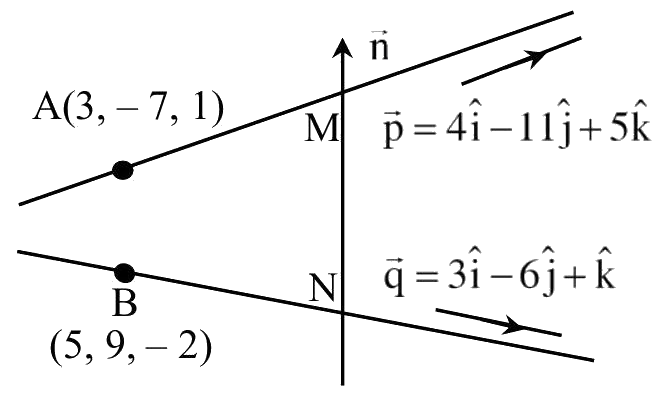
Sol. n→=p→×q→ n→=|i^j^k^4−1153−61|=19i^+11j^+9k^ S.d. = projection of AB→ on n→ =|AB→⋅n→|n→||=|(2i^+16j^−3k^)⋅(19i^+11j^+9k^)361+121+81| =38+176−27563 S.d. =187563Question figure
Question 249 / Numerical
Question 249
Let Q be the foot of the perpendicular from the point P(7,−2,13) on the plane containing the lines x+16=y−17=z−38 and x−13=y−25=z−37 . Then (PQ)2, is equal to .
Numerical answer: ____________________
Enter the requested value (an integer; 0 decimal places). Use the units and scaling stated in the question.
Correct answer: 96

Source solution

Containing the line |x+1y−1z−3678357|=0 9(x+1)−18(y−1)+9(z−3)=0 x−2y+z=0 PQ=|7+4+136|=46 PQ2=96
Question 250 / MCQ
Question 250
Shortest distance between the lines x−31=y−84=z−322,x+31=y+71=z−67 is
A.
330
B.
30
C.
230
D.
430
Correct answer: A

Source solution

Sol. AB→=−3ı^−7ȷ^+6k^−(3ı^+8ȷ^+3k^)=−6ı^−15ȷ^+3k^ p→=ı^+4ȷ^+22k^ q→=ı^+ȷ^+7k^ p→×q→=|ı^ȷ^k^1422117|=6ı^+15ȷ^−3k^ Shortest distance =|AB→⋅(p→×q→)||p→×q→|=|36+225+9|36+225+9=330.
Question 251 / MCQ
Question 251
Let P be the foot of the perpendicular from the point Q(10,−3,−1) on the line x−37=y−2−1=z+1−2. Then the area of the right angled triangle PQR , where R is the point (3,−2,1), is
A.
915
B.
30
C.
815
D.
330
Correct answer: D

Source solution

Sol. x−37=y−2−1=z+1−2=λ ⇒7λ+3,−λ+2,−2λ−1 dr's of QP ⇒ 7λ−7,−λ+5,−2λ Now (7λ−7)⋅7−(−λ+5)+(2λ)⋅2=0 54λ−54=0⇒λ=1 ∴P=(10,1,−3) PQ→=−4j^+2k^ PR→=−7i^−3j^+4k^ Area =|12|ijk0−42−7−34||=330
Question 252 / MCQ
Question 252
The distance of the line x−22=y−63=z−34 from the point (1,4,0) along the line x1=y−22=z+33 is :
A.
17
B.
14
C.
15
D.
13
Correct answer: B

Source solution

Let the equation of the parallel line be x−11=y−42=z−03 The point of intersection can be expressed as (λ+1,2λ+4,3λ) We also have the parametric representation of another line: (2t+2,3t+6,4t+3) Setting the two expressions equal gives: λ+1=2t+2 2λ+4=3t+6 3λ=4t+3 From the first equation, we can express λ in terms of t: λ=2t+1 Substituting λ into the second equation: 2(2t+1)+4=3t+6 This simplifies to: 4t+2+4=3t+6 Thus, 4t+6=3t+6 Solving for t: t=0 Now substituting t=0 back into the parametric equations gives the point of intersection: (2(0)+2,3(0)+6,4(0)+3)=(2,6,3) Next, we calculate the distance from the point (1,4,0) to the point of intersection (2,6,3): Distance=(2−1)2+(6−4)2+(3−0)2 Calculating each term: =12+22+32=1+4+9=14 Thus, the final answer is 14
Choose another chapter