Learne2i
Learne2i Priority Practice solutions
JEE Main 2025 / Session 2
All chapters

Mathematics

Three Dimensional Geometry

Question 223 / MCQ
Question 223
The perpendicular distance from the origin to the plane containing the two lines, x+23=y−25=z+57 and x−11=y−44=z+47, is:
A.
11/6
B.
611
C.
11
D.
116
Correct answer: A

Source solution

Step 1: Calculate the determinant |i^j^k^357147| Step 2: Expand the determinant =i^(5⋅7−4⋅7)−j^(3⋅7−1⋅7)+k^(3⋅4−5⋅1) =i^(35−28)−j^(21−7)+k^(12−5) =7i^−14j^+7k^ Step 3: Factor out common terms =i^−2j^+k^ Step 4: Write the equation of the plane 1(x+2)−2(y−2)+1(z+15)=0 ⇒x−2y+z+11=0 Step 5: Calculate the distance from the origin to the plane d=|11|12+(−2)2+12=111+4+1=116
Question 224 / MCQ
Question 224
The plane through the intersection of the planes x+y+z=1 and 2x+3y−z+4=0 and parallel to the y-axis also passes through the point:
A.
(−3,0,−1)
B.
(3,3,−1)
C.
(3,2,1)
D.
(−3,1,1)
Correct answer: C

Source solution

Sol. Equation of the plane: Starting with the equation: (x+y+z−1)+λ(2x+3y−z+4)=0 we can rearrange it to: (1+2λ)x+(1+3λ)y+(1−λ)z−(1−4λ)=0 The direction ratios (dr's) of the normal to the plane are: 1+2λ,1+3λ,1−λ Since the plane is parallel to the y-axis, we set: 1+3λ=0 Solving for λ: λ=−13 Substituting λ back into the equation of the plane gives: x+4z−7=0 To verify, we check if the point (3,2,1) satisfies this equation: 3+4(1)−7=0 Thus, the point satisfies the equation. Hence, the answer is 3.
Question 225 / MCQ
Question 225
Two lines x−31=y+13=z−6−1 and x+57=y−2−6=z−34 intersect at the point R. The reflection of R in the xy-plane has coordinates :-
A.
(2,4,7)
B.
(−2,4,7)
C.
(2,−4,−7)
D.
(2,−4,7)
Correct answer: C

Source solution

Sol. Point on L1(λ+3,3λ−1,−λ+6) Point on L2(7μ−5,−6μ+2,4μ+3) (i)⇒λ+3=7μ−5 3λ−1=−6μ+2 … (ii) ⇒λ=−1,μ=1 point R(2,−4,7) Reflection is (2,−4,−7)
Question 226 / MCQ
Question 226
the perpendicular distance from the origin to the plane containing the two lines, x+23=y−25=z+57 and x−11=y−44=z+47, is:
A.
11/6
B.
611
C.
11
D.
116
Correct answer: A

Source solution

Sol. |ijk357147| i^(35−28)−j^(21.7)+k^(12−5) 7i^−14j^+7k^ i^−2j^+k^ 1(x+2)−2(y−2)+1(z+15)=0 x−2y+z+11=0 114+1+1=116
Question 227 / MCQ
Question 227
Let A(a,b),B(3,4) and (−6,−8) respectively denote the centroid, circumcentre and orthocentre of a triangle. Then, the distance of the point P(2a+3,7 b+5) from the line 2x+3y−4=0 measured parallel to the line x−2y−1=0 is
A.
1557
B.
1756
C.
1757
D.
517
Correct answer: C

Source solution

G=A(a,b),O=(3,4),H=(−6,−8), where G, O, and H denote the centroid, circumcentre, and orthocentre of a triangle. Using the Euler line relation, OG→=13OH→. Hence, G=O+13(H−O). Substituting the coordinates, (a,b)=(3,4)+13((−6,−8)−(3,4)). =(3,4)+13(−9,−12). =(3,4)+(−3,−4). (a,b)=(0,0). Therefore, a=0,b=0. --- The point P=(2a+3,7b+5) becomes P=(3,5). We have to find the distance of P from the line 2x+3y−4=0 measured parallel to the line x−2y−1=0. The direction vector of the line x−2y−1=0 is d→=(2,1). Hence the required line through P(3,5) is x−32=y−51=t. Thus, x=3+2t,y=5+t. Since this line meets 2x+3y−4=0, we get 2(3+2t)+3(5+t)−4=0. 6+4t+15+3t−4=0. 17+7t=0. t=−177. --- The required distance is the length of the segment along the direction (2,1): D=|t|22+12. =1775. Therefore, 1757. Hence, the correct option is (3) 1757.
Question 228 / Numerical
Question 228
The shortest distance between the lines x−23=y+12=z−62 and x−63=1−y2=z+80 is ______.
Numerical answer: ____________________
Enter the requested value (an integer; 0 decimal places). Use the units and scaling stated in the question.
Correct answer: 14

Source solution

The direction vectors are (3,2,2) and (3,−2,0). Their cross product is (4,6,−12), of magnitude 14. The scalar triple product with displacement (4,2,−14) is 196, so the shortest distance is 14.
Question 229 / MCQ
Question 229
If the foot of the perpendicular from point (4,3,8) on the line L1:x−al=y−23=z−b4, l≠0 is (3,5,7), then the shortest distance between the line L1 and line L2:x−23=y−44=z−55 is equal to :
A.
12
B.
16
C.
23
D.
13 Official Answer by NTA (2)}
Correct answer: B

Source solution

Sol. (3,5,7) satisfy the line L1 3−aℓ=5−23=7−b4 3−aℓ=1&7−b4=1 (2)a+ℓ=3…(1)&b=3 v→1=⟨4,3,8⟩−⟨3,5,7⟩ v→1=⟨1,−2,1⟩ v→2=⟨ℓ,3,4⟩ v→1⋅v→2=0⇒ℓ−6+4=0⇒ℓ=2 a+ℓ=3⇒a=1 L1:x−12=y−23=z−34 L2:x−23=y−44=z−55 A=<1,2,3> B=<2,4,5> AB→=⟨1,2,2⟩ p→=2i^+3j^+4k^ q→=3i^+4j^+5k^ p→×q→=−i^+2j^−k^ Shortest distance =|AB→⋅(p→×q→)|p→×q→||=16
Question 230 / MCQ
Question 230
The shortest distance between the lines x−12=y−21=z−6−3 and x−12=y+8−7=z−45
A.
53
B.
23
C.
33
D.
43
Correct answer: B

Source solution

Sol. 4 L1=x−12=y+8−7=z−45=λ L2x−12=y−21=z−6−3=μ S.D. =|(b→−a→)⋅(b→1×b→2)|b→1×b→2||a→=i−8j+4kb→=i+2j+6k b→1×b→2=|ijk2−7521−3| =i(21−5)−j(−6−10)+k(2+14) =16i+16j+16k |b→1×b→2|=|16(i+j+k)| =16×3 b→−a→=(10j+2k) S.D. =|(10j+2k)⋅16(i+j+k)163| =|16(10+2)163|=123⇒123×33 =1233=43
Question 231 / MCQ
Question 231
The distance of line 3y−2z−1=0=3x−z+4 from the point (2, -1, 6) is :
A.
26
B.
25
C.
26
D.
42
Correct answer: C

Source solution

3y−2z−1=0=3x−z+43y−2z−1=03x−z+4=0 D.R's ⇒(0,3,2) Let DR's of given line are a, b, c Now 3 b−2c=0 & 3a−c=0 ∴6a=3b=2ca:b:c=3:6:9 Any pt on line 3 K−1,6 K+1,9 K+1 Now 3(3 K−1)+6(6 K+1)1+9(9 K+1)=0 ⇒K=13 Point on line ⇒ (0, 3, 4) Given point (2, -1, 6) ⇒ Distance =4+16+4=26
Question 232 / MCQ
Question 232
The shortest distance between lines L1 and L2, where L1:x−12=y+1−3=z+42 and L2 is the line passing through the points A(−4,4,3)⋅B(−1,6,3) and perpendicular to the line x−3−2=y3=z−11, is
A.
121221
B.
24117
C.
141221
D.
42117
Correct answer: C

Source solution

Sol.- L2=x+43=y−42=z−30 ∴ S.D =|x2−x1y2−y1z2−z12−32320||n1→×n2→| =|5−5−72−32320||n1→×n2→| =141|−4i^+6j^+13k^| =14116+36+169 =141221
Question 233 / MCQ
Question 233
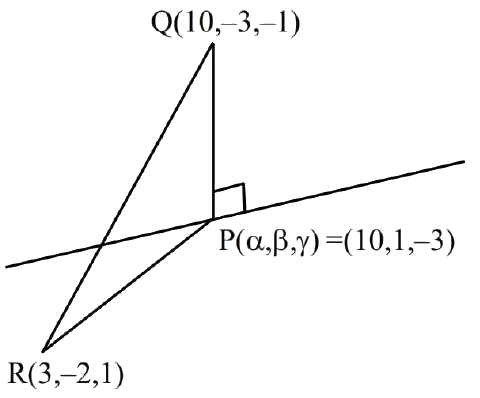
Let P be the foot of the perpendicular from the point Q(10,−3,−1) on the line x−37=y−2−1=z+1−2. Then the area of the right angled triangle PQR, where R is the point (3,−2,1), is
A.
915
B.
30
C.
815
D.
330
Correct answer: D

Source solution

Let x−37=y−2−1=z+1−2=λ From this, we can express x, y, and z in terms of λ: x=7λ+3,y=−λ+2,z=−2λ−1 The direction ratios (dr's) of line QP are: 7λ−7,−λ+5,−2λ Now, we set up the equation for the area of the triangle formed by points P, Q, and R: (7λ−7)⋅7−(−λ+5)+(2λ)⋅2=0 Simplifying this gives: 54λ−54=0⇒λ=1 Substituting λ back, we find the coordinates of point P: P=(10,1,−3) Next, we calculate the vectors PQ→ and PR→: PQ→=−4j^+2k^ PR→=−7i^−3j^+4k^ The area of the triangle is given by: Area=|12|i^j^k^0−42−7−34| Calculating the determinant: =330 Thus, the final area is: Area=330Question figure
Question 234 / MCQ
Question 234
Let d be the distance of the point of intersection of the lines x+63=y2=z+11 and x−74=y−93=z−42 from the point (7,8,9). Then d2+6 is equal to :
A.
(4) 78
B.
(3) 75
C.
(2) 69
D.
(1) 72
Correct answer: A

Source solution

Sol. We start with the equations: x+63=y2=z+11=λ From this, we can express x, y, and z in terms of λ: x=3λ−6,y=2λ,z=λ−1 Next, we have another set of equations: x−74=y−93=z−42=μ This gives us: x=4μ+7,y=3μ+9,z=2μ+4 Now, we equate the expressions for x: (1)3λ−6=4μ+7⇒3λ−4μ=13 Next, we equate the expressions for y: (2)2λ=3μ+9⇒2λ−3μ=9 We can multiply the second equation by 3: (3)6λ−9μ=27 Now, we multiply the first equation by 2: (4)6λ−8μ=26 Next, we subtract equation (4) from equation (3): (6λ−9μ)−(6λ−8μ)=27−26 This simplifies to: −μ=−1⇒μ=−1 Substituting μ=−1 back into equation (1): 3λ−4(−1)=13 This simplifies to: 3λ+4=13⇒3λ=9⇒λ=3 Now we can find the coordinates: x=3λ−6=3(3)−6=3 y=2λ=2(3)=6 z=λ−1=3−1=2 Thus, the intersection point is (3,6,2). Next, we find the distance d2 from the point (3,6,2) to the point (7,8,9): d2=(7−3)2+(8−6)2+(9−2)2=42+22+72=16+4+49=69
Question 235 / Numerical
Question 235
The square of the distance of the image of the point (6,1,5) in the line x−13=y2=z−24, from the origin is .
Numerical answer: ____________________
Enter the requested value (an integer; 0 decimal places). Use the units and scaling stated in the question.
Correct answer: 62

Source solution
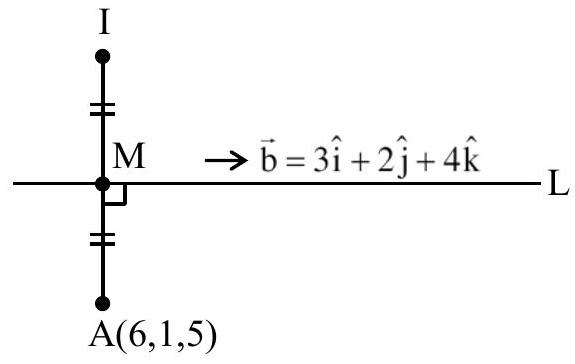
Question figure Sol. Let M(3λ+1,2λ,4λ+2) AM→⋅b→=0 ⇒9λ−15+4λ−2+16λ−12=0 ⇒29λ=29 ⇒λ=1 M(4,2,6),I=(2,3,7) Required Distance =4+9+49=62 Ans. 62
Question 236 / MCQ
Question 236
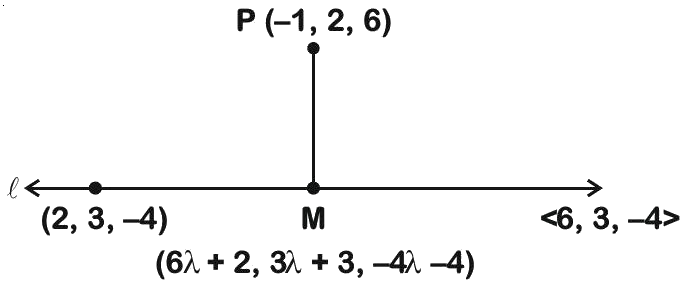
The distance of the point having position vector −i^+2j^+6k^ from the straight line passing through the point (2,3,−4) and parallel to the vector, 6i^+3j^−4k^ is :
A.
7
B.
43
C.
6
D.
213
Correct answer: A

Source solution

Sol. Equation of I is x−26=y−33=z+4−4 Let M(6λ+2,3λ+3,−4λ−4) DR's of PM is ⟨6λ+3,3λ+1,−4λ−10⟩ ⇒(6λ+3)(6)+(3λ+1)(3)+(−4λ−10)(−4)=0 ⇒λ=−1 i.e. M≡(−4,0,0) ∴PM=9+4+36=7Question figure
Question 237 / MCQ
Question 237
Let the line x1=6−y2=z+85 intersect the lines x−54=y−73=z+21 and x+36=3−y3=z−61 at the points A and B respectively. Then the distance of the mid-point of the line segment AB from the plane 2x−2y+z=14 is
A.
4
B.
103
C.
3
D.
113
Correct answer: A

Source solution

Sol. We start with the equations: x1=y−6−2=z+85=λ (1)x−54=y−73=z+21=μ (2)x+34=y−3−3=z−61=γ **Finding Intersection of (1) & (2) "A":** From (1): x=λ,y=−2λ+6,z=5λ−8 From (2): x=4μ+5,y=3μ+7,z=μ−2 Setting the equations equal: λ=4μ+5 −2λ+6=3μ+7 5λ−8=μ−2 Solving these equations, we find: λ=1 and μ=−1. Thus, the intersection point A is: A(1,4,−3) **Finding Intersection of (1) & (3) "B":** From (1): x=λ,y=−2λ+6,z=5λ−8 From (3): x=6γ−3,y=−3γ+3,z=γ+6 Setting the equations equal: λ=6γ−3 −2λ+6=−3γ+3 5λ−8=γ+6 Solving these equations, we find: λ=3 and γ=1. Thus, the intersection point B is: B(3,0,7) **Finding the Midpoint of A & B:** Midpoint=(1+32,4+02,−3+72)=(2,2,2) **Calculating the Perpendicular Distance from the Plane:** The equation of the plane is: 2x−2y+z=14 The distance d from the point (2,2,2) to the plane is given by: d=|2(2)−2(2)+2−144+4+1|=4
Choose another chapter