Learne2i
Learne2i Priority Practice solutions
JEE Main 2025 / Session 2
All chapters

Mathematics

Three Dimensional Geometry

Question 208 / MCQ
Question 208
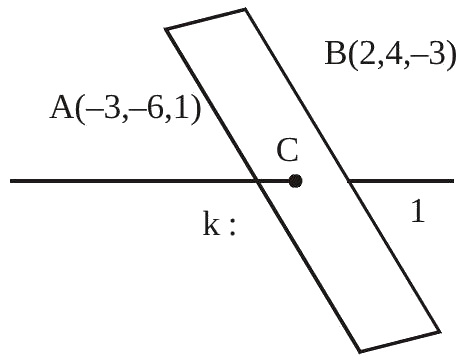
Let P be a plane lx+my+nz=0 containing the line, 1−x1=y+42=z+23. If plane P divides the line segment AB joining points A(−3,−6,1) and B(2,4,−3) in ratio k:1 then the value of k is equal to :
A.
1.5
B.
3
C.
2
D.
4
Correct answer: C

Source solution

Sol. Point C is (2k−3k+1,4k−6k+1,−3k+1k+1) x−1−1=y+42=z+23 Plane lx+my+nz=0 l(−1)+m(2)+n(3)=0 (1)−l+2 m+3n=0 It also satisfy point ( 1,−4,−2 ) (2)l−4 m−2n=0 Solving (1) and (2) 2 m+3n=4 m+2n n=2 m l−4 m−4 m=0 l=8 m l8=m1=n2 l:m:n=8:1:2 Plane is 8x+y+2z=0 It will satisfy point C 8(2k−3k+1)+(4k−6k+1)+2(−3k+1k+1)=0 16k−24+4k−6−6k+2=0 14k=28∴k=2Question figure
Question 209 / MCQ
Question 209
Let P be the plane containing the straight line x−39=y+4−1=z−7−5 and perpendicular to the plane containing the straight lines x2=y3=z5 and x3=y7=z8. If d is the distance of P from the point (2,−5,11), then d2 is equal to :
A.
1472
B.
96
C.
323
D.
54
Correct answer: C

Source solution

Sol. Given the equation of the plane: a(x−3)+b(y+4)+c(z−7)=0 We have the following system of equations: 9a−b−5c=0−11a−b+5c=0 Solving this system, we find the direction ratios proportional to (1,−1,2). Thus, the equation of the plane can be expressed as: x−y+2z=21 Next, we calculate the distance d from the point to the plane: d=86 Squaring the distance gives: d2=323
Question 210 / MCQ
Question 210
If the four points, whose position vectors are 3i^−4j^+2k^, i^+2j^−k^, −2i^−j^+3k^ and 5i^−2αj^+4k^ are coplanar, then α is equal to
A.
7317
B.
10717
C.
−7317
D.
−10717
Correct answer: A

Source solution

Sol. Given the points: P=3i^−4j^+2k^,Q=i^+2j^−k^,R=−2i^−j^+3k^,S=5i^−2αj^+4k^. Calculate the vectors: PQ→=Q−P=(−2i^+6j^−3k^),QR→=R−Q=(−3i^−3j^+4k^),RS→=S−R=(7i^+(1−2α)j^+k^). Set the scalar triple product to zero: [PQ→,QR→,RS→]=0. This leads to the determinant: |−26−3−3−3471−2α1|=0. Calculating the determinant: −2(−3+8α−4)−6(−31)−3(6α−3+21)=0. Simplifying gives: −2(8α−7)+186−3(6α+18)=0. Solving for α: −16α+14+186−18α−54=0, −34α+146=0, α=14634=7317. Final answer: α=7317.
Question 211 / MCQ
Question 211
Let P be the plane containing the straight line x−39=y+4−1=z−7−5 and perpendicular to the plane containing the straight lines x2=y3=z5 and x3=y7=z8. If d is the distance of P from the point (2,−5,11), then d2 is equal to :
A.
1472
B.
96
C.
323
D.
54
Correct answer: D

Source solution

Sol. a(x−3)+b(y+4)+c(z−7)=0  P: 9a−b−5c=0−11a−b+5c=0 After solving DR's ∝(1,−1,2) Equation of plane x−y+2z=21 d=86 d2=323
Question 212 / MCQ
Question 212
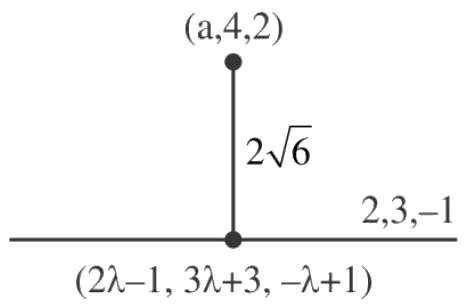
If the length of the perpendicular drawn from the point P(a,4,2),a>0 on the line x+12=y−33=z−1−1 is 26 units and Q(α1,α2,α3) is the image of the point P in this line, then a+∑i=13αi is equal to :
A.
7
B.
8
C.
12
D.
14
Correct answer: B

Source solution

Sol. (2λ−1−a)2+(3λ−1)3+(−λ−1)(−1)=0 ⇒4λ−2−2a+9λ−3+λ+1=0 ⇒14λ−4−2a=0 ⇒7λ−2−a=0 and, (2λ−1−a)2+(3λ−1)2+(λ+1)2=24 ⇒(5λ−1)2+(3λ−1)2+(λ+1)2=24 ⇒35λ2−14λ−21=0 ⇒(λ−1)(35λ+21)=0 For, λ=1⇒a=5 Let (α1,α2,α3) be reflection of point P α1+5=2 α2+4=12 α3+2=0 α1=−3 α2=8 α3=−2 a+α1+α2+α3=8Question figure
Question 213 / MCQ
Question 213
The equation of the line passing through (−4,3,1), parallel to the plane x+2y−z−5=0 and intersecting the line x+1−3=y−32=z−2−1 is:
A.
x+4−1=y−31=z−11
B.
x+43=y−3−1=z−11
C.
x+41=y−31=z−13
D.
x−42=y+31=z+14
Correct answer: B

Source solution

Sol. Normal vector of plane containing two intersecting lines is parallel to vector. (V→1)=|i^j^k^301−32−1| =−2i^+6k^ ∴ Required line is parallel to vector (V→2)=|i^j^k^12−1−206|=3i^−j^+k^ ⇒ Required equation of line is x+43=y−3−1=z−11Question figure
Question 214 / MCQ
Question 214
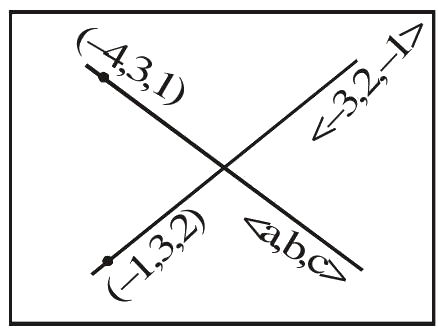
The equation of the line passing through (−4,3,1), parallel to the plane x+2y−z−5=0 and intersecting the line x+1−3=y−32=z−2−1 is:
A.
x+4−1=y−31=z−11
B.
x+43=y−3−1=z−11
C.
x+41=y−31=z−13
D.
x−42=y+31=z+14
Correct answer: B

Source solution

Sol. 1. The normal vector of the plane containing two intersecting lines is parallel to the vector: V→1=|i^j^k^301−32−1| 2. Calculating the determinant: V→1=−2i^+6k^ 3. Therefore, the required line is parallel to the vector: V→2=|i^j^k^12−1−206|=3i^−j^+k^ 4. The required equation of the line is: x+43=y−3−1=z−11Question figure
Question 215 / MCQ
Question 215
The plane containing the line x−32=y+2−1=z−13 and also containing its projection on the plane 2x+3y−z=5, contains which one of the following points ?
A.
(2,0,−2)
B.
(-2, 2, 2)
C.
(0,−2,2)
D.
(2,2,0)
Correct answer: A

Source solution

Sol. The normal vector of required plane =(2i^−j^+3k^)×(2i^+3j^−k^) =−8i^+8j^+8k^ So, direction ratio of normal is (−1,1,1) So required plane is −(x−3)+(y+2)+(z−1)=0 ⇒−x+y+z+4=0 Which is satisfied by (2, 0,−2 )
Question 216 / MCQ
Question 216
On which of the following lines lies the point of intersection of the line, x−42=y−52=z−31 and the plane, x+y+z=2 ?
A.
x−22=y−32=z+33
B.
x−41=y−51=z−5−1
C.
x−11=y−32=z+4−5
D.
x+33=4−y3=z+1−2
Correct answer: C

Source solution

Sol. General point on the given line is x=2λ+4 y=2λ+5 z=λ+3.<. Solving with plane, 2λ+4+2λ+5+λ+3=2 5λ+12=2 5λ=−10 λ=−2 ∴ Option (3) is the correct answer.
Question 217 / MCQ
Question 217
The plane passing through the point (4,−1,2) and parallel to the lines x+23=y−2−1=z+12 and x−21=y−32=z−43 also passes through the point:
A.
(−1,−1,−1)
B.
(−1,−1,1)
C.
(1,1,−1)
D.
(1,1,1)
Correct answer: C

Source solution

Sol. Let n→ be the normal vector to the plane passing through the point (4,−1,2) and parallel to the lines L1 and L2. We can find n→ using the determinant: n→=|i^j^k^3−12123| Calculating the determinant, we find: n→=−7i^−7j^+7k^ The equation of the plane can be expressed as: −1(x−4)−1(y+1)+1(z−2)=0 Simplifying this, we get: x+y−z−1=0 Now, we can check the options.
Question 218 / MCQ
Question 218
The plane containing the line x−32=y+2−1=z−13 and also containing its projection on the plane 2x+3y−z=5, contains which one of the following points?
A.
(2,0,−2)
B.
(-2, 2, 2)
C.
(0,−2,2)
D.
(2,2,0)
Correct answer: A

Source solution

Sol. 1. Find the normal vector of the required plane: n=(2i^−j^+3k^)×(2i^+3j^−k^) n=−8i^+8j^+8k^ 2. The direction ratios of the normal vector are (−1,1,1). 3. The equation of the required plane can be expressed as: −(x−3)+(y+2)+(z−1)=0 Simplifying this gives: −x+y+z+4=0 4. Verify that the point (2,0,−2) satisfies the plane equation: −2+0−2+4=0 Thus, the point (2,0,−2) lies on the required plane.
Question 219 / MCQ
Question 219
The plane passing through the point (4,−1,2) and parallel to the lines x+23=y−2−1=z+12 and x−21=y−32=z−43 also passes through the point :
A.
(−1,−1,−1)
B.
(−1,−1,1)
C.
(1,1,−1)
D.
(1,1,1)
Correct answer: D

Source solution

Sol. Let n→ be the normal vector to the plane passing through (4,−1,2) and parallel to the lines L1& L2 then n→=|i^j^k^3−12123| ∴n→=−7i^−7j^+7k^ ∴ Equation of plane is −1(x−4)−1(y+1)+1(z−2)=0 ∴x+y−z−1=0
Question 220 / MCQ
Question 220
If the point (2,α,β) lies on the plane which passes through the points (3,4,2) and (7,0,6) and is perpendicular to the plane 2x−5y=15, then 2α −3β is equal to :-
A.
5
B.
17
C.
12
D.
7
Correct answer: D

Source solution

Sol. Normal vector of plane =|ijk2−504−44|=−4(5i^+2j^−3k^) equation of plane is 5(x−7)+2y−3(z−6)=0 5x+2y−3z=17
Question 221 / MCQ
Question 221
If the point (2,α,β) lies on the plane which passes through the points (3,4,2) and (7,0,6) and is perpendicular to the plane 2x−5y=15, then 2α−3β is equal to :-
A.
5
B.
17
C.
12
D.
7
Correct answer: B

Source solution

Sol. To find the equation of the plane, we first determine the normal vector using the determinant: Normal vector=|ijk2−504−44| Calculating the determinant, we have: =−4(5i^+2j^−3k^) Thus, the normal vector is: n=−4(5,2,−3) Next, we use the point-normal form of the plane equation. Given a point (7,0,6) on the plane, the equation can be expressed as: 5(x−7)+2(y−0)−3(z−6)=0 Expanding this, we get: 5x−35+2y−3z+18=0 Simplifying, we arrive at the final equation of the plane: 5x+2y−3z=17
Question 222 / MCQ
Question 222
The plane through the intersection of the planes x+y+z=1 and 2x+3y−z+4=0 and parallel to y-axis also passes through the point :
A.
(−3,0,−1)
B.
(3,3,−1)
C.
(3,2,1)
D.
(−3,1,1)
Correct answer: C

Source solution

Sol. Equation of plane (x+y+z−1)+λ(2x+3y−z+4)=0⇒(1+2λ)x+(1+3λ)y+(1−λ)z−1+4λ=0 dr's of normal of the plane are 1+2λ,1+3λ,1−λ Since plane is parallel to y - axis, 1+3λ=0 ⇒λ=−1/3 So the equation of plane is x+4z−7=0 Point (3, 2, 1) satisfies this equation Hence Answer is (3)
Choose another chapter