Learne2i
Learne2i Priority Practice solutions
JEE Main 2025 / Session 2
All chapters

Physics

Ray Optics and Optical Instruments

Question 220 / Numerical
Question 220
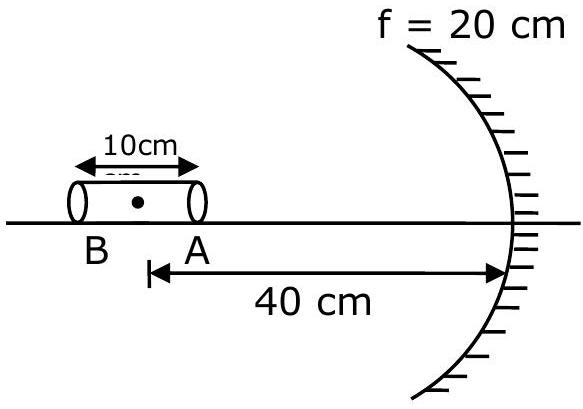
A thin cylindrical rod of length 10 cm is placed horizontally on the principle axis of a concave mirror of focal length 20 cm . The rod is placed in a such a way that mid point of the rod is at 40 cm from the pole of mirror. The length of the image formed by the mirror will be x3 cm. The value of x is .
Numerical answer: ____________________
Enter the requested value (an integer; 0 decimal places). Use the units and scaling stated in the question.
Correct answer: 32

Source solution

32 Question figure Image of end A: u=−35 cm f=−20 cm v= ? v=ufu−f =−35×−20−35+20 =−35×−20−15 v=−1403 Image of end B : u=−45 cm v= ? f=−20 cm v=ufu−f =−45×−20−45+20 =−45×−20−25 v=−36 ∴ length of image =|−36+1403| =|−108+1403|=323 ∴ The value of x=32
Question 221 / Numerical
Question 221
A ray of light passing through a prism (μ=3) suffers minimum deviation. It is found that the angle of incidence is double the angle of refraction within the prism. Then, the angle of prism is ____ (in degrees)
Numerical answer: ____________________
Enter the requested integer (0 decimal places).
Correct answer: 60

Source solution

At minimum deviation r1=r2=A2 Also given i=2r1=A Now 1. sin⁡i=3sin⁡r1 1sin⁡ A=3sin⁡ A2⇒2sin⁡ A2cos⁡ A2=3sin⁡ A2⇒cos⁡ A2=32⇒ A2=30∘⇒A=60∘
Question 222 / MCQ
Question 222
The diffraction pattern of a light of wavelength 400 nm diffracting from a slit of width 0.2 mm is focused on the focal plane of a convex lens of focal length 100 cm . The width of the 1st  secondary maxima will be :
A.
2 mm
B.
2 cm
C.
0.02 mm
D.
0.2 mm
Correct answer: A

Source solution

Width of the first secondary maximum=λDa Given, a=0.2×10⁻³m,λ=400×10−9m,D=100×10−2m. Therefore, Width of the first secondary maximum=400×10−90.2×10−3×100×10−2 =4000.2×10−6 =2000×10−6m =2×10⁻³m=2mm. 2mm
Question 223 / MCQ
Question 223
A thin plano convex lens made of glass of refractive index 1.5 is immersed in a liquid of refractive index 1.2. When the plane side of the lens is silver coated for complete reflection, the lens immersed in the liquid behaves like a concave mirror of focal length 0.2 m . The radius of curvature of the curved surface of the lens is :-
A.
0.15 m
B.
0.10 m
C.
0.20 m
D.
0.25 m
Correct answer: B

Source solution

μ2v=μ2−μ1R 1.5v=1.5−1.2R=0.3R v=1.5R0.3=5R For the second surface, μ1f−μ2v=μ1−μ2−R 1.2f−1.55R=1.2−1.5−R=0.3R 1.2f=0.3R+0.3R=0.6R f=1.2R0.6=2R Given, f=20cm R=f2=10cm=0.1m R=0.1m
Question 224 / MCQ
Question 224
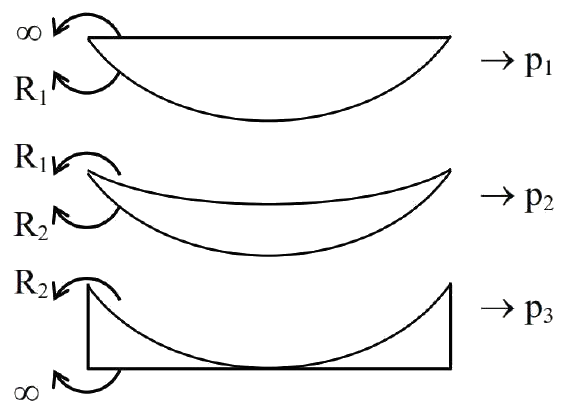
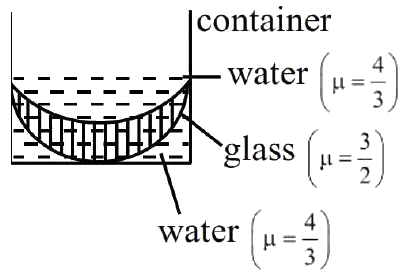
In the diagram given below, there are three lenses formed. Considering negligible thickness of each of them as compared to [R1] and [R2], i.e., the radii of curvature for upper and lower surfaces of the glass lens, the power of the combination isQuestion figure
A.
−16(1|R1|+1|R2|)
B.
−16(1|R1|−1|R2|)
C.
16(1|R1|+1|R2|)
D.
16(1|R1|−1|R2|)
Correct answer: B

Source solution

⇒peq=p1+p2+p3 ⇒p1=(43−1)(1∞−1−|R1|) ⇒p1=13|R1| ⇒p2=(12)(1−|R1|−1−|R2|) ⇒p2=12(1|R2|−1|R1|) ⇒p3=(13)(1−|R2|−1∞)=−13|R2| ⇒peq=13(1|R1|−1|R2|)−12(1|R1|−1|R2|)=−16(1|R1|−1|R2|)Question figure
Question 225 / MCQ
Question 225
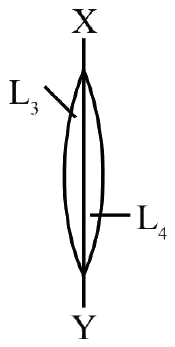
Two identical symmetric double convex lenses of focal length f are cut into two equal parts L1, L2 by AB plane and L3, L4 by XY plane as shown in figure respectively. The ratio of focal lengths of lenses L1 and L3 isORQuestion figure
A.
1:4
B.
1:1
C.
2:1
D.
1:2
Correct answer: D

Source solution

P=1f If lenses L1 and L2 have power P, fL1=fL2=f If lenses L3 and L4 have power P2, fL3=fL4=2f Therefore, fL1:fL3=f:2f
Question 226 / MCQ
Question 226
A plano-convex lens having radius of curvature of first surface 2 cm exhibits focal length of f1 in air. Another plano-convex lens with first surface radius of curvature 3 cm has focal length of f2 when it is immersed in a liquid of refractive index 1.2. If both the lenses are made of same glass of refractive index 1.5, the ratio of f1 and f2 will be :-
A.
3:5
B.
1:3
C.
1:2
D.
2:3
Correct answer: B

Source solution

1f1=(μ−1)(1R1−1R2) =(1.5−1)(12−0) 1f1=0.25 f1=4cm For the lens in medium, 1f2=(μlμm−1)(13−0) =(1.51.2−1)13 =0.31.2⋅13 =112 f2=12cm f1:f2=4:12=1:3
Question 227 / MCQ
Question 227
For the thin convex lens, the radii of curvature are at 15 cm and 30 cm respectively. The focal length the lens is 20 cm . The refractive index of the material is :
A.
1.2
B.
1.4
C.
1.5
D.
1.8
Correct answer: C

Source solution

Sol. 1f=(μlensμair−1)(1R1−1R2) ⇒1+20=(μ1−1)(1+15−1−30) ⇒120=(μ−1)(330) ⇒μ−1=12 ⇒μ=1+12=32=1⋅5
Question 228 / MCQ
Question 228
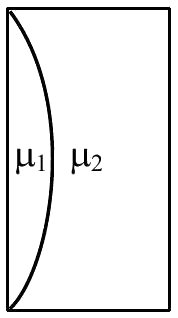
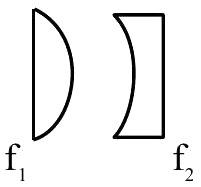
Curved surfaces of a plano-convex lens of refractive index μ1 and a plano-concave lens of refractive index μ2 have equal radius of curvature as shown in figure. Find the ratio of radius of curvature to the focal length of the combined lenses.Question figure
A.
1μ2−μ1
B.
μ1−μ2
C.
1μ1−μ2
D.
μ2−μ1
Correct answer: B

Source solution

Sol. 1f1=(μ1−1)(1R) 1f2=(μ2−1)(−1R) 1f1+1f2=1feq=(μ1−1)−(μ2−1)R 1feq=(μ1−μ2)R Rfeq=(μ1−μ2)Question figure
Question 229 / MCQ
Question 229
A plano-convex lens (focal length f2, refractive index μ2, radius of curvature R ) fits exactly into a plano-concave lens (focal length f1, refractive index μ1, radius of curvature R ). Their plane surfaces are parallel to each other. Then, the focal length of the combination will be :
A.
f1−f2
B.
f1+f2
C.
Rμ2−μ1
D.
2f1f2f1+f2
Correct answer: C

Source solution

1F=1f1+1f2 =1−μ1R+μ2−1R =1−μ1+μ2−1R =μ2−μ1R ∴F=Rμ2−μ1 1F=μ2−μ1R
Question 230 / MCQ
Question 230
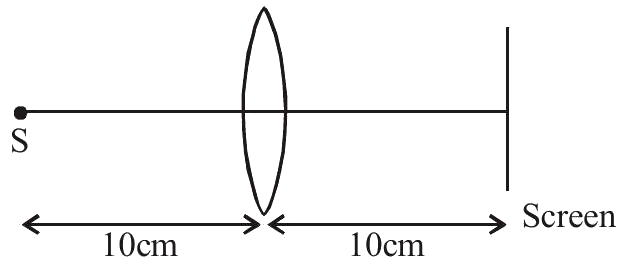
A convex lens is put 10 cm from a light source and it makes a sharp image on a screen, kept 10 cm from the lens. Now a glass block (refractive index 1.5) of 1.5 cm thickness is placed in contact with the light source. To get the sharp image again, the screen is shifted by a distance d . Then d is :
A.
0.55 cm away from the lens
B.
1.1 cm away from the lens
C.
0.55 cm towards the lens
D.
0
Correct answer: A

Source solution

Sol. 1v−1u=1f⇒110−1−10=1f⇒f=5cm Shift due to slab =t(1−1μ) in the direction of incident ray =1.5(1−23)=0.5 Again, 1v−1−9.5=15⇒1u=15−219=995⇒v=959=10.55cmQuestion figure
Question 231 / MCQ
Question 231
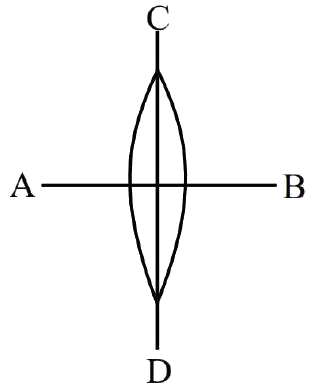
A symmetric thin biconvex lens is cut into four equal parts by two planes AB and CD as shown in figure. If the power of original lens is 4D then the power of a part of the divided lens isQuestion figure
A.
8 D
B.
4 D
C.
D
D.
2 D
Correct answer: D

Source solution

1f1=(μ−1)(1R−−1R) =(μ−1)2R P1=1f1=4D For the second lens, 1f2=(μ−1)(1R−0) =(μ−1)1R P2=1f2=P12 =42=2D P2=2D
Question 232 / MCQ
Question 232
A convex lens mode of glass (refractive index = 1.5) has focal length 24 cm in air. When it is totally immersed in water (refractive index =1.33 ), its focal length changes to
A.
72 cm
B.
96 cm
C.
24 cm
D.
48 cm
Correct answer: B

Source solution

Sol. 18=(μℓμS−1)[1R1−1R2] (i)124=(1.5−1)[2R] 1f′=(1.51.33−1)(2R) (ii)1f′=(1.5⋅34−1)2R (i) divided by (ii) f′24=4 f′=96cm
Question 233 / MCQ
Question 233
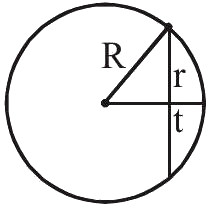
The thickness at the centre of a plano convex lens is 3 mm and the diameter is 6 cm . If the speed of light in the material of the lens is 2×10⁸ ms−1. The focal length of the lens is......... .
A.
0.30 cm
B.
15 cm
C.
1.5 cm
D.
30 cm
Correct answer: D

Source solution

Sol. R2=r2+(R−t)2 R2=r2+R2+t2−2Rt Neglecting t2, we get R=r22t ∴1f=(μ−1)(1R−1∞)=μ−1R f=Rμ−1=r22t(μ−1)=(3×10⁻²)22×3×10−3(32−1) =9×10−46×10−3⋅1×2 f=0.3m=30cmQuestion figure
Question 234 / MCQ
Question 234
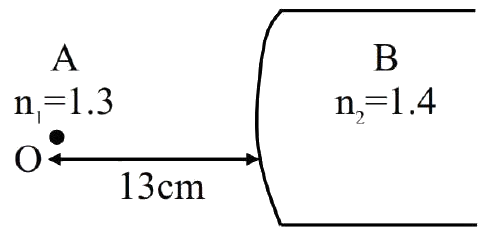
In a long glass tube, mixture of two liquids A and B with refractive indices 1.3 and 1.4 respectively, forms a convex refractive meniscus towards A . If an object placed at 13 cm from the vertex of the meniscus in A forms an image with a magnification of ' -2 ' then the radius of curvature of meniscus is :
A.
1 cm
B.
13 cm
C.
23 cm
D.
43 cm
Correct answer: C

Source solution

Sol. n2v−n1u=n2−n1R 1.4V−1.3−13=0.1R 1.4V=1−R10R 1.4v=1−R10R m=vn2un1 −2×−131.3=10R1−R R=23cmQuestion figure
Choose another chapter