
Learne2i
Learne2i Priority Practice solutions
JEE Main 2025 / Session 2
All chapters

Physics

Ray Optics and Optical Instruments

Question 235 / MCQ
Question 235
A plano convex lens of refractive index μ1 and focal length f1 is kept in contact with another plano concave lens of refractive index μ2 and focal length f2. If the radius of curvature of their spherical faces is R each and f1=2f2, then μ1 and μ2 are related as :
A.
μ1+μ2=3
B.
2μ1−μ2=1
C.
2μ2−μ1=1
D.
3μ2−2μ1=1
Correct answer: B

Source solution

Sol. 12f2=1f1=(μ1−1)(1∞−1−R) 1f2=(μ2−1)(1−R−1∞) (μ1−1)R=(μ2−1)2R 2μ2−μ1=1
Question 236 / MCQ
Question 236
A monochromatic light of wavelength 6000\AA is incident on the single slit of width 0.01 mm . If the diffraction pattern is formed at the focus of the convex lens of focal length 20 cm , the linear width of the central maximum is :
A.
60 mm
B.
24 mm
C.
120 mm
D.
12 mm
Correct answer: B

Source solution

Sol. Linear width W=2λda=2⋅6×10−7⋅0.21×10−5=2.4×10−2=24mm
Question 237 / MCQ
Question 237
Given is a thin convex lens of glass (refractive index μ ) and each side having radius of curvature R. One side is polished for complete reflection. At what distance from the lens, an object be placed on the optic axis so that the image gets formed on the object itself.
A.
R/μ
B.
R/(2μ−3)
C.
μR
D.
R/(2μ−1)
Correct answer: D

Source solution

Peq=2Pl+Pm 1feq=2fl−1fm =4(μ−1)R+2R =4μ−2R feq=R4μ−2 =R2(2μ−1) Since the equivalent system contains a mirror, Req=2feq =2(R2(2μ−1)) Req=R2μ−1
Question 238 / Numerical
Question 238
A convex lens of refractive index 1.5 and focal length 18 cm in air is immersed in water. The change in focal length of the lens will be cm (Given refractive index of water =43 )
Numerical answer: ____________________
Enter the requested value (an integer; 0 decimal places). Use the units and scaling stated in the question.
Correct answer: 54

Source solution

54 1f=(μ−1)(1R1−1R2) 118=(1.5−1)2R…. (1)1f=(1.543−1)2R…… Div eq. by eq. 2 f18=0.5×81 f=72 cm change =72−18 =54
Question 239 / MCQ
Question 239
The power of a lens (biconvex) is 1.25 m−1 in particular medium. Refractive index of the lens is 1.5 and radii of curvature are 20 cm and 40 cm respectively. The refractive index of surrounding medium :
A.
1.0
B.
97
C.
32
D.
43
Correct answer: B

Source solution

P=(μlμm−1)(1R1−1R2) Given, P=1.25D,μl=1.5 R1=+20cm=0.2m R2=−40cm=−0.4m 1.25=(1.5μm−1)(10.2−1−0.4) 1.25=(1.5μm−1)(5+2.5) 1.25=7.5(1.5μm−1) 1.5μm−1=1.257.5=16 1.5μm=76 μm=1.5×67=97 μm=97≈1.286
Question 240 / MCQ
Question 240
A thin prism P1 with angle 4∘ made of glass having refractive index 1.54, is combined with another thin prism P2 made of glass having refractive index 1.72 to get dispersion without deviation. The angle of the prism P2 in degrees is
A.
4
B.
3
C.
16/3
D.
1.5
Correct answer: B

Source solution

δnet=0 For a thin prism, δ=(μ−1)A Hence, (μ1−1)A1=(μ2−1)A2 (1.54−1)×4=(1.72−1)A2 0.54×4=0.72A2 A2=2.160.72 A2=3∘
Question 241 / MCQ
Question 241
The refractive index of a converging lens is 1.4. What will be the focal length of this lens if it is placed in a medium of same refractive index ? (Assume the radii of curvature of the faces of lens are R1 and R2 respectively)
A.
1
B.
Infinite
C.
R1R2R1−R2
D.
Zero
Correct answer: B

Source solution

Sol. 1F=[μLμS−1][1R1−1R2] If μL=μS⇒1F=0⇒F=∞
Question 242 / MCQ
Question 242
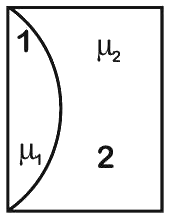
One plano-convex and one plano-concave lens of same radius of curvature ' R ' but of different materials are joined side by side as shown in the figure. If the refractive index of the material of 1 is μ1 and that of 2 is μ2, then the focal length of the combination is :Question figure
A.
R2(μ1−μ2)
B.
R2−(μ1−μ2)
C.
Rμ1−μ2
D.
2Rμ1−μ2
Correct answer: C

Source solution

Sol. Focal length of plano-convex lens: f1=R(μ1−1) Focal length of plano-concave lens: f2=−R(μ2−1) For the combination of two lenses: 1feq=1f1+1f2=μ1−1R−μ2−1R =μ1−μ2R ∴feq=Rμ1−μ2
Question 243 / MCQ
Question 243
When a beam of white light is allowed to pass through convex lens parallel to principal axis, the different colours of light converge at different point on the principle axis after refraction. This is called:
A.
Spherical aberration
B.
Polarisation
C.
Chromatic aberration
D.
Scattering
Correct answer: C

Source solution

Different colours have different refractive indices ∴they are focused at different points by a lens. This defect of a lens is called Chromatic Aberration (due to dispersion of light by the lens)
Question 244 / MCQ
Question 244
A convex lens of focal length 40 cm forms an image of an extended source of light on a photoelectric cell. A current I is produced. The lens is replaced by another convex lens having the same diameter but focal length 20 cm . The photoelectric current now is :
A.
I2
B.
4 I
C.
2 I
D.
I
Correct answer: D

Source solution

Photocurrent∝number of photoelectrons emitted per second Photocurrent depends on the total light energy falling on the photocell. Both lenses have the same diameter. ∴Both collect the same amount of light from the source. Changing the focal length only changes the size and intensity distribution of the image, not the total light reaching the photocell. ∴Number of emitted photoelectrons remains unchanged. I′=I
Question 245 / MCQ
Question 245
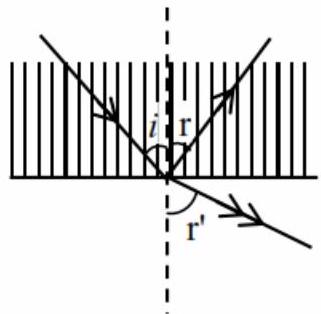
A ray of light passes from a denser medium to a rarer medium at an angle of incidence i. The reflected and refracted rays make an angle of 90° with each other. The angle of reflection and refraction are respectively r and r'. The critical angle is given by : Question figure
A.
sin−1⁡(cotr)
B.
tan−1⁡(sin⁡i)
C.
sin−1⁡(tan⁡r′)
D.
sin−1⁡(tan⁡r)
Correct answer: D

Source solution

r+r′+90∘=180∘⇒r′=90−r=90−in1sin⁡i=n2sin⁡r′=n2sin⁡(90−i)n1sin⁡i=n2cos⁡i⇒tan⁡i=n2n1 Now sin⁡C=n2n1=tan⁡i ⇒C=sin−1⁡(tan⁡i)=sin−1⁡(tan⁡r)
Question 246 / MCQ
Question 246
An effective power of a combination of 5 identical convex lenses which are kept in contact along the principal axis is 25 D . Focal length of each of the convex lens is :
A.
20 cm
B.
50 cm
C.
500 cm
D.
25 cm
Correct answer: A

Source solution

Sol. We know that Peq=∑Pi Therefore, given all lenses are identical, 5P=25D Thus, P=5D Consequently, 1f=5⇒f=15m=20cm Hence option (1).
Choose another chapter