
Learne2i
Learne2i Priority Practice solutions
JEE Main 2026 / Session 1
All chapters

Mathematics

Three Dimensional Geometry

Question 232 / MCQ
Question 232
If the point (2,α,β) lies on the plane which passes through the points (3,4,2) and (7,0,6) and is perpendicular to the plane 2x−5y=15, then 2α −3β is equal to :-
A.
5
B.
17
C.
12
D.
7
Correct answer: D

Source solution

Sol. Normal vector of plane =|ijk2−504−44|=−4(5i^+2j^−3k^) equation of plane is 5(x−7)+2y−3(z−6)=0 5x+2y−3z=17
Question 233 / MCQ
Question 233
If the point (2,α,β) lies on the plane which passes through the points (3,4,2) and (7,0,6) and is perpendicular to the plane 2x−5y=15, then 2α−3β is equal to :-
A.
5
B.
17
C.
12
D.
7
Correct answer: B

Source solution

Sol. To find the equation of the plane, we first determine the normal vector using the determinant: Normal vector=|ijk2−504−44| Calculating the determinant, we have: =−4(5i^+2j^−3k^) Thus, the normal vector is: n=−4(5,2,−3) Next, we use the point-normal form of the plane equation. Given a point (7,0,6) on the plane, the equation can be expressed as: 5(x−7)+2(y−0)−3(z−6)=0 Expanding this, we get: 5x−35+2y−3z+18=0 Simplifying, we arrive at the final equation of the plane: 5x+2y−3z=17
Question 234 / MCQ
Question 234
On which of the following lines lies the point of intersection of the line, x−42=y−52=z−31 and the plane, x+y+z=2 ?
A.
x−22=y−32=z+33
B.
x−41=y−51=z−5−1
C.
x−11=y−32=z+4−5
D.
x+33=4−y3=z+1−2
Correct answer: C

Source solution

Sol. General point on the given line is x=2λ+4 y=2λ+5 z=λ+3.<. Solving with plane, 2λ+4+2λ+5+λ+3=2 5λ+12=2 5λ=−10 λ=−2 ∴ Option (3) is the correct answer.
Question 235 / MCQ
Question 235
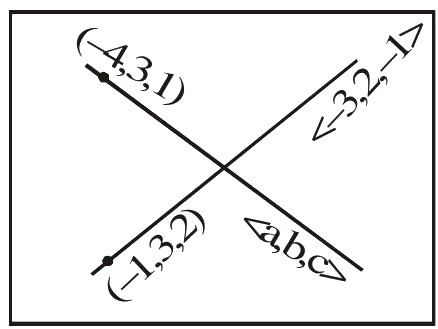
The equation of the line passing through (−4,3,1), parallel to the plane x+2y−z−5=0 and intersecting the line x+1−3=y−32=z−2−1 is:
A.
x+4−1=y−31=z−11
B.
x+43=y−3−1=z−11
C.
x+41=y−31=z−13
D.
x−42=y+31=z+14
Correct answer: B

Source solution

Sol. Normal vector of plane containing two intersecting lines is parallel to vector. (V→1)=|i^j^k^301−32−1| =−2i^+6k^ ∴ Required line is parallel to vector (V→2)=|i^j^k^12−1−206|=3i^−j^+k^ ⇒ Required equation of line is x+43=y−3−1=z−11Question figure
Question 236 / MCQ
Question 236
The equation of the line passing through (−4,3,1), parallel to the plane x+2y−z−5=0 and intersecting the line x+1−3=y−32=z−2−1 is:
A.
x+4−1=y−31=z−11
B.
x+43=y−3−1=z−11
C.
x+41=y−31=z−13
D.
x−42=y+31=z+14
Correct answer: B

Source solution

Sol. 1. The normal vector of the plane containing two intersecting lines is parallel to the vector: V→1=|i^j^k^301−32−1| 2. Calculating the determinant: V→1=−2i^+6k^ 3. Therefore, the required line is parallel to the vector: V→2=|i^j^k^12−1−206|=3i^−j^+k^ 4. The required equation of the line is: x+43=y−3−1=z−11Question figure
Question 237 / MCQ
Question 237
The plane containing the line x−32=y+2−1=z−13 and also containing its projection on the plane 2x+3y−z=5, contains which one of the following points ?
A.
(2,0,−2)
B.
(-2, 2, 2)
C.
(0,−2,2)
D.
(2,2,0)
Correct answer: A

Source solution

Sol. The normal vector of required plane =(2i^−j^+3k^)×(2i^+3j^−k^) =−8i^+8j^+8k^ So, direction ratio of normal is (−1,1,1) So required plane is −(x−3)+(y+2)+(z−1)=0 ⇒−x+y+z+4=0 Which is satisfied by (2, 0,−2 )
Question 238 / MCQ
Question 238
The perpendicular distance from the origin to the plane containing the two lines, x+23=y−25=z+57 and x−11=y−44=z+47, is:
A.
11/6
B.
611
C.
11
D.
116
Correct answer: A

Source solution

Step 1: Calculate the determinant |i^j^k^357147| Step 2: Expand the determinant =i^(5⋅7−4⋅7)−j^(3⋅7−1⋅7)+k^(3⋅4−5⋅1) =i^(35−28)−j^(21−7)+k^(12−5) =7i^−14j^+7k^ Step 3: Factor out common terms =i^−2j^+k^ Step 4: Write the equation of the plane 1(x+2)−2(y−2)+1(z+15)=0 ⇒x−2y+z+11=0 Step 5: Calculate the distance from the origin to the plane d=|11|12+(−2)2+12=111+4+1=116
Question 239 / MCQ
Question 239
The plane containing the line x−32=y+2−1=z−13 and also containing its projection on the plane 2x+3y−z=5, contains which one of the following points?
A.
(2,0,−2)
B.
(-2, 2, 2)
C.
(0,−2,2)
D.
(2,2,0)
Correct answer: A

Source solution

Sol. 1. Find the normal vector of the required plane: n=(2i^−j^+3k^)×(2i^+3j^−k^) n=−8i^+8j^+8k^ 2. The direction ratios of the normal vector are (−1,1,1). 3. The equation of the required plane can be expressed as: −(x−3)+(y+2)+(z−1)=0 Simplifying this gives: −x+y+z+4=0 4. Verify that the point (2,0,−2) satisfies the plane equation: −2+0−2+4=0 Thus, the point (2,0,−2) lies on the required plane.
Question 240 / MCQ
Question 240
the perpendicular distance from the origin to the plane containing the two lines, x+23=y−25=z+57 and x−11=y−44=z+47, is:
A.
11/6
B.
611
C.
11
D.
116
Correct answer: A

Source solution

Sol. |ijk357147| i^(35−28)−j^(21.7)+k^(12−5) 7i^−14j^+7k^ i^−2j^+k^ 1(x+2)−2(y−2)+1(z+15)=0 x−2y+z+11=0 114+1+1=116
Question 241 / MCQ
Question 241
The plane through the intersection of the planes x+y+z=1 and 2x+3y−z+4=0 and parallel to y-axis also passes through the point :
A.
(−3,0,−1)
B.
(3,3,−1)
C.
(3,2,1)
D.
(−3,1,1)
Correct answer: C

Source solution

Sol. Equation of plane (x+y+z−1)+λ(2x+3y−z+4)=0⇒(1+2λ)x+(1+3λ)y+(1−λ)z−1+4λ=0 dr's of normal of the plane are 1+2λ,1+3λ,1−λ Since plane is parallel to y - axis, 1+3λ=0 ⇒λ=−1/3 So the equation of plane is x+4z−7=0 Point (3, 2, 1) satisfies this equation Hence Answer is (3)
Question 242 / MCQ
Question 242
The plane passing through the point (4,−1,2) and parallel to the lines x+23=y−2−1=z+12 and x−21=y−32=z−43 also passes through the point:
A.
(−1,−1,−1)
B.
(−1,−1,1)
C.
(1,1,−1)
D.
(1,1,1)
Correct answer: C

Source solution

Sol. Let n→ be the normal vector to the plane passing through the point (4,−1,2) and parallel to the lines L1 and L2. We can find n→ using the determinant: n→=|i^j^k^3−12123| Calculating the determinant, we find: n→=−7i^−7j^+7k^ The equation of the plane can be expressed as: −1(x−4)−1(y+1)+1(z−2)=0 Simplifying this, we get: x+y−z−1=0 Now, we can check the options.
Question 243 / MCQ
Question 243
The equation of the plane containing the straight line x2=y3=z4 and perpendicular to the plane containing the straight lines x3=y4=z2 and x4=y2=z3 is:
A.
x+2y−2z=0
B.
x−2y+z=0
C.
5x+2y−4z=0
D.
3x+2y−3z=0
Correct answer: B

Source solution

Sol. Vector along the normal to the plane containing the lines x3=y4=z2 and x4=y2=z3 is (8i^−j^−10k^) vector perpendicular to the vectors 2i^+3j^+4k^ and 8i^−j^−10k^ is 26i^−52j^+26k^ so, required plane is 26x−52y+26z=0 x−2y+z=0
Question 244 / MCQ
Question 244
The plane passing through the point (4,−1,2) and parallel to the lines x+23=y−2−1=z+12 and x−21=y−32=z−43 also passes through the point :
A.
(−1,−1,−1)
B.
(−1,−1,1)
C.
(1,1,−1)
D.
(1,1,1)
Correct answer: D

Source solution

Sol. Let n→ be the normal vector to the plane passing through (4,−1,2) and parallel to the lines L1& L2 then n→=|i^j^k^3−12123| ∴n→=−7i^−7j^+7k^ ∴ Equation of plane is −1(x−4)−1(y+1)+1(z−2)=0 ∴x+y−z−1=0
Question 245 / MCQ
Question 245
The plane through the intersection of the planes x+y+z=1 and 2x+3y−z+4=0 and parallel to the y-axis also passes through the point:
A.
(−3,0,−1)
B.
(3,3,−1)
C.
(3,2,1)
D.
(−3,1,1)
Correct answer: C

Source solution

Sol. Equation of the plane: Starting with the equation: (x+y+z−1)+λ(2x+3y−z+4)=0 we can rearrange it to: (1+2λ)x+(1+3λ)y+(1−λ)z−(1−4λ)=0 The direction ratios (dr's) of the normal to the plane are: 1+2λ,1+3λ,1−λ Since the plane is parallel to the y-axis, we set: 1+3λ=0 Solving for λ: λ=−13 Substituting λ back into the equation of the plane gives: x+4z−7=0 To verify, we check if the point (3,2,1) satisfies this equation: 3+4(1)−7=0 Thus, the point satisfies the equation. Hence, the answer is 3.
Question 246 / MCQ
Question 246
Let a line pass through two distinct points P(−2,−1,3) and Q, and be parallel to the vector 3i^+2j^+2k^. If the distance of the point Q from the point R(1,3,3) is 5, then the square of the area of △PQR is equal to:
A.
136
B.
140
C.
144
D.
148
Correct answer: A

Source solution

Sol. 1. Let PQ→ be parallel to 3i^+2j^+2k^ and point R(1,3,3). 2. Define point Q as Q(3λ−2,2λ−1,2λ+3), where λ∈R−{0}. 3. The distance |QR→| is given by: |QR→|=5=(3λ−3)2+(2λ−4)2+(2λ)2 4. Squaring both sides, we have: 25=(3λ−3)2+(2λ−4)2+(2λ)2 5. Expanding and simplifying: 17λ2−34λ+25=25⇒17λ2−34λ=0 6. Factoring out λ: λ(17λ−34)=0⇒λ=2(since λ≠0) 7. Substitute λ back to find Q: Q(4,3,7),P(−2,−1,3),R(1,3,3) 8. The area of triangle △PQR is given by: [PQR]=12|PQ→×PR→| 9. Calculate the cross product: PQ→=Q−P=(4+2,3+1,7−3)=(6,4,4) PR→=R−P=(1+2,3+1,3−3)=(3,4,0) 10. The cross product is: PQ→×PR→=|i^j^k^644340| 11. Evaluating the determinant: =i^(4⋅0−4⋅4)−j^(6⋅0−4⋅3)+k^(6⋅4−4⋅3) =−16i^+12j^+6k^ 12. The magnitude is: ‖−16i^+12j^+6k^‖=(−16)2+122+62=256+144+36=436 13. Therefore, the area is: [PQR]=12436=109 14. Finally, the squared area is: [PQR]2=136
Choose another chapter