Learne2i
Learne2i Priority Practice solutions
JEE Main 2026 / Session 1
All chapters

Mathematics

Three Dimensional Geometry

Question 247 / MCQ
Question 247
If Q(0,−1,−3) is the image of the point P in the plane 3x−y+4z=2 and R is the point (3,−1,−2), then the area (in sq. units) of △PQR is :
A.
652
B.
914
C.
213
D.
912
Correct answer: D

Source solution

Sol. To find the coordinates of point Q in the plane, we start with the equation: (x−0)3=(y+1)−1=(z+3)4=−2(1−12−2)9+1+16=1 From this, we can derive the coordinates: x=3,y=−2,z=1 Thus, the coordinates of point P are P(3,−2,1), point Q is Q(0,−1,−3), and point R is R(3,−1,−2). Next, we calculate the area of triangle △PQR: Area=12|PQ→×QR→| First, we find the vectors: PQ→=Q−P=(0−3,−1+2,−3−1)=(−3,1,−4) QR→=R−Q=(3−0,−1+1,−2+3)=(3,0,1) Now, we compute the cross product: PQ→×QR→=|i^j^k^−31−4301| Calculating the determinant: =i^(1⋅1−0⋅(−4))−j^(−3⋅1−3⋅(−4))+k^(−3⋅0−1⋅3) =i^(1)−j^(−3+12)−k^(3) =i^−j^(9)−k^(3) Thus, the cross product is: PQ→×QR→=(1,−9,−3) Now, we find the magnitude: ‖PQ→×QR→‖=12+(−9)2+(−3)2=1+81+9=91 Finally, the area of triangle PQR is: Area=1291 Thus, the final answer is: 912
Question 248 / MCQ
Question 248
Let PQR be a triangle with R(−1,4,2). Suppose M(2,1,2) is the mid point of PQ . The distance of the centroid of △PQR from the point of intersection of the line x−20=y2=z+3−1 and x−11=y+3−3=z+11 is
A.
69
B.
9
C.
69
D.
99
Correct answer: C

Source solution

Sol. Centroid G divides MR in 1:2 G(1,2,2) Point of intersection A of given lines is ( 2,−6,0 ) AG=69
Question 249 / Numerical
Question 249
The square of the distance of the image of the point (6,1,5) in the line x−13=y2=z−24, from the origin is .
Numerical answer: ____________________
Enter the requested value (an integer; 0 decimal places). Use the units and scaling stated in the question.
Correct answer: 62

Source solution
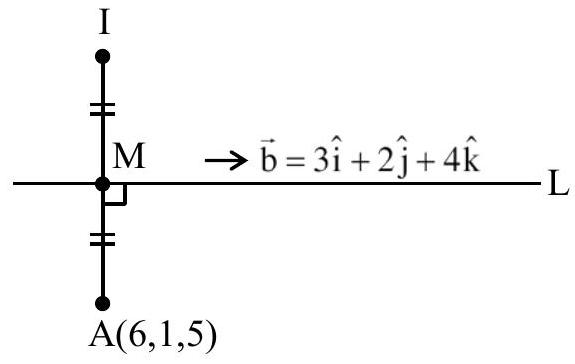
Question figure Sol. Let M(3λ+1,2λ,4λ+2) AM→⋅b→=0 ⇒9λ−15+4λ−2+16λ−12=0 ⇒29λ=29 ⇒λ=1 M(4,2,6),I=(2,3,7) Required Distance =4+9+49=62 Ans. 62
Question 250 / MCQ
Question 250
Let the values of p, for which the shortest distance between the lines x+13=y4=z5 and r→=(pi^+2j^+k^)+λ(2i^+3j^+4k^) is 16, be a,b, (a<b). Then the length of the latus rectum of the ellipse x2a2+y2b2=1 is :-
A.
9
B.
32
C.
23
D.
18
Correct answer: C

Source solution

Sol. shortest distance =|(a¯−b¯)|⋅(p¯×q¯)|p¯×q¯| where a¯=−i^+0j^+0k^ >a―−b―=(−1−p)i^−2j^−k^ b―=pi^+2j^+k^ p―=3i^+4j^+5k^ q―=2i^+3j^+4k^ 116=|−1−p+4−1|6 |−p+2|=1 p=3&q=1 x212+y233=1 L⋅R=2a2 b=2×13=23 option (3)
Question 251 / MCQ
Question 251
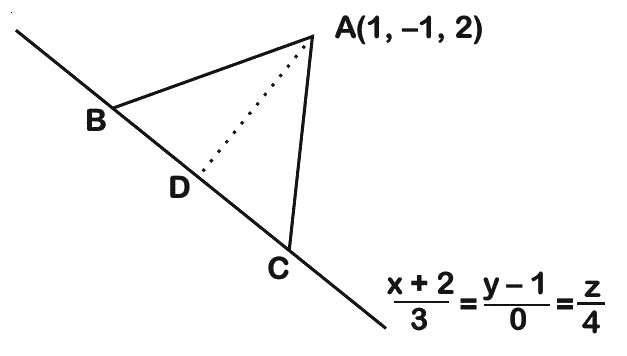
The vertices B and C of a △ABC lie on the line, x+23=y−10=z4 such that BC=5 units. Then the area (in sq. units) of this triangle, given that the point A(1,−1,2), is:
A.
517
B.
34
C.
6
D.
234
Correct answer: B

Source solution

Sol. The area of △ABC is given by the formula: Area=12×BC×AD Given BC=5, we need to find the perpendicular distance AD from point A to line BC. Let point D on line BC be represented as (3λ−2,1,4λ). The vector AD→ can be expressed as: AD→=(3λ−3)i^+2j^+(4λ−2)k^ Since AD→ and BC→ are perpendicular, we have: AD→⋅BC→=0 Calculating the dot product: (3λ−3)⋅3+2⋅0+(4λ−2)⋅4=0 This simplifies to: 9λ−9+16λ−8=0 Combining like terms gives: 25λ−17=0⇒λ=1725 Thus, the coordinates of point D are: D=(125,1,6825) Next, we calculate the magnitude of vector AD→: |AD→|=(125−1)2+22+(6825−2)2 Calculating each term: =(−2425)2+4+(1825)2 This simplifies to: =576+2500+324252=3400252=34⋅1025=2345 Now, substituting back into the area formula: Area of triangle=12×|BC→|×|AD→| Calculating the area: =12×5×2345=34 Thus, the final area of triangle ABC is: Area=34Question figure
Question 252 / MCQ
Question 252
Let a line pass through two distinct points P(−2,−1,3) and Q , and be parallel to the vector 3i^+2j^+2k. If the distance of the point Q from the point R(1,3,3) is 5 , then the square of the area of △PQR is equal to:
A.
136
B.
140
C.
144
D.
148
Correct answer: A

Source solution

Sol. PQ→ parallel to 3i^+2j^+2k^,R(1,3,3) ⇒Q(3λ−2,2λ−1,2λ+3),λ∈R−{0} |QR→|=5=(3λ−3)2+(2λ−4)2+(2λ)2 ∴17λ2−34λ+25=25⇒λ=2(∵λ≠0) ∴Q(4,3,7),P(−2,−1,3),R(1,3,3) Area of △PQR=[PQR]=12|PQ→×PR→| [PQR]=12‖i^j^k^644340‖=‖i^j^k^322340‖ [PQR]=|−8i^+6j^+6k^|=136 ∴[PQR]2=136
Question 253 / MCQ
Question 253
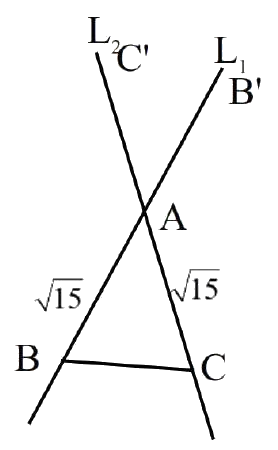
Let A be the point of intersection of the lines L1:x−71=y−50=z−3−1 and L2:x−13=y+34=z+75. Let B and C be the points on the lines L1 and L2 respectively such that AB=AC=15. Then the square of the area of the triangle ABC is :
A.
(4) 60
B.
(3) 57
C.
(2) 63
D.
(1) 54
Correct answer: D

Source solution

Let the angle between the two lines be θ. cos⁡θ=|3+0−5250| sin⁡θ=210=15 sin2⁡θ+cos2⁡θ=1⟹sin2⁡θ=1−cos2⁡θ sin2⁡θ=1−(15)2=1−125=2425 sin⁡θ=245 Area=12absin⁡θ =121515⋅245 =152410=15⋅2610=362 Square of area=(362)2=9⋅64=544=272 Final answer: option (1)Question figure
Question 254 / MCQ
Question 254
Let the line passing through the points (−1,2,1) and parallel to the line x−12=y+13=z4 intersect the line x+23=y−32=z−41 at the point P. Then the distance of P from the point Q(4,−5,1) is :
A.
5
B.
10
C.
56
D.
55
Correct answer: D

Source solution

Let the line through (−1,2,1) parallel to x−12=y+13=z4: x+12=y−23=z−14=λ ⇒x=2λ−1,y=3λ+2,z=4λ+1 Let x+23=y−32=z−41=μ ⇒x=3μ−2,y=2μ+3,z=μ+4 For intersection: 2λ−1=3μ−2, 3λ+2=2μ+3, 4λ+1=μ+4 λ=1,μ=1 P(1,5,5),Q(4,−5,1) PQ=9+100+16=125=55
Question 255 / MCQ
Question 255
Let A(a,b),B(3,4) and (−6,−8) respectively denote the centroid, circumcentre and orthocentre of a triangle. Then, the distance of the point P(2a+3,7 b+5) from the line 2x+3y−4=0 measured parallel to the line x−2y−1=0 is
A.
1557
B.
1756
C.
1757
D.
517
Correct answer: C

Source solution

G=A(a,b),O=(3,4),H=(−6,−8), where G, O, and H denote the centroid, circumcentre, and orthocentre of a triangle. Using the Euler line relation, OG→=13OH→. Hence, G=O+13(H−O). Substituting the coordinates, (a,b)=(3,4)+13((−6,−8)−(3,4)). =(3,4)+13(−9,−12). =(3,4)+(−3,−4). (a,b)=(0,0). Therefore, a=0,b=0. --- The point P=(2a+3,7b+5) becomes P=(3,5). We have to find the distance of P from the line 2x+3y−4=0 measured parallel to the line x−2y−1=0. The direction vector of the line x−2y−1=0 is d→=(2,1). Hence the required line through P(3,5) is x−32=y−51=t. Thus, x=3+2t,y=5+t. Since this line meets 2x+3y−4=0, we get 2(3+2t)+3(5+t)−4=0. 6+4t+15+3t−4=0. 17+7t=0. t=−177. --- The required distance is the length of the segment along the direction (2,1): D=|t|22+12. =1775. Therefore, 1757. Hence, the correct option is (3) 1757.
Question 256 / MCQ
Question 256
Let for a triangle ABC, AB→=−2i^+j^+3k^ CB→=αi^+βj^+γk^ CA→=4i^+3j^+δk^ If δ>0 and the area of the triangle ABC is 56, then CB→⋅CA→ is equal to
A.
60
B.
120
C.
108
D.
54 Official Answer. By NTA (1)
Correct answer: A

Source solution

AB―+BC―+CA―=0→ Given: α=2, β=4, γ−δ=3 Using the area of the triangle: 12|AB―×AC―|=56 Solving the equation: (δ−9)2+(2δ+12)2+100=600 This simplifies to: δ=5,γ=8 Finally, we find: CB―⋅CA―=60
Question 257 / MCQ
Question 257
Let the values of p, for which the shortest distance between the lines x+13=y4=z5 and r→=(pi^+2j^+k^)+λ(2i^+3j^+4k^) is 16, be a,b, (a<b). Then the length of the latus rectum of the ellipse x2a2+y2b2=1 is :-
A.
18
B.
23
C.
32
D.
9
Correct answer: B

Source solution

Sol. The shortest distance is given by the formula: Shortest distance=|(a¯−b¯)|⋅(p¯×q¯)|p¯×q¯| where a¯=−i^+0j^+0k^ Next, we calculate a¯−b¯: a¯−b¯=(−1−p)i^−2j^−k^ Given: b¯=pi^+2j^+k^ p¯=3i^+4j^+5k^ q¯=2i^+3j^+4k^ Now, we set up the equation: 116=|−1−p+4−1|6 This simplifies to: |−p+2|=1 Solving for p: p=3orp=1 Next, we have the equation of the ellipse: x212+y232=1 Calculating L⋅R: L⋅R=2a2b=2×13=23 Thus, the final answer is option (3).
Question 258 / Numerical
Question 258
Let Q and R be two points on the line x+12=y+23=z−12 at a distance 26 from the point P(4,2,7). Then the square of the area of the triangle PQR is .
Numerical answer: ____________________
Enter the requested value (an integer; 0 decimal places). Use the units and scaling stated in the question.
Correct answer: 153

Source solution

Let ( 2λ−1,3λ−2,2λ+1 ) be any point on the line (2λ−5)2+(3λ−4)2+(2λ−6)2=26 λ=1,3 Q(1,1,3);R(5,7,7);P(4,2,7) Area of triangle PQR=1/2|PQ→×PR→| =153
Question 259 / MCQ
Question 259
Let the position vectors of two points P and Q be 3i^−j^+2k^ and i^+2j^−4k^, respectively. Let R and S be two points such that the direction ratios of lines PR and QS are (4,−1,2) and ( −2,1,−2 ), respectively. Let lines PR and QS intersect at T . If the vector TA→ is perpendicular to both PR→ and QS→ and the length of vector TA→ is 5 units, then the modulus of a position vector of A is :
A.
482
B.
171
C.
5
D.
227
Correct answer: B

Source solution

Sol. P(3,−1,2) Q(1,2,−4) PR→‖4i^−j^+2k^ QS→‖−2i^+j^−2k^ dr's of normal to the plane containing P,T&Q will be proportional to : |i^j^k^4−12−21−2| ∴ℓ0=m4=n2 For point, T:PT→=x−34=y+1−1=z−22=λ QT→=x−1−2=y−11=z+4−2=μ T:(4λ+3,−λ−1,2λ+2) ≅(2μ+1,μ+2,−2μ−4) 4λ+3=−2μ+1⇒2λ+μ=−1 λ+μ=−3⇒λ=2 & μ=−5λ+μ=−3⇒λ=2 So point T:(11,−3,6) OA→=(11i^−3j^+6k^)±(2j^+k^5)5 OA→=(11i^−3j^+6k^)±(2j^+k^) OA→=11i^−j^+7k^ or 9i^−5j^+5k^ |OA→|=121+1+49=171 or 81+25+25=131Question figure
Question 260 / MCQ
Question 260
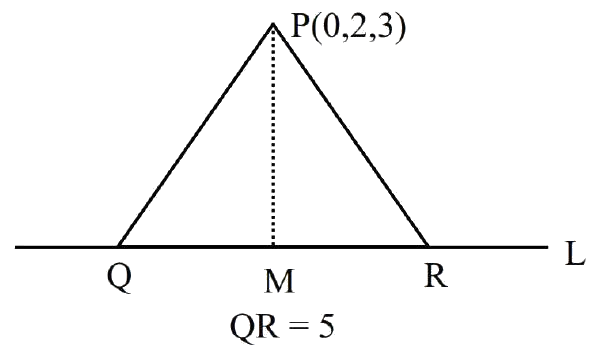
Let the vertices Q and R of the triangle PQR lie on the line x+35=y−12=z+43,QR=5 and the coordinates of the point P be (0,2,3). If the area of the triangle PQR is mn then:
A.
m−521n=0
B.
2 m−521n=0
C.
5 m−221n=0
D.
5 m−212n=0
Correct answer: B

Source solution

Let M(5λ−3,2λ+1,3λ−4) Direction ratios of PM⇒5λ−3,2λ+1,3λ−4 Direction ratios of line L⇒5,2,3 Since PM⊥L, we have: (5λ−3)⋅5+(2λ+1)⋅2+(3λ−4)⋅3=0 Expanding this gives: 25λ−15+4λ+2+9λ−12=0 Combining like terms: (25λ+4λ+9λ)−15+2−12=0 38λ−25=0 Solving for λ: λ=2538 Substituting λ=1 into M: ∴M(2,3,−1) Calculating the length of PM: PM=(5−2)2+(2−3)2+(3+1)2=4+1+16=21 Calculating the area: Area=12×5×21=5212 Setting up the equation: 2m−521n=0Question figure
Question 261 / MCQ
Question 261
The line L1 is parallel to the vector a→=−3i^+2j^+4k^ and passes through the point (7,6,2) and the line L2 is parallel to the vector b→=2i^+j^+3k^ and passes through the point (5,3,4). The shortest distance between the lines L1 and L2 is :
A.
2338
B.
2157
C.
2357
D.
2138
Correct answer: A

Source solution

Sol. Given the lines: L1:(7i^+6j^+2k)+λ(−3i^+2j^+4k) L2:(5i^+3j^+4k)+μ(2i^+j^+3k) To find the distance between the skew lines, we use the formula: Distance=(a2−a1)⋅(b1×b2)‖b1×b2‖ Where: - a1=(7,6,2) - a2=(5,3,4) - b1=(−3,2,4) - b2=(2,1,3) Calculating a2−a1: a2−a1=(5−7,3−6,4−2)=(−2,−3,2) Next, we compute b1×b2: b1×b2=|i^j^k^−324213|=i^(2⋅3−4⋅1)−j^(−3⋅3−4⋅2)+k^(−3⋅1−2⋅2) Calculating the determinant: =i^(6−4)−j^(−9−8)+k^(−3−4) =2i^+17j^−7k^ Now, we find the magnitude ‖b1×b2‖: ‖b1×b2‖=22+172+(−7)2=4+289+49=342 Now substituting into the distance formula: Distance=(−2,−3,2)⋅(2,17,−7)342 Calculating the dot product: =(−2⋅2)+(−3⋅17)+(2⋅−7)342=−4−51−14342=−69342 Thus, the distance is: =69342=69338=2338 Final answer: 2338
Choose another chapter