Learne2i
Learne2i Priority Practice solutions
JEE Main 2026 / Session 1
All chapters

Mathematics

Three Dimensional Geometry

Question 262 / MCQ
Question 262
The line L1 is parallel to the vector a→=−3i^+2j^+4k^ and passes through the point (7,6,2) and the line L2 is parallel to the vector b→=2i^+j^+3k^ and passes through the point (5, 3, 4). The shortest distance between the lines L1 and L2 is :
A.
2338
B.
2157
C.
2357
D.
2138
Correct answer: A

Source solution

Sol. L1:(7i^+6j^+2k)+λ(−3i^+2j^+4k) L2:(5i^+3j^+4k)+λ(2i^+j^+3k) Distance between skew lines =(2i^+3j^−2k^)⋅(2i^+17j^−7k^)342 =69342=69338=2338
Question 263 / MCQ
Question 263
If the image of the point (4,4,3) in the line x−12=y−21=z−13 is (α,β,γ), then α+β+γ is equal to
A.
9
B.
12
C.
8
D.
7
Correct answer: A

Source solution

Sol. ∫P(4,4,3)Q(2λ+1,λ+2,3λ+11)x−12=y−21=z−13 PQ→⊥(2i^+j^+3k^) ⇒2(2λ−3)+1(λ−2)+3(3λ−2)=0 ⇒14λ−14=0,λ=1 So, Q(3,3,4) Let image in R(α,β,γ) α+42=3,β+42=3,γ+32=4 (α,β,γ)=(2,2,5) ⇒α+β+γ=9
Question 264 / MCQ
Question 264
Let P the point of intersection of the lines x−21=y−45=z−21 and x−32=y−23=z−32. Then, the shortest distance of P from the line 4x=2y=z is
A.
5147
B.
147
C.
3147
D.
6147
Correct answer: C

Source solution

Line L1:x−21=y−45=z−21=λ Hence, x=2+λ,y=4+5λ,z=2+λ. Similarly, Line L2:x−32=y−23=z−32=μ gives x=3+2μ,y=2+3μ,z=3+2μ. Since the two lines intersect at P, 2+λ=3+2μ, 4+5λ=2+3μ. From the first equation, λ−2μ=1. From the second, 5λ−3μ=−2. Substituting λ=1+2μ, 5(1+2μ)−3μ=−2 5+7μ=−2 μ=−1. Therefore, λ=1+2(−1)=−1. Hence, P=(2−1,4−5,2−1)=(1,−1,1). --- The line 4x=2y=z can be written as x1=y2=z4=t. Thus it passes through the origin and has direction vector d→=(1,2,4). Let r→=(1,−1,1) be the position vector of P. The shortest distance from a point to a line through the origin is D=|r→×d→||d→|. Now, r→×d→=|i^j^k^1−11124|=(−6,−3,3). Therefore, |r→×d→|=(−6)2+(−3)2+32=54=36. Also, |d→|=12+22+42=21. Hence, D=3621=327=3147. 3147 Hence, the correct option is (3) 3147.
Question 265 / MCQ
Question 265
If Q(0,−1,−3) is the image of the point P in the plane 3x−y+4z=2 and R is the point (3,−1,−2), then the area (in sq. units) of △PQR is :
A.
652
B.
914
C.
213
D.
912
Correct answer: D

Source solution

Sol. Image of Q in plane (x−0)3=(y+1)−1=z+3+4=−2(1−12−2)9+1+16=1 x=3,y=−2,z=1 P(3,−2,1),Q(0,−1,−3),R(3,−1,−2) Now area of △PQR is 12|PQ→×QR→|=12‖i^j^k^3−14301‖=12|{i^(−1)−j^(3−12)+k^(3)}|=12(1+81+9)=912
Question 266 / MCQ
Question 266
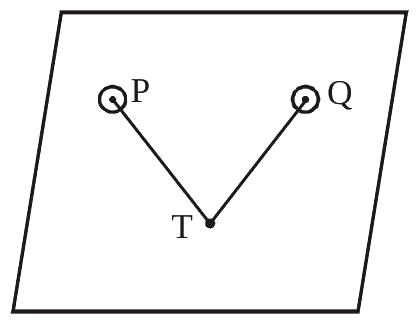
Let the position vectors of two points P and Q be 3i^−j^+2k^ and i^+2j^−4k^, respectively. Let R and S be two points such that the direction ratios of lines PR and QS are (4,−1,2) and (−2,1,−2), respectively. Let lines PR and QS intersect at T. If the vector TA→ is perpendicular to both PR→ and QS→ and the length of vector TA→ is 5 units, then the modulus of a position vector of A is:
A.
482
B.
171
C.
5
D.
227
Correct answer: B

Source solution

Sol. Let points be defined as follows: P(3,−1,2),Q(1,2,−4) Direction ratios of the normal to the plane containing points P,T,Q will be proportional to the determinant: |i^j^k^4−12−21−2| Thus, we have: ℓ0=m4=n2 For point T, we express the vector PT→ as: PT→=x−34=y+1−1=z−22=λ Similarly, for point Q: QT→=x−1−2=y−11=z+4−2=μ The coordinates of point T can be expressed as: T:(4λ+3,−λ−1,2λ+2) And for point Q: T≅(2μ+1,μ+2,−2μ−4) Setting the equations equal gives: 4λ+3=−2μ+1⇒2λ+μ=−1 λ+μ=−3 Solving these equations: 1. From 2λ+μ=−1 2. Substitute μ=−3−λ into the first equation: 2λ+(−3−λ)=−1⇒λ−3=−1⇒λ=2 3. Substitute λ=2 back to find μ: μ=−3−2=−5 Thus, point T is: T:(11,−3,6) Now, we calculate OA→: OA→=(11i^−3j^+6k^)±(2j^+k^5)5 This simplifies to: OA→=(11i^−3j^+6k^)±(2j^+k^) Thus, we have two possible vectors: OA→=11i^−j^+7k^or9i^−5j^+5k^ Calculating the magnitudes: |OA→|=121+1+49=171 or |OA→|=81+25+25=131Question figure
Question 267 / MCQ
Question 267
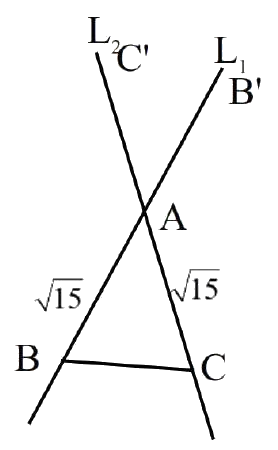
Let A be the point of intersection of the lines L1:x−71=y−50=z−3−1 and L2:x−13=y+34=z+75. Let B and C be the point on the lines L1 and L2 respectively such that AB=AC=15. Then the square of the area of the triangle ABC is :
A.
54
B.
63
C.
57
D.
60
Correct answer: A

Source solution

Sol. Angle between both lines cos⁡θ=|3+0−5250| sin⁡θ=210=15 sin⁡θ=245 area =12absin⁡θ 121515245 square of area 15.15.244.25 option (1)Question figure
Question 268 / MCQ
Question 268
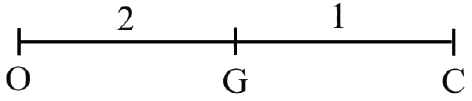
Let the position vectors of three vertices of a triangle be 4p→+q→−3r→,−5p→+q→+2r→ and 2p→−q→+2r→. If the position vectors of the orthocenter and the circumcenter of the triangle are p→+q→+r→4 and αp→+βq→+γr→ respectively, then α+2β+5γ is equal to:
A.
3
B.
1
C.
6
D.
4
Correct answer: A

Source solution

Sol. We know that: - Orthocenter O=p→+q→+r→4 - Circumcenter C=αp→+βq→+γr→ - Centroid G=p→+q→+r→3 Using the relation: 2(αp→+βq→+γr→)+p→+q→+r→4=3(p→+q→+r→3) We simplify: 8(αp→+βq→+γr→)=3(p→+q→+r→) From this, we get: 8α=3,8β=3,8γ=3 Thus, α=38,β=38,γ=38 Now, we calculate: α+2β+3γ=38+68+158=248=3Question figure
Question 269 / MCQ
Question 269
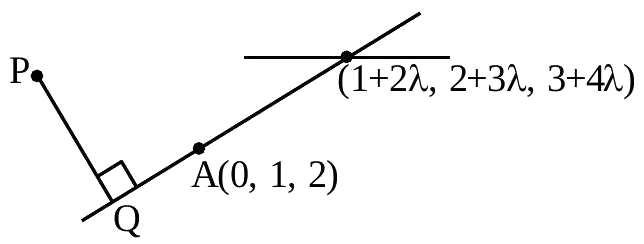
Let the line L pass through the point (0,1,2), intersect the line x−12=y−23=z−34 and be parallel to the plane 2x+y−3z=4. Then the distance of the point P(1,−9,2) from the line L is
A.
9
B.
54
C.
69
D.
74
Correct answer: D

Source solution

Let AB→⋅n→=0 AB→=(1+2λ)i^+(1+3λ)j^+(1+4λ)k^ n→=2i^+j^−3k^ Calculating the dot product: (1+2λ)⋅2+(1+3λ)⋅1+(1+4λ)⋅(−3)=0 Expanding this gives: 2+4λ+1+3λ−3−12λ=0 Combining like terms: 5λ=0⇒λ=0 Now, the line AB→ can be expressed as: r→=j^+2k^+μ(i^+j^+k^) The general form of point Q is: Q(μ,1+μ,2+μ) Since PQ→⋅AB→=0: (μ−1)+(10+μ)+μ=0 Simplifying this: 3μ−1+10=0⇒3μ=−9⇒μ=−3 Finally, the distance is calculated as: Distance=16+49+9=74Question figure
Question 270 / MCQ
Question 270
Let (α,β) be the centroid of the triangle formed by the lines 15x−y=82, 6x−5y=−4 and 9x+4y=17. Then α+2β and 2α−β are the roots of the equation
A.
x2−7x+12=0
B.
x2−13x+42=0
C.
x2−14x+48=0
D.
x2−10x+25=0
Correct answer: B

Source solution

Sol. Upon solving, we find the coordinates of the points as (6,8), (1,2), and (5,−7). The centroid (α,β) is calculated as follows: α=6+1+53=4 β=8+2−73=1 Next, we have the equations: α+2β=6 2α−β=7 The final answer is: x2−13x+42=0
Question 271 / MCQ
Question 271
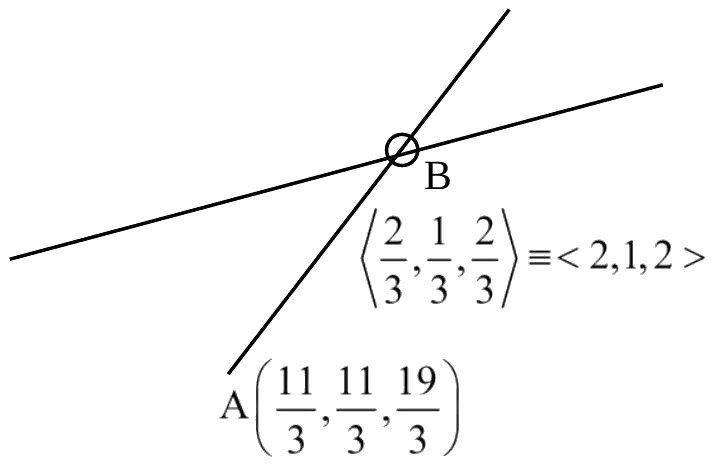
Consider the line L passing through the points (1,2,3) and (2,3,5). The distance of the point (113,113,193) from the line L along the line 3x−112=3y−111=3z−192 is equal to :
A.
3
B.
5
C.
4
D.
6
Correct answer: A

Source solution

Sol. Given the equations: x−12−1=y−23−2=z−35−3 This simplifies to: x−11=y−21=z−32=λ From this, we can express x, y, and z in terms of λ: x=1+λ,y=2+λ,z=3+2λ The point B can be represented as: B(1+λ,2+λ,3+2λ) The direction ratios (D.R.) of line segment AB are given by: ⟨3λ−83,3λ−53,6λ−103⟩ Substituting B into the equation: B(53,83,133) Setting the ratios equal: 3λ−83λ−5=21 Cross-multiplying gives: 3λ−8=6λ−10 Rearranging the equation: 3λ=2⇒λ=23 Now, we calculate the length of AB: AB=36+9+363=93=3Question figure
Question 272 / Numerical
Question 272
Let the foot of perpendicular from the point A(4,3, 1) on the plane P:x−y+2z+3=0 be N. If B(5, α,β),α,β∈Z is a point on plane P such that the area of the triangle ABN in 32, then α2+β2+αβ is equal to .
Numerical answer: ____________________
Enter the requested value (an integer; 0 decimal places). Use the units and scaling stated in the question.
Correct answer: 7

Source solution
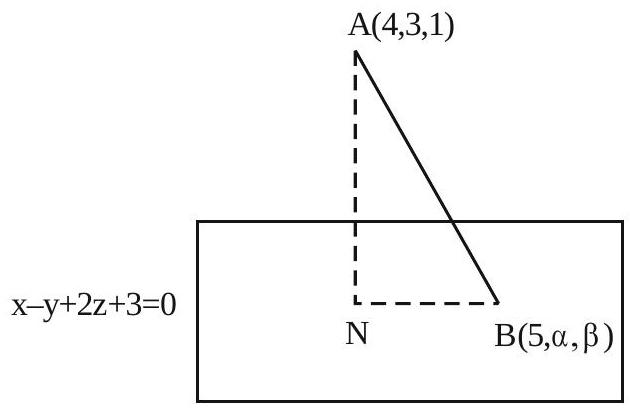
Question figure AN=6 5−α+2β+3=0 (1)⇒α=8+2β N is given by x−41=y−3−1=z−12=−(4−3+2+3)1+1+4⇒x=3,y=4,z=−1 N is (3,4,−1)BN=4+(α−4)2+(β+1)2=4+(2β+4)2+(β+1)2 Area of ΔABN=12AN×BN=32⇒12×6×BN=32BN=234+(2β+4)2+(β+1)2=12(2β+4)2+(β+1)2−8=05β2+18β+9=0(5β+3)(β+3)=0⇒α=−3α=2α2+β2+αβ=9+4−6=7
Question 273 / MCQ
Question 273
Let the line passing through the points (−1,2,1) and parallel to the line x−12=y+13=z4 intersect the line x+23=y−32=z−41 at the point P. Then the distance of P from the point Q(4,−5,1) is :
A.
5
B.
4
C.
(2) 10
D.
(3) 56
Correct answer: D

Source solution

Given line L1:x−12=y+13=z4. Its direction vector is d→1=(2,3,4). Therefore, the line passing through (−1,2,1) and parallel to L1 is x+12=y−23=z−14=λ. Hence, x=−1+2λ,y=2+3λ,z=1+4λ. --- The second line is x+23=y−32=z−41=μ. Thus, x=−2+3μ,y=3+2μ,z=4+μ. Since the two lines intersect at P, (1)−1+2λ=−2+3μ, (2)2+3λ=3+2μ, (3)1+4λ=4+μ. From (3), μ=4λ−3. Substituting into (1), −1+2λ=−2+3(4λ−3), −1+2λ=12λ−11, 10=10λ, λ=1. Hence, μ=4(1)−3=1. Therefore, P=(−1+2,2+3,1+4)=(1,5,5). --- Given Q=(4,−5,1). Hence, PQ=(4−1)2+(−5−5)2+(1−5)2. =32+(−10)2+(−4)2. =9+100+16. =125=55. 56 Therefore, the distance of P from Q is 56.
Question 274 / MCQ
Question 274
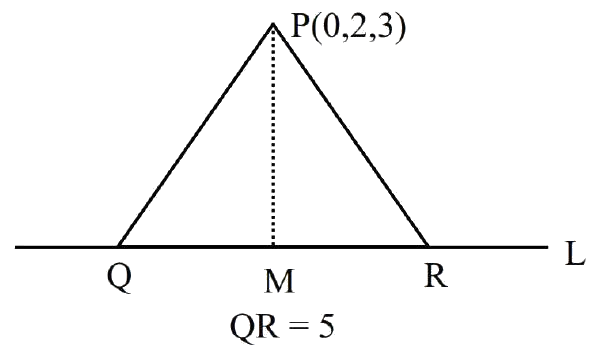
Let the vertices Q and R of the triangle PQR lie on the line x+35=y−12=z+43,QR=5 and the coordinates of the point P be (0,2,3). If the area of the triangle PQR is mn then :
A.
m−521n=0
B.
2 m−521n=0
C.
5 m−221n=0
D.
5 m−212n=0
Correct answer: B

Source solution

Sol. M(5λ−3,2λ+1,3λ−4) Drs of PM⇒5λ−3,2λ−1,3λ−7 Drs of line L⇒5,2,3 PM⊥L ⇒(5λ−3)5+(2λ−1)2+(3λ−7)3=0 ⇒λ=1 ∴M(2,3,−1) PM=4+1+16=21 Area =12×5×21=mn 2 m−521n=0Question figure
Question 275 / MCQ
Question 275
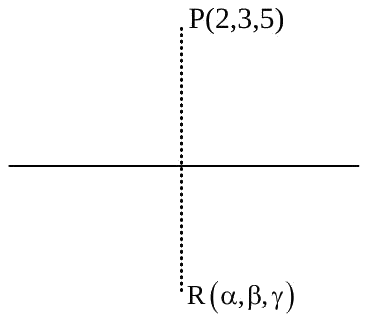
Let (α,β,γ) be mirror image of the point (2,3,5) in the line x−12−y−23−z−34. Then 2α+3β+4γ is equal to
A.
32
B.
33
C.
31
D.
34
Correct answer: B

Source solution

Sol. ∵PR→⊥(2,3,4) ∴PR→⋅(2,3,4)=0 (α−2,β−3,γ−5)⋅(2,3,4)=0 ⇒2α+3β+4γ=4+9+20=33Question figure
Question 276 / MCQ
Question 276
Let P be the point of intersection of the lines x−21=y−45=z−21 and x−32=y−23=z−32. Then, the shortest distance of P from the line 4x=2y=z is
A.
5147
B.
147
C.
3147
D.
6147
Correct answer: C

Source solution

Let L1≡x−21=y−45=z−21=λ P(λ+2,5λ+4,λ+2) L2≡x−32=y−23=z−32 P(2μ+3,3μ+2,2μ+3) Setting the equations equal: λ+2=2μ+3and3μ+2=5λ+4 From the first equation: λ=2μ+1 Substituting into the second equation: 3μ=5(2μ+1)+2 3μ=10μ+7 −7=7μ⇒μ=−1 λ=−1 Both satisfy P: P(1,−1,1) Next, consider: L3≡x1/4=y1/2=z1 L3=x1=y2=z4=k Coordinates of Q(k,2k,4k). Direction ratios of PQ=⟨k−1,2k+1,4k−1⟩. Since PQ⊥L3: (k−1)+2(2k+1)+4(4k−1)=0 k−1+4k+2+16k−4=0 21k−3=0⇒k=17 Thus, the coordinates of Q are: Q(17,27,47) Now, calculate PQ: PQ=(1−17)2+(−1−27)2+(1−47)2 =3649+8149+949=12649=1267 PQ=3147 Thus, the answer is: Option 3 will satisfy.
Choose another chapter